
What Is the Rise Over Run Slope Calculator?
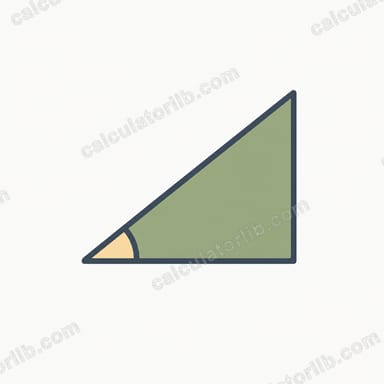
This calculator finds the slope of a line, ramp, roof, or road using the classic "rise over run" relationship. Slope describes how steep something is by comparing the vertical change (rise) to the horizontal change (run). It instantly converts that ratio into three useful forms: the decimal slope, the grade percentage, and the angle of incline in degrees.
How to Use It
Enter the rise (the vertical distance between two points) and the run (the horizontal distance between the same two points). Use the same units for both — feet, meters, or inches all work, since slope is a ratio. Press calculate to see the slope value, the equivalent percentage grade, and the angle.
The Formula Explained
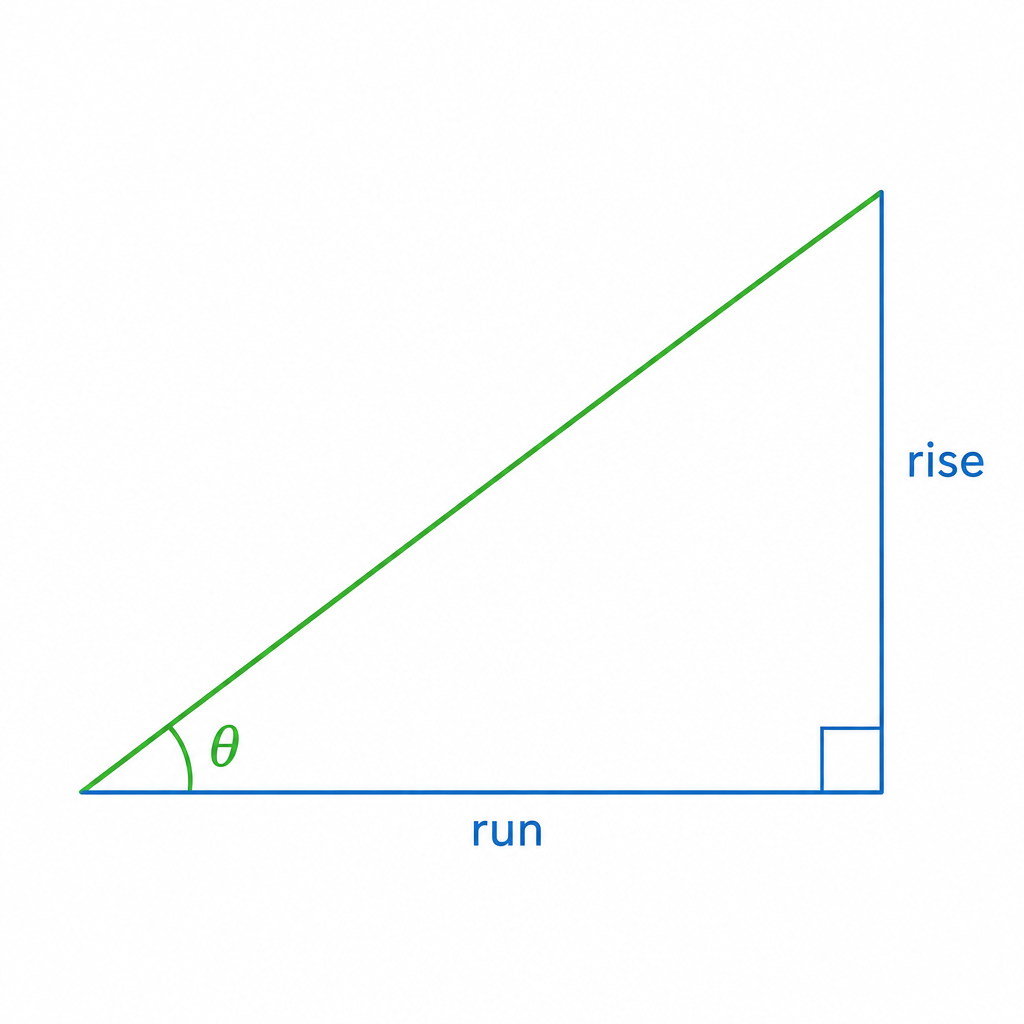
The core equation is $$\text{slope} = \dfrac{\text{rise}}{\text{run}}$$ A slope of 1 means the surface rises one unit for every unit traveled horizontally — a 45-degree angle, which is also where the "45-degree rule" gets its name. To express slope as a percentage grade, multiply by 100. To find the angle, take the arctangent of rise divided by run: $$\theta = \arctan\!\left(\dfrac{\text{rise}}{\text{run}}\right)$$
Worked Example
Suppose a roof rises 3 feet over a horizontal run of 4 feet. The slope is \(3 \div 4 = \mathbf{0.75}\). As a grade that is \(0.75 \times 100 = \mathbf{75\%}\). The angle is \(\arctan(0.75) \approx \mathbf{36.87°}\). So this roof is fairly steep but well below the 45-degree (100% grade) threshold.
Slope, Grade & Angle Conversion Table
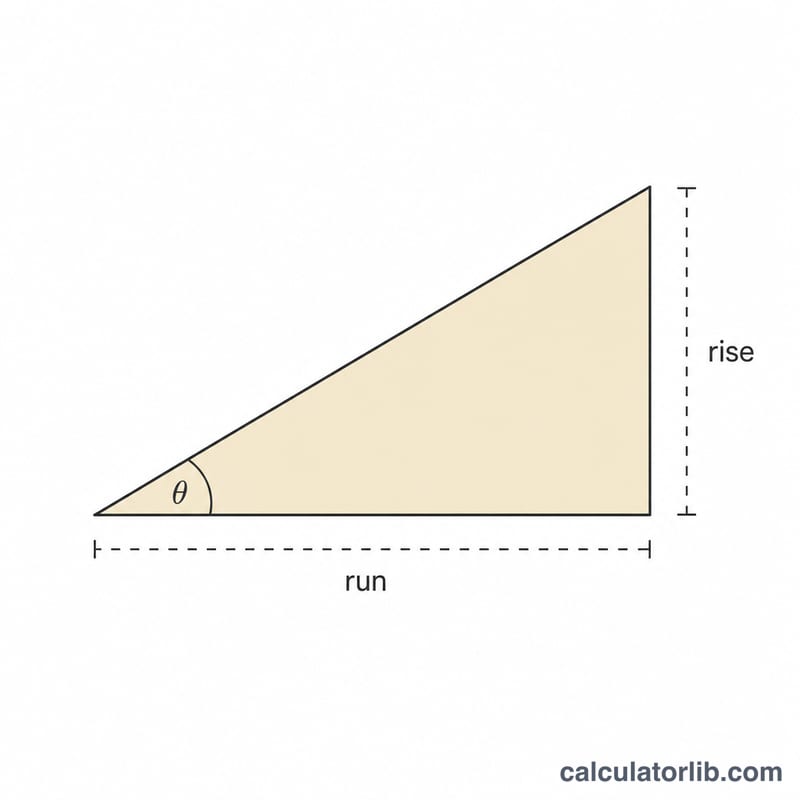
The same incline can be described three ways: as a ratio (rise to run), as a grade percentage (\(\frac{\text{rise}}{\text{run}}\times100\%\)), and as an angle in degrees (\(\theta=\arctan(\text{rise}/\text{run})\)). The table below converts several common slopes between all three.
| Ratio (rise:run) | Grade (%) | Angle (degrees) |
|---|---|---|
| 1:12 | 8.33% | 4.76° |
| 1:8 | 12.50% | 7.13° |
| 1:4 | 25.00% | 14.04° |
| 1:2 | 50.00% | 26.57° |
| 1:1 | 100.00% | 45.00° |
Note that grade and angle are not proportional. A 100% grade equals exactly 45°, but a 50% grade is only about 26.57° — well under half of 45°.
Standard Slope Requirements by Application
Building codes, accessibility law, and engineering practice each define acceptable slope ranges for their use case. The values below are widely cited maximums and typical ranges; always confirm against the edition of the code in force for your jurisdiction and project.
| Application | Slope (ratio) | Grade | Approx. angle | Governing standard / reference |
|---|---|---|---|---|
| Accessible ramp (max running slope) | 1:12 | 8.33% | 4.76° | ADA Standards / ICC A117.1 |
| Accessible ramp cross slope (max) | 1:48 | 2.08% | 1.19° | ADA Standards |
| Walkway / accessible route (max running) | 1:20 | 5.00% | 2.86° | ADA — slopes > 1:20 treated as ramps |
| Low-slope (flat) roof | ≤ 2:12 to 3:12 | ≤ 17–25% | ≤ ~9–14° | IBC / IRC roofing membrane ranges |
| Standard-slope roof | 4:12 to 9:12 | 33–75% | 18–37° | Typical asphalt-shingle range |
| Steep-slope roof | ≥ 9:12 to 12:12+ | ≥ 75–100% | ≥ 37–45°+ | IRC steep-slope classification |
| Maximum highway grade (typical) | ~1:14 to 1:17 | 6–7% | 3.4–4.0° | AASHTO Green Book (terrain-dependent) |
The minimum roofing slope for shingle products and the exact maximum grade for a given road class depend on local code and design speed, so treat these as guideposts rather than fixed legal limits.
Key Terms Explained
- Rise
- The vertical change between two points — how far up (or down) the line travels. The numerator in the slope fraction.
- Run
- The horizontal change between the same two points — how far across the line travels. The denominator in the slope fraction.
- Slope (ratio)
- The ratio of rise to run, \(\frac{\text{rise}}{\text{run}}\). Often written as a fraction (1/12) or a colon ratio (1:12). A larger value means a steeper incline.
- Grade (%)
- The slope expressed as a percentage: \(\frac{\text{rise}}{\text{run}}\times100\%\). A 100% grade rises one unit for every one unit of horizontal travel.
- Angle of incline (degrees)
- The angle the line makes with the horizontal, \(\theta=\arctan\!\left(\frac{\text{rise}}{\text{run}}\right)\). It ranges from 0° (flat) toward 90° (vertical).
- Pitch
- A roofing term for slope, conventionally expressed as rise over a 12-unit run (e.g., a "6:12 pitch" rises 6 inches per 12 inches of horizontal run).
- Undefined slope
- A perfectly vertical line, where the run is zero. Dividing by zero is undefined, so the slope has no finite value and the angle is 90°.
FAQ
What does a slope of 1 mean? A slope of 1 means equal rise and run — a perfect 45-degree angle and a 100% grade.
Why is my run not allowed to be zero? A run of zero would make the line perfectly vertical, giving an undefined (infinite) slope, so division is guarded.
Is grade the same as angle? No. Grade is the slope expressed as a percentage, while the angle is measured in degrees. A 100% grade equals a 45° angle.