
What this calculator does
The Running Calories by Distance Calculator estimates how much energy you burn on a run using only two simple inputs: your body weight and the distance covered. It relies on the well-known approximation that running roughly 1 kilometre costs about 1.036 kcal per kilogram of body weight, largely independent of how fast you run. This makes distance — not pace — the dominant driver of total calories burned.
How to use it
Enter your body weight in kilograms and the distance you ran (or plan to run) in kilometres. The calculator returns the total estimated calories for the run and the energy cost per kilometre. Use it to plan fueling, track training load, or compare runs of different lengths.
The formula explained
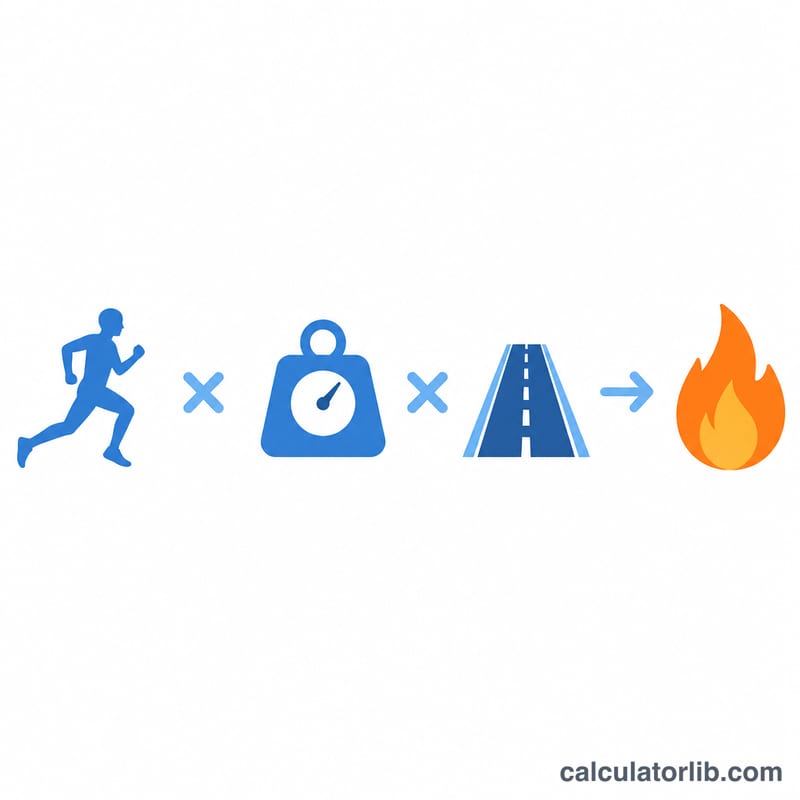
The core equation is $$\text{kcal} \approx 1.036 \times \text{weight(kg)} \times \text{distance(km)}$$. The constant 1.036 represents the approximate net energy cost of running one kilometre per kilogram of body mass. Because heavier runners must move more mass over the same distance, calories scale linearly with both weight and distance.
Worked example
A 70 kg runner completes a 10 km run. $$\text{Calories} \approx 1.036 \times 70 \times 10 = 725.2 \text{ kcal}$$ or about 72.5 kcal per kilometre. A lighter 55 kg runner over the same 10 km would burn $$\approx 1.036 \times 55 \times 10 = 569.8 \text{ kcal}$$
FAQ
Does pace affect the result? Total calories depend mainly on distance and weight; the energy cost per kilometre stays roughly constant across most running speeds, so pace has only a minor effect.
Does this include resting metabolism? The 1.036 constant approximates the gross energy of running. For net calories above what you'd burn at rest, subtract your resting expenditure for the same time period.
Is walking the same? No. Walking is more economical per kilometre, so this calculator should be used for running rather than walking.