
What this calculator does
This tool estimates how many calories you burn while running a set distance, based on your body weight. Running is largely a weight-bearing activity, so the energy you spend is roughly proportional to how much mass you move and how far you carry it. That makes distance and body weight the two most reliable inputs for a quick estimate — more reliable, in fact, than pace for total calorie burn over a fixed distance.
How to use it
Enter your body weight in pounds and the distance you ran (or plan to run) in miles, then read off the total calories burned and the calories per mile. The calculator converts your inputs to metric internally and applies a standard energy coefficient, so the numbers stay consistent whether you think in miles or kilometers.
The formula explained
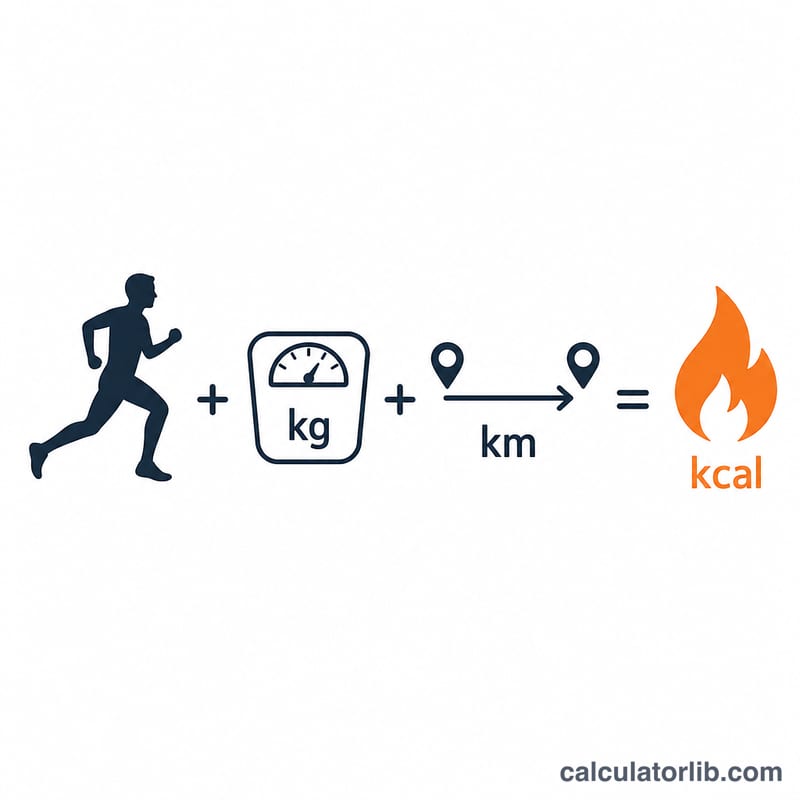
The core equation is \(\text{kcal} = 0.75 \times \text{weight(kg)} \times \text{distance(km)}\). The 0.75 factor represents the gross energy cost of running roughly 1 kg of body mass over 1 km. Because \(1\ \text{lb} \approx 0.4536\ \text{kg}\) and \(1\ \text{mile} \approx 1.609\ \text{km}\), this is equivalent to the handy imperial shortcut \(\text{kcal} \approx 0.53 \times \text{weight(lb)} \times \text{miles}\). This is gross energy expenditure, which is what most fitness trackers report.
Worked example
A 150 lb runner covers 3 miles. Converting: \(150\ \text{lb} = 68.04\ \text{kg}\) and \(3\ \text{miles} = 4.828\ \text{km}\). Then $$\text{kcal} = 0.75 \times 68.04 \times 4.828 \approx 246\ \text{calories},$$ or about 82 calories per mile. Using the imperial shortcut: \(0.53 \times 150 \times 3 \approx 238\) — close enough for everyday planning.
FAQ
Does running speed change the result? Over a fixed distance, pace has only a small effect on total burn — covering 3 miles costs a similar amount of energy whether you jog or sprint, though sprinting burns slightly more per minute.
Is this gross or net calories? It estimates gross calories burned, which includes the energy you would have used at rest. Subtract a small resting amount if you want net "extra" burn.
How accurate is it? It is a population-average estimate. Individual factors like running economy, terrain, wind, and fitness can shift the real value by 10–20%.