
What This Calculator Does
The Running Calories Burned Calculator estimates the net energy you expend while running, based on your body weight and the distance covered. Research shows that the calories burned per kilometer of running are largely determined by your weight and are relatively independent of how fast you run — covering the same distance burns roughly the same energy whether you sprint or jog it.
How to Use It
Enter your body weight in kilograms and the distance you ran in kilometers, then read the estimated net calories. "Net" means the energy used above resting metabolism, so it reflects the true cost of the run itself.
The Formula Explained
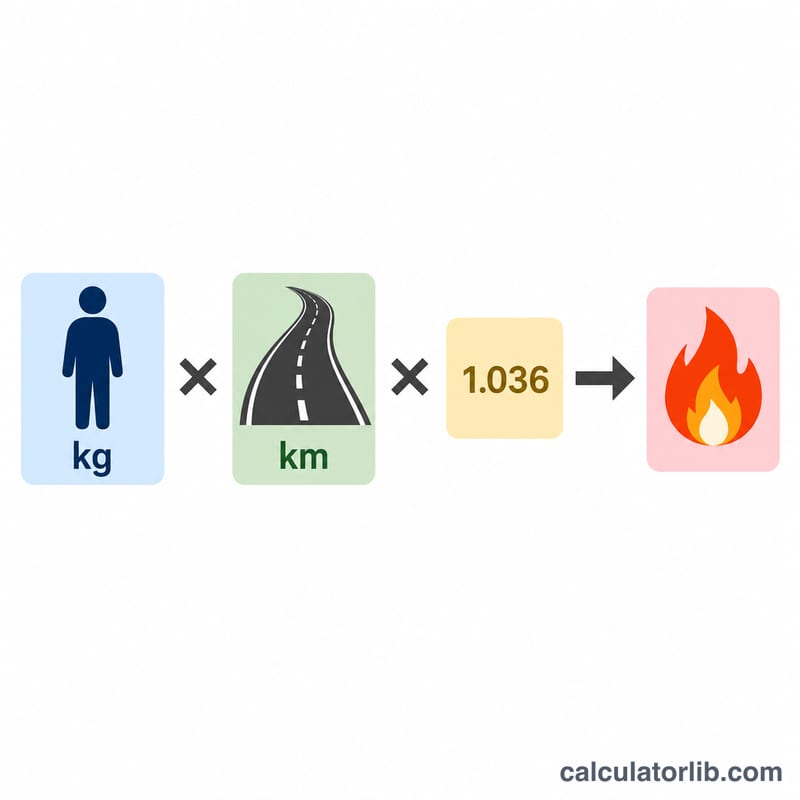
The calculator uses the widely cited approximation:
$$\text{Calories} \approx 1.036 \times \text{weight (kg)} \times \text{distance (km)}$$
The constant 1.036 represents the net energy cost of running roughly one kilometer per kilogram of body mass. A heavier runner moves more mass over the same distance, so they burn more calories — which is why weight is the dominant factor.
Worked Example
Suppose you weigh 70 kg and run 5 km:
$$\text{Calories} = 1.036 \times 70 \times 5 = \mathbf{362.6 \text{ kcal}}$$ or about 72.5 kcal per kilometer.
FAQ
Does running speed matter? Only modestly. Faster running burns more per minute, but because you finish sooner, the total per-kilometer cost stays close to this estimate.
Is this gross or net calories? This estimates net calories — energy used beyond what you'd burn resting during the same time.
How accurate is it? It's a solid ballpark. Terrain, wind, running economy and incline can shift the real value by 10–20%, so treat it as a guide rather than an exact measurement.