
What Is Body Surface Area (BSA)?
Body Surface Area (BSA) is a measurement of the total surface area of the human body, expressed in square meters (m²). It is widely used in medicine — particularly for calculating drug dosages (such as chemotherapy), cardiac index, and other physiological parameters — because it correlates better with metabolic mass than body weight alone. This calculator uses the Mosteller formula, the most popular method due to its simplicity and accuracy.
How to Use This Calculator
Enter your height in centimeters and your weight in kilograms, then submit. The calculator returns your estimated BSA in square meters. A typical adult value falls between 1.6 and 2.0 m². Always consult a healthcare professional for clinical dosing decisions.
The Mosteller Formula Explained
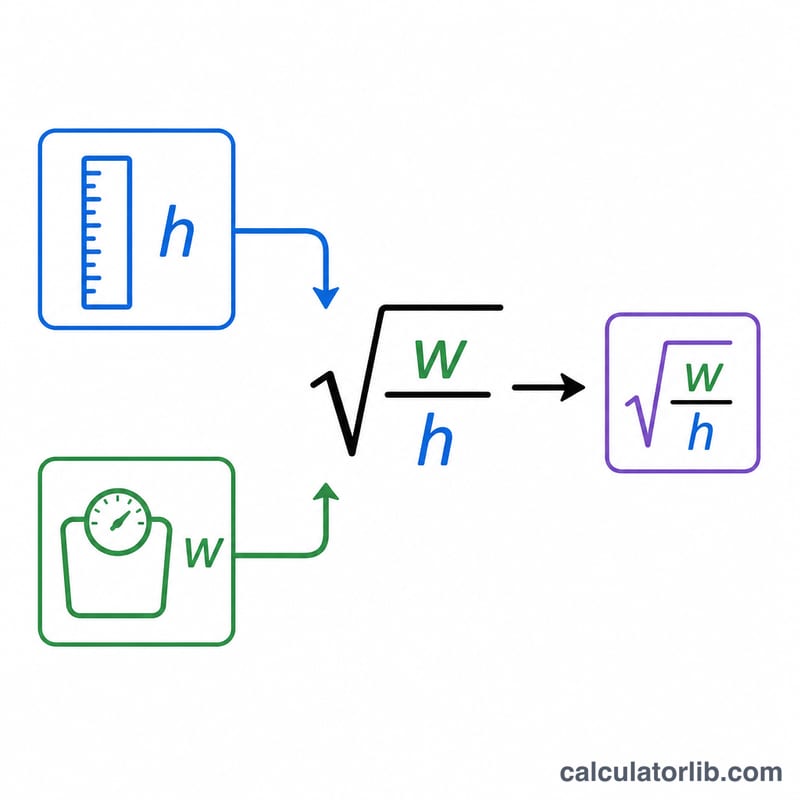
The Mosteller equation is: $$\text{BSA} = \sqrt{\dfrac{\text{Height} \times \text{Weight}}{3600}}$$, where height is in centimeters and weight is in kilograms. The square root keeps the result in proper area units, and the constant 3600 normalizes the product. It was published by R.D. Mosteller in 1987 as a simplified alternative to the older Du Bois formula.
Worked Example
For a person who is 180 cm tall and weighs 75 kg: $$\text{BSA} = \sqrt{\frac{180 \times 75}{3600}} = \sqrt{\frac{13500}{3600}} = \sqrt{3.75} = 1.9365 \text{ m}^2$$ So this person has a body surface area of about 1.94 m².
BSA Across Different Body Sizes
The Mosteller formula computes Body Surface Area (BSA) as \[\text{BSA} = \sqrt{\dfrac{\text{Height (cm)} \times \text{Weight (kg)}}{3600}}\] The table below applies this formula to several realistic adult and adolescent height/weight pairs. Each result is the square root of the product of height and weight divided by 3600.
| Height (cm) | Weight (kg) | Calculation | BSA (m²) |
|---|---|---|---|
| 150 | 50 | \(\sqrt{(150\times50)/3600}\) | 1.44 |
| 165 | 60 | \(\sqrt{(165\times60)/3600}\) | 1.66 |
| 175 | 70 | \(\sqrt{(175\times70)/3600}\) | 1.84 |
| 180 | 75 | \(\sqrt{(180\times75)/3600}\) | 1.94 |
| 190 | 90 | \(\sqrt{(190\times90)/3600}\) | 2.18 |
For example, at 165 cm and 60 kg: \(165\times60 = 9900\), \(9900/3600 = 2.75\), and \(\sqrt{2.75} = 1.66\ \text{m}^2\). Taller and heavier individuals produce larger BSA values, while the square-root relationship means BSA changes more gradually than weight alone.
Typical BSA Reference Values
The values below are commonly cited population reference points for Body Surface Area. Individual results vary with body composition and the formula used (Mosteller, Du Bois, Haycock and others differ slightly).
| Population / standard | Approximate BSA (m²) | Notes / source |
|---|---|---|
| Average adult male | ~1.9 | Frequently cited average for adult men; varies with stature and weight |
| Average adult female | ~1.6 | Frequently cited average for adult women |
| General adult average | ~1.7–1.8 | Pooled adult estimate used in many physiology texts |
| Child (~9 years) | ~1.07 | Approximate pediatric value; rises with age and size |
| Neonate (term newborn) | ~0.2–0.25 | Approximate value for a full-term newborn (e.g. ~50 cm, ~3.5 kg) |
| Dosing / GFR normalization standard | 1.73 | Conventional reference BSA used to index renal function (eGFR per 1.73 m²) and other normalized measures |
The 1.73 m² figure originates from an early 20th-century estimate of the average adult BSA and remains the standard normalization constant in nephrology and several other clinical contexts.
Interpreting Your BSA Result
Body Surface Area expresses the total external area of the body in square metres. For most adults the Mosteller result falls in the range of roughly 1.6 to 2.0 m², with smaller-framed adults below this range and larger individuals above it. A single BSA value on its own is not a measure of health — it is a scaling quantity used to standardize physiological and pharmacological calculations to body size.
Drug dosing. Many medications, particularly chemotherapy agents, are prescribed in amounts per square metre (mg/m²). The prescribed dose is found by multiplying the per-area dose by the patient's BSA, so an accurate height and weight matter for the result.
Cardiac index. BSA is used to normalize cardiac output to body size. Cardiac index is cardiac output divided by BSA, expressed in L/min/m². For instance, a cardiac output of 5.0 L/min in a patient with a BSA of 1.9 m² gives a cardiac index of about 2.63 L/min/m². This allows comparison between people of different sizes.
The 1.73 m² standard. Estimated glomerular filtration rate (eGFR) and certain other measures are reported "per 1.73 m²" — the historical average adult BSA — so that values can be compared across individuals regardless of body size. Adjusting a measured value to a patient's actual BSA can be relevant for people whose body size differs markedly from this average.
This information is general and educational only and is not medical advice. Clinical dosing and interpretation should always be performed and verified by a qualified healthcare professional.
FAQ
Which BSA formula is most accurate? The Mosteller formula is widely accepted and clinically validated; it gives results very close to the Du Bois formula while being far easier to compute.
Why is BSA used for drug dosing? Many drugs, especially in oncology, are dosed per square meter of body surface area because BSA better reflects blood volume and metabolic rate than weight alone.
What is a normal BSA? Average adult BSA is roughly 1.7 m² (about 1.6 m² for women and 1.9 m² for men), though it varies with body size.