What this calculator does
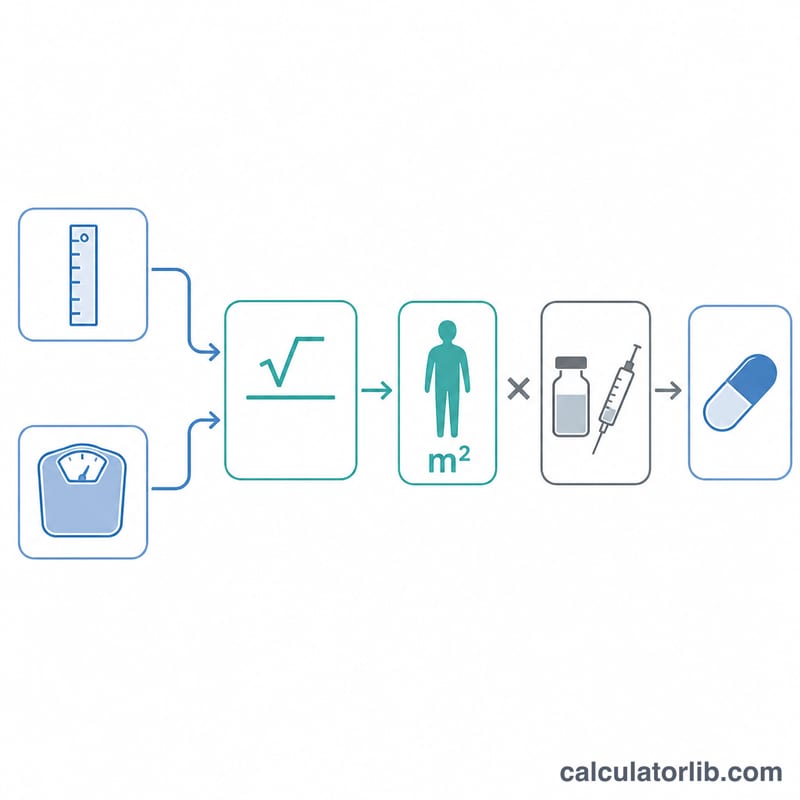
Many drugs — especially cytotoxic chemotherapy agents — are prescribed per square metre of body surface area (BSA) rather than per kilogram, because BSA correlates better with blood volume, cardiac output and renal clearance than weight alone. This tool converts a height and weight into BSA, then multiplies that BSA by the dose intensity you enter (in mg/m²) to give a total dose in milligrams. It is a general-purpose arithmetic aid and is not tied to any single country or protocol.
The formula explained
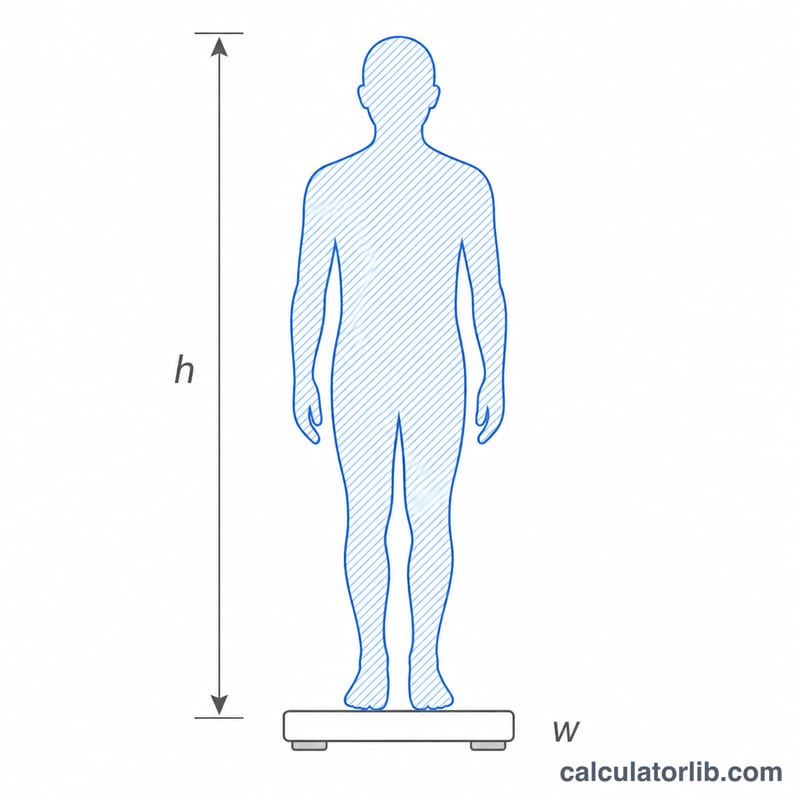
The default method is the Mosteller equation, which is simple and widely used in oncology:
$$\text{BSA} = \sqrt{\frac{H \times W}{3600}}$$where \(H\) = height in centimetres and \(W\) = weight in kilograms. The total dose is then
$$\text{Dose} = D \times \text{BSA}_{\text{used}}$$with \(D\) = dose intensity in mg/m². Two alternatives are offered: Du Bois, \(\text{BSA} = 0.007184 \times H^{0.725} \times W^{0.425}\), and Haycock, \(\text{BSA} = 0.024265 \times H^{0.3964} \times W^{0.5378}\), which is often preferred in paediatrics.
Worked example
An adult is 170 cm tall and weighs 70 kg, and the protocol specifies 100 mg/m².
$$\text{BSA} = \sqrt{\frac{170 \times 70}{3600}} = \sqrt{3.3056} = 1.818\,\text{m}^2$$$$\text{Dose} = 100 \times 1.818 = 181.8\,\text{mg}$$That works out to roughly 2.60 mg/kg, a useful cross-check against weight-based limits.
How to use it
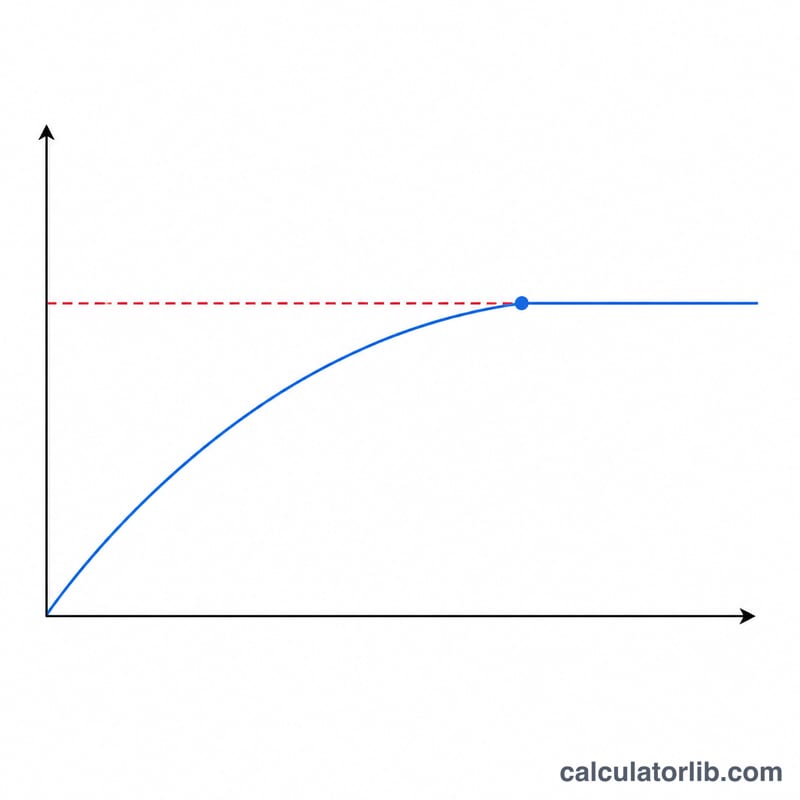
Enter height in cm and weight in kg, type the protocol dose in mg/m², and pick a BSA formula. If your protocol caps BSA (a common practice, often at 2.0 m² for obese patients), enter that cap; leave it at 0 for no cap. The result shows the raw BSA, the BSA actually used, the total dose and the equivalent mg/kg.
Interpreting Your Result
The calculator returns four linked values: the estimated body surface area (BSA), the BSA actually used for the calculation, the total dose in milligrams, and the equivalent dose per kilogram of body weight. Each answers a different question.
BSA in m²
BSA is an estimate of the total external surface area of the body, expressed in square metres. It is not measured directly — it is predicted from height and weight by a regression equation. Typical values are roughly 1.6–2.0 m² for adults, about 1.3–1.7 m² for older children and adolescents, and about 0.2–0.25 m² for a term neonate. A very tall or heavy adult can exceed 2.3 m². Because BSA scales with the square root of height × weight (Mosteller) or with fractional powers of both (Du Bois, Haycock), it grows more slowly than weight: doubling body weight raises BSA by roughly 40–50%, not 100%.
Why the formula choice matters less than it looks
Mosteller, Du Bois and Haycock were fitted to different reference samples, so they disagree slightly — typically by about 1–3% in average-sized adults. For a 175.3 cm, 74.8 kg adult the three give approximately 1.908 m², 1.903 m² and 1.915 m² respectively, a spread of well under 1%. Disagreement widens at the extremes: Du Bois was derived from a very small sample (nine subjects, 1916) and tends to underestimate in obesity, while Haycock was developed with infants and children in the dataset and is often preferred in paediatrics. Switching formulas therefore changes the total dose by a few percent at most — usually less than the rounding applied when the dose is drawn up.
BSA used vs raw BSA
"BSA used" equals the calculated BSA unless a cap is entered. If a cap is set and the calculated BSA exceeds it, the capped value replaces it: \(\text{BSA}_{\text{used}} = \min(\text{BSA},\ \text{cap})\). Capping (for example at 2.0 m²) is a protocol-level convention used by some institutions and national guidance to limit absolute dose in very large patients; it is not a property of the BSA equations themselves, and many protocols apply no cap at all. If you enter a cap of 0 or leave it blank, no capping occurs.
Total dose and mg/kg
The total dose is simply dose intensity × BSA used: \(\text{Dose} = \text{mg/m}^2 \times \text{BSA}_{\text{used}}\). This is an exact arithmetic value before rounding. Real prescriptions are almost always rounded — to a whole milligram, to a 5% band, or to a practical vial or syringe increment — so a computed 333.99 mg may be prescribed as 334 mg, 335 mg or 330 mg depending on local policy.
The mg/kg figure is the same total dose divided by body weight. It is useful as a sanity check, because some drugs carry a weight-based ceiling or a paediatric limit expressed in mg/kg, and because in small children mg/kg and mg/m² dosing can diverge substantially for the same drug.
Limits of the calculation
BSA formulas are validated statistical estimates, not measurements, and they were derived in specific populations; individual error of 5% or more is possible, particularly at the extremes of body habitus. Amputation, severe oedema, ascites and pregnancy all distort the height–weight relationship the equations assume. Whether actual, ideal or adjusted body weight should be entered, how the result is rounded or banded, and any reduction for renal or hepatic impairment are all decisions governed by the treating protocol. Some regimens do not use BSA at all: carboplatin, for example, is conventionally dosed by target AUC using the Calvert equation with glomerular filtration rate, so a BSA-derived dose is not applicable to it.
This section is general information about the arithmetic of BSA-based dosing, not medical advice. Dose selection and administration are clinical decisions for a qualified prescriber working from the applicable protocol and product information.
Unit Conversions for Height and Weight
All three BSA equations built into this calculator use centimetres and kilograms, and their numeric constants (3600 in Mosteller; 0.007184 in Du Bois; 0.024265 in Haycock) are tied to those units. Entering inches or pounds will produce a meaningless result, so convert first.
Exact conversion factors
- 1 inch = 2.54 cm (exact, by international definition)
- 1 foot = 12 in = 30.48 cm (exact)
- 1 pound (avoirdupois) = 0.45359237 kg (exact)
- 1 stone = 14 lb = 6.35029 kg (UK/Ireland usage)
- 1 m² = 10.7639 ft²
Common heights
| Feet & inches | Inches | Centimetres |
|---|---|---|
| 5'0" | 60 | 152.4 |
| 5'2" | 62 | 157.5 |
| 5'4" | 64 | 162.6 |
| 5'6" | 66 | 167.6 |
| 5'8" | 68 | 172.7 |
| 5'10" | 70 | 177.8 |
| 6'0" | 72 | 182.9 |
| 6'2" | 74 | 188.0 |
| 6'4" | 76 | 193.0 |
Common weights
| Pounds | Stone | Kilograms |
|---|---|---|
| 100 | 7 st 2 lb | 45.4 |
| 120 | 8 st 8 lb | 54.4 |
| 140 | 10 st 0 lb | 63.5 |
| 160 | 11 st 6 lb | 72.6 |
| 180 | 12 st 12 lb | 81.6 |
| 200 | 14 st 4 lb | 90.7 |
| 220 | 15 st 10 lb | 99.8 |
| 250 | 17 st 12 lb | 113.4 |
| 300 | 21 st 6 lb | 136.1 |
Worked conversion and dose
An adult measured at 5 ft 9 in and 165 lb:
$$\text{Height} = (5 \times 12 + 9)\ \text{in} \times 2.54 = 69 \times 2.54 = 175.26\ \text{cm}$$
$$\text{Weight} = 165\ \text{lb} \times 0.45359237 = 74.84\ \text{kg}$$
Entering 175.3 cm and 74.8 kg with the Mosteller equation:
$$\text{BSA} = \sqrt{\dfrac{175.3 \times 74.8}{3600}} = \sqrt{\dfrac{13112.44}{3600}} = \sqrt{3.6423} = 1.908\ \text{m}^2$$
At a dose intensity of 175 mg/m² the total dose is \(175 \times 1.908 = 333.99\) mg, i.e. about 334 mg, which is \(333.99 \div 74.8 = 4.46\) mg/kg.
Note that 1 m² = 10.7639 ft² is included only for completeness — BSA results are conventionally reported in m² everywhere, including in countries that otherwise use customary units.
Definitions & Glossary
- Body surface area (BSA)
- The total external surface area of the body in square metres, estimated from height and weight by a regression equation rather than measured. Used as a scaling variable because it correlates better than body weight with cardiac output, blood volume, renal filtration and hepatic metabolism.
- Dose intensity (mg/m²)
- The amount of drug prescribed per square metre of BSA. This is the protocol-specified number (for example 175 mg/m², 50 mg/m² or 1000 mg/m²) and is the input labelled dose_per_m2 in this calculator.
- Total dose (mg)
- Dose intensity multiplied by the BSA used: \(\text{Dose} = \text{mg/m}^2 \times \text{BSA}_{\text{used}}\). An unrounded arithmetic value that a prescription then rounds to a practical increment.
- mg/kg equivalent
- The same total dose expressed per kilogram of body weight, \(\text{Dose} \div \text{weight}\). Used as a cross-check when a drug also carries a weight-based maximum or when comparing against paediatric mg/kg regimens.
- BSA cap / dose capping
- An upper limit placed on the BSA value used in the calculation (commonly 2.0 m² where the practice is applied), so that very large patients do not receive an extrapolated dose. Capping is an institutional or national protocol convention — it is not part of the BSA equations, and many protocols deliberately do not cap.
- Mosteller equation (1987)
- \(\text{BSA} = \sqrt{(\text{height}_{\text{cm}} \times \text{weight}_{\text{kg}}) / 3600}\). Published by R. D. Mosteller as a simplified formula; it agrees closely with earlier equations and is the most widely used in oncology because it can be computed by hand.
- Du Bois & Du Bois equation (1916)
- \(\text{BSA} = 0.007184 \times \text{height}^{0.725} \times \text{weight}^{0.425}\). The historical reference formula, derived from a sample of only nine subjects; still cited in many references, but it tends to underestimate BSA in obesity and in infants.
- Haycock equation (1978)
- \(\text{BSA} = 0.024265 \times \text{height}^{0.3964} \times \text{weight}^{0.5378}\). Developed by Haycock and colleagues using geometric measurements that included infants and children, and therefore often preferred for paediatric and neonatal work.
- Actual vs ideal body weight
- Actual (total) body weight is the measured weight. Ideal body weight is a height-derived reference value, and adjusted body weight is a blend of the two. Which to enter is a protocol decision: most cytotoxic BSA dosing uses actual body weight, but some drugs and some renal-function estimates specify ideal or adjusted weight instead. The same height with a lower entered weight always yields a lower BSA and a lower dose.
- Dose banding / rounding
- Rounding a calculated dose to a standard increment so that pre-prepared or vial-sized doses can be used. Bands are usually defined as a tolerance around the calculated value (a few percent) and are set locally; dose banding is a formalised practice in the UK NHS, while elsewhere simple rounding to a whole milligram or to a vial size is more common.
- AUC-based dosing
- A separate, non-BSA method in which the dose is chosen to achieve a target plasma area under the concentration–time curve. The standard example is carboplatin via the Calvert equation, \(\text{Dose} = \text{target AUC} \times (\text{GFR} + 25)\), which uses renal function rather than BSA. A BSA calculator does not apply to such regimens.
Capping worked through
For a 190 cm, 120 kg adult the Mosteller BSA is \(\sqrt{(190 \times 120)/3600} = \sqrt{6.333} = 2.517\ \text{m}^2\). Without a cap, 175 mg/m² would give 440.5 mg. With a 2.0 m² cap, \(\text{BSA}_{\text{used}} = 2.0\) and the dose becomes 350 mg — about 20% lower. Whether a cap applies is defined by the treating protocol.
These definitions are general information, not medical advice; dosing decisions belong to a qualified prescriber following the applicable protocol.
FAQ
Which BSA formula should I choose? Mosteller is the most common default for adults; Du Bois is the historical standard; Haycock performs well in infants and children. The three usually agree within a few percent.
Why cap BSA at 2.0 m²? Some institutions cap BSA to avoid very large absolute doses in patients with high body weight, where toxicity risk may rise faster than benefit. Follow your own protocol.
Can I use pounds and inches? Convert first: 1 in = 2.54 cm and 1 lb = 0.4536 kg. The calculator expects metric units.
Is this clinically validated? No. It reproduces published equations for education and double-checking; every real dose must be verified by a qualified prescriber and pharmacist.