What this calculator does
The Cow Weight Estimation Calculator turns two simple tape measurements into an estimate of a live animal body weight, so you can dose dewormers, plan rations, price an animal or track growth without moving it onto a scale. It uses the classic Schaeffer formula, the same arithmetic built into commercial cattle weigh-tapes, and reports the answer in both pounds and kilograms.
How to take the measurements
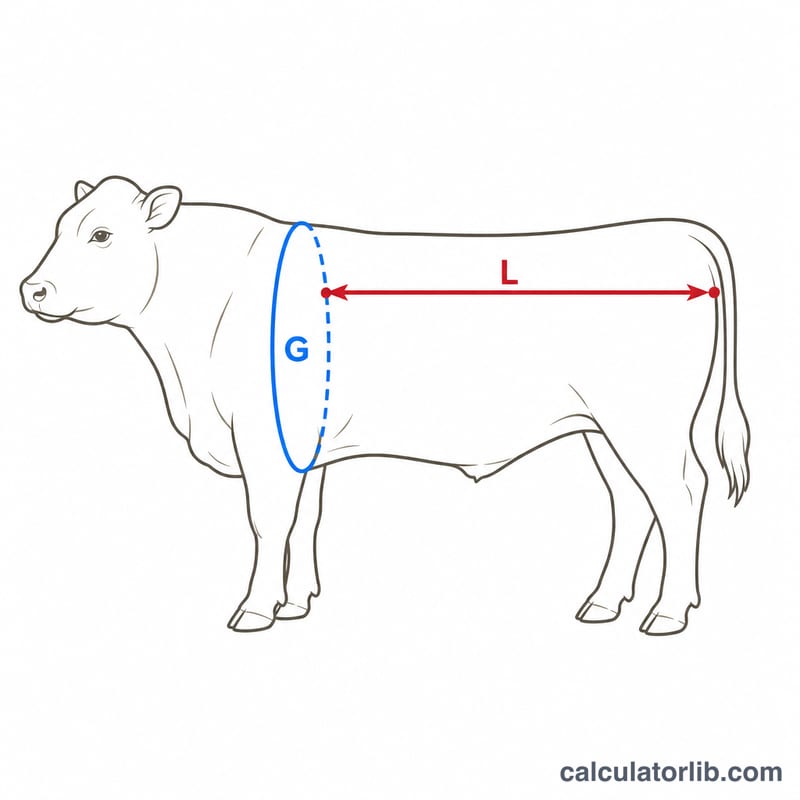
Stand the animal square on level ground with the head in a normal position. Heart girth is the circumference of the chest, taken snugly all the way around the body immediately behind the front legs and over the tips of the shoulder blades. Body length runs from the point of the shoulder straight back to the pin bone (the bony point beside the tail head). Pick inches or centimetres in the form; the calculator converts internally, so you only need to be consistent within one measurement set.
The formula explained
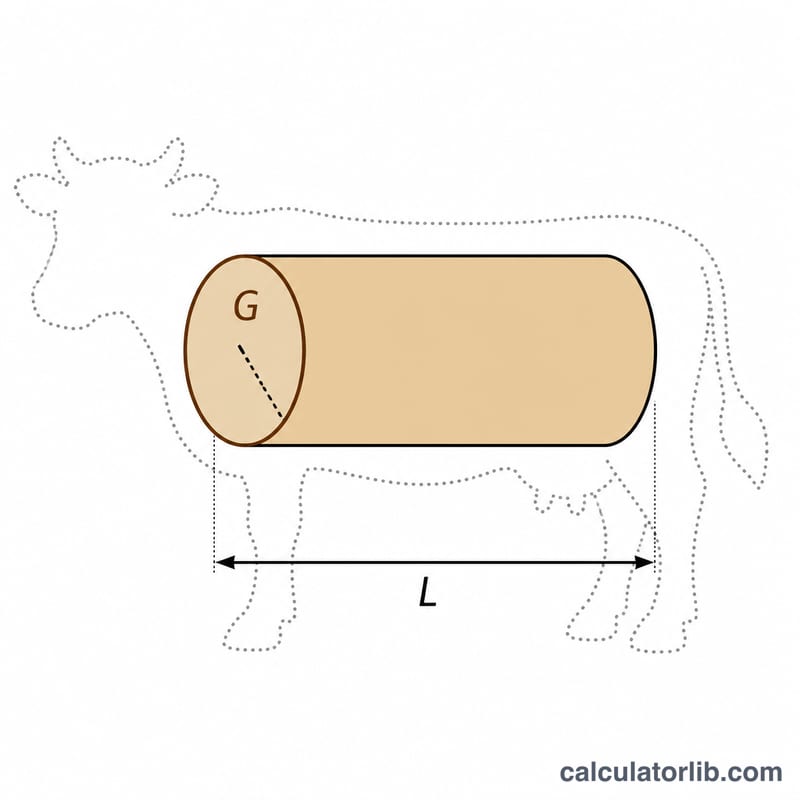
With \(G\) = heart girth and \(L\) = body length in inches, and \(W\) = live weight in pounds:
$$W = \frac{G^{2} \times L}{300}$$The girth term is squared because chest circumference stands in for the cross-sectional area of the barrel, while length supplies the third dimension; the constant 300 converts that volume proxy into pounds of live animal. In metric units the same relationship becomes \(W_{\text{kg}} = \frac{G^{2} \times L}{10838}\), where \(G\) and \(L\) are in centimetres.
Worked example
A beef cow tapes 70 inches around the heart girth and measures 55 inches from shoulder point to pin bone:
$$W = \frac{70^{2} \times 55}{300} = \frac{269500}{300} = 898.3\,\text{lb}$$That is about 407 kg live weight, and roughly 557 lb of dressed carcass at a 62% yield.
Typical Heart Girth and Weight by Breed Type and Age
The table below gives typical heart girth measurements and the live weights they correspond to for common cattle classes. Heart girth is measured with a flexible tape passed right behind the front legs and over the highest point of the withers, snug but not compressing the hide. These are typical ranges observed in general beef and dairy production, not official standards — actual animals vary widely with breed, frame score, body condition, gut fill and pregnancy status.
| Class of cattle | Heart girth (in) | Heart girth (cm) | Typical live weight (lb) | Typical live weight (kg) |
|---|---|---|---|---|
| Weaned calf (6–8 months) | 46–52 | 117–132 | 400–500 | 180–230 |
| Yearling steer or heifer | 58–66 | 147–168 | 650–850 | 295–385 |
| Finished (market) steer | 72–80 | 183–203 | 1,200–1,450 | 545–660 |
| Mature beef cow | 72–82 | 183–208 | 1,100–1,500 | 500–680 |
| Mature dairy cow (Holstein) | 76–86 | 193–218 | 1,300–1,600 | 590–725 |
| Mature bull (beef breeds) | 82–94 | 208–239 | 1,700–2,300 | 770–1,045 |
Dairy frames read low. The Schaeffer tape formula was developed on beef-type cattle, whose deep, thick-muscled barrel is well described by girth. Holsteins, Jerseys and other dairy breeds are angular and relatively light for their skeletal size, so a tape estimate on a lactating dairy cow commonly under-reads true scale weight — often by several percent, and more in thin, high-producing cows. Conversely, a heavily pregnant cow or a full-gut animal straight off feed and water can read high. Treat every figure here as a starting point for comparison, then calibrate against your own scale readings if you have access to one.
Interpreting Your Estimated Weight
The number this calculator returns is an estimate of live weight — the animal as it stands, hide, gut contents and all. That distinction matters because live weight itself is not a fixed quantity: a cow weighed full, straight off pasture or feed, can be 3–5% heavier than the same cow after normal shrink from handling, sorting and hauling. A tape measurement taken in the morning before feeding and the same measurement taken after a full day's grazing will not agree, so record when and under what conditions you measured.
Expected accuracy. For mature beef-type cattle in moderate body condition, heart-girth tape estimates typically land within about ±3–5% of scale weight — roughly ±35 to ±60 lb (16–27 kg) on a 1,200 lb (545 kg) cow. Error grows substantially for dairy-type cattle, very thin or very fat animals, cows in the last trimester of pregnancy, and young growing calves whose body proportions are still changing. If your estimate disagrees sharply with your own judgement of the animal, re-measure before trusting it; a tape that slipped off the withers or sagged behind the elbow is the most common cause of a bad reading.
Live weight to carcass weight. Dressing percentage converts live weight into hot carcass weight:
$$\text{Carcass weight} = \text{Live weight} \times \text{Dressing \%}$$
Well-finished beef cattle generally dress around 60–64%. Dairy-type animals, cull cows, and thin or heavily gut-filled cattle dress lower — commonly in the low 50s percent. So a 1,250 lb finished steer at 62% yields roughly 775 lb of hot carcass, while a 1,400 lb cull dairy cow at 52% yields about 730 lb despite weighing more alive. Retail take-home yield is lower again after chilling, boning and trimming.
Feeding. Dry-matter intake for cattle is usually planned at about 2–2.5% of body weight per day, with lactating and growing animals at the upper end and dry, mature animals lower. A 1,200 lb (545 kg) cow therefore eats roughly 24–30 lb (11–14 kg) of dry matter daily. A tape estimate is entirely adequate for sizing a ration, a hay stack or a grazing budget across a group — average the herd rather than fussing over individuals.
Sale value. In markets that price per hundredweight (the United States and Canada), value is weight ÷ 100 × price per cwt; elsewhere it is simply weight in kilograms × price per kg. At $180 per cwt, an 850 lb yearling is worth about $1,530; at a live price of $3.60 per kg, a 385 kg yearling is about $1,386. Because a few percent of estimated weight translates directly into money, use scale weights for any transaction where both parties are relying on the figure.
Caution — dosing. Do not use a tape estimate as the basis for administering any product with a narrow margin of safety. Anaesthetics, sedatives, some anthelmintics and most injectable products with toxicity near the therapeutic dose require an actual scale weight, and veterinary advice on rounding. Under-dosing also has a real cost: it drives anthelmintic resistance. Weigh the animal, or dose the heaviest in the group only where the product label explicitly permits it.
This section is general information about how weight estimates are used in livestock management, not veterinary or financial advice. Consult your veterinarian for animal health decisions and a qualified adviser for marketing decisions.
Frequently asked questions
How accurate is a tape estimate? For mature beef-type cattle in moderate condition it is usually within 3-5% of scale weight. Dairy breeds carry weight differently and often read a little low.
Can I use it on calves? The formula is built for grown animals. Under about 300 lb the squared-girth relationship overestimates, so treat young calf results as a rough guide only.
Is it safe for medication dosing? Only for products with a wide safety margin. For antibiotics, anaesthetics or anything dosed tightly by kilogram, weigh the animal on a scale.