What this calculator does
Yarn is sold by weight but consumed by length, so a pattern that lists only dimensions leaves you guessing at the checkout. This tool turns a project size and a gauge swatch into the yarn length you will use, the weight of wool that length represents, and the number of skeins to buy. It works for any fibre, any units of gauge, and any ball size, because everything is derived from the yardage and weight printed on your own ball band.
How to use it
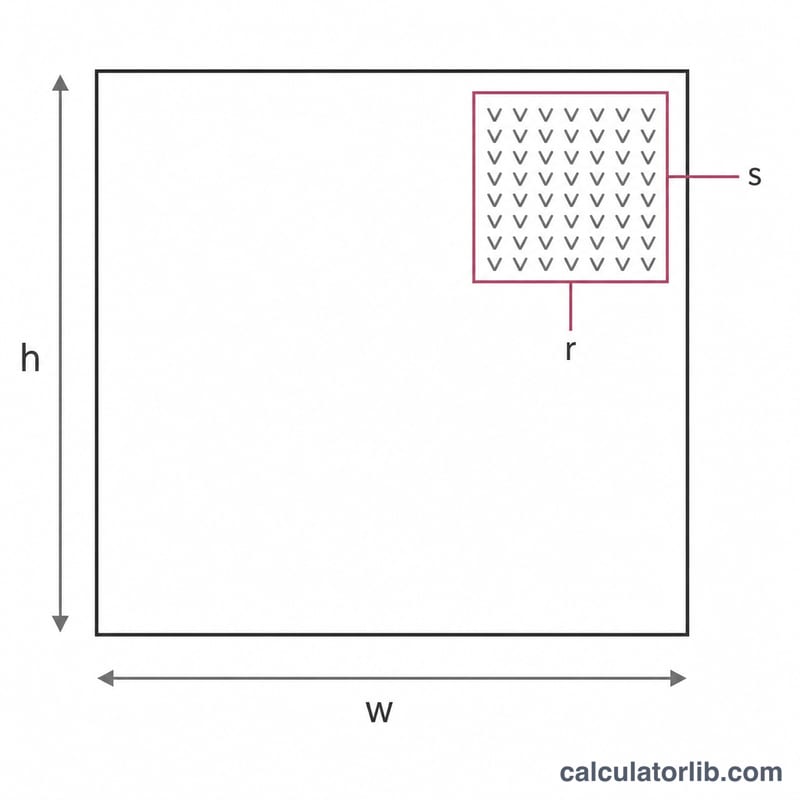
Measure the finished width and length of the piece in inches. Knit or crochet a swatch, block it, and count stitches and rows over 4 inches. Choose the stitch type: denser stitches swallow more yarn per stitch. Finally copy the yardage and gram weight from the ball band and add an allowance (10 percent is typical) for seams, swatching and mistakes.
The formula
Each stitch consumes roughly \(f\) times its own width in yarn, and a stitch is \(1/s\) inches wide, where \(s\) is stitches per inch. Multiplying by the stitch count \(W \times H \times s \times r\) makes the stitch gauge cancel, leaving:
$$L_{yd} = \frac{W \times H \times r \times f}{36}$$Here \(W\) and \(H\) are inches, \(r\) is rows per inch and 36 converts inches to yards. The weight then follows from the yarn density:
$$\text{Weight}_{g} = L_{yd}\,(1+w)\times\frac{g_{s}}{y_{s}}$$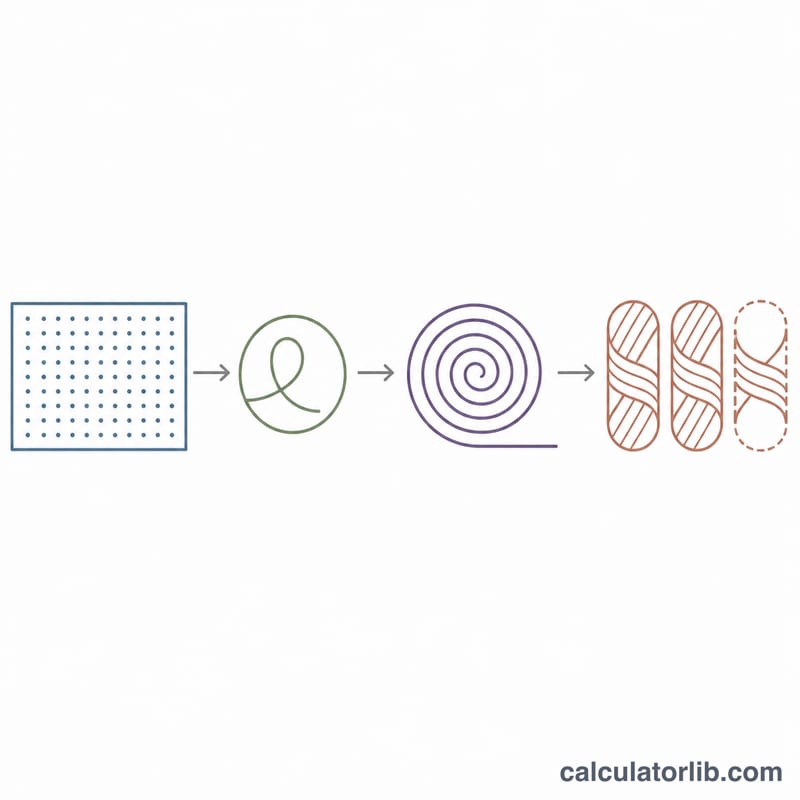
Worked example
A 20 by 24 inch stockinette cushion cover at 20 stitches and 28 rows per 4 inches gives \(r = 7\) rows per inch and \(f = 3\):
$$L_{yd} = \frac{20 \times 24 \times 7 \times 3}{36} = 280\ \text{yd}$$With a 10 percent allowance that is 308 yards. A 100 g skein of 220 yards has a density of \(100/220 = 0.4545\) g per yard, so:
$$\text{Weight} = 308 \times 0.4545 = 140\ \text{g} \Rightarrow 2\ \text{skeins}$$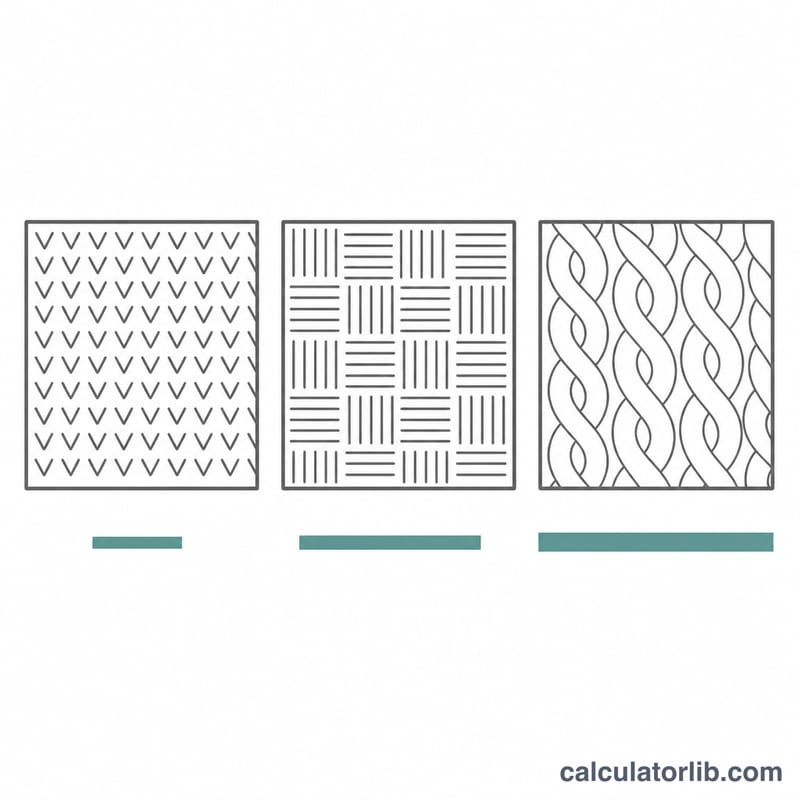
Yarn Consumption Factors by Stitch Pattern
The stitch type factor \(f\) in this calculator expresses roughly how much yarn length a single stitch consumes, measured in multiples of the stitch width. A denser fabric — more twists, crossings or floats per stitch — pulls more yarn through the same square inch of finished cloth. The calculator's select field offers four representative values (3, 3.5, 4.5, 6); the table below shows where common patterns fall so you can pick the closest option, or adjust your extra allowance to compensate.
| Stitch pattern | Typical factor \(f\) | Closest field value | Why it differs |
|---|---|---|---|
| Lace / openwork (knit) | 2 – 2.5 | 3 | Yarn overs create holes, so fabric area is made partly of air rather than yarn. |
| Stockinette / stocking stitch | ≈ 3 | 3 | The baseline smooth fabric: one simple loop per stitch, no crossing or extra texture. |
| Garter stitch | ≈ 3.5 | 3.5 | Rows compress vertically, so more rows (and more yarn) fit into the same length. |
| Seed / moss stitch | 3.5 – 4 | 3.5 | Alternating knit and purl bumps thicken the fabric and shorten it lengthwise. |
| Ribbing 1×1 (measured relaxed) | ≈ 4 | 4.5 | Rib pulls in widthwise; the hidden folds of fabric still contain yarn. |
| Cables / travelling stitches | 4.5 – 5 | 4.5 | Crossing stitch columns over one another consumes extra length and tightens gauge. |
| Stranded colourwork (per colour layer) | 5 – 6 | 6 | Floats on the wrong side mean two strands are carried across most of each row. |
| Crochet single crochet (UK double crochet) | 4 – 4.5 | 4.5 | Each stitch is a short, dense post; crochet uses noticeably more yarn than knitting. |
| Crochet half double crochet (UK half treble) | ≈ 5 | 4.5 | Taller post with an extra yarn over adds length per stitch. |
| Crochet double crochet (UK treble) | 5.5 – 6 | 6 | Tall posts drawn through two loops at a time; the most yarn-hungry basic stitch. |
| Granny squares / mesh | ≈ 4 | 4.5 | Tall clusters are offset by the open chain spaces between them. |
Terminology note: crochet stitch names differ between the US and UK systems, so both are given above. These factors are empirical averages, not constants — expect roughly ±10–15% variation depending on fibre, plying, hook or needle style, and your personal tension. Treat the estimate as a shopping guide and always round up to whole skeins.
Standard Yarn Weight Categories, Gauge and Yardage
The Craft Yarn Council (CYC) Standard Yarn Weight System — a North American industry guideline, widely referenced but not a legal standard — groups yarns by thickness from 0 (lace) to 7 (jumbo). It is useful for sanity-checking the gauge and yardage you type into the calculator.
| CYC number | Name | Knit stitches per 4 in (10 cm) | Needle size (mm) | Needle size (US) | Typical yd per 100 g |
|---|---|---|---|---|---|
| 0 | Lace | 33 – 40 | 1.5 – 2.25 | 000 – 1 | 600 – 1000 |
| 1 | Super fine / fingering, sock | 27 – 32 | 2.25 – 3.25 | 1 – 3 | 380 – 450 |
| 2 | Fine / sport | 23 – 26 | 3.25 – 3.75 | 3 – 5 | 280 – 350 |
| 3 | Light / DK | 21 – 24 | 3.75 – 4.5 | 5 – 7 | 220 – 260 |
| 4 | Medium / worsted, aran | 16 – 20 | 4.5 – 5.5 | 7 – 9 | 190 – 220 |
| 5 | Bulky / chunky | 12 – 15 | 5.5 – 8 | 9 – 11 | 100 – 130 |
| 6 | Super bulky | 7 – 11 | 8 – 12.75 | 11 – 17 | 50 – 80 |
| 7 | Jumbo | 6 or fewer | 12.75 and larger | 17 and larger | Under 50 |
Needle sizes in millimetres are the metric standard used worldwide; the US numbering column applies to needles sold in the United States. Yardage per 100 g varies with fibre and construction — a woollen-spun, lofty wool gives more yards per gram than a densely plied worsted-spun or a wool blended with silk or alpaca, so a single-ply DK can exceed the range above.
Always enter the real ball band figures into the Yards per Skein and Grams per Skein fields, and your own swatched stitch and row gauge into the gauge fields. This table exists only to flag an implausible entry — if you have typed 26 stitches per 4 inches together with 120 yd per 100 g, one of the two numbers is almost certainly wrong.
Worked check with a DK example: a 40 in × 60 in blanket in stockinette at 22 stitches and 30 rows per 4 in, using 240 yd / 100 g skeins and a 10% allowance, gives
$$N = 40 \times 60 \times \frac{22}{4} \times \frac{30}{4} = 99{,}000\ \text{stitches}$$$$Y = \frac{99{,}000 \times 3}{36 \times 5.5} \times 1.10 = 1650\ \text{yd}$$which is about 1650 yards — comfortably inside the plausible range for a DK blanket of that size, and 7 full skeins once rounded up.
Buying Yarn From Your Estimate
The calculator returns three numbers: total yards, total grams, and skeins rounded up. The skein count is the one you take to the shop — but a few habits turn a good estimate into a project that does not run out of yarn two rows from the end.
- Always round up to whole skeins. The tool already applies a ceiling, so 6.2 skeins becomes 7. Never buy 6 and hope your tension is tighter than your swatch.
- Buy one extra skein when you land near a boundary. If the yardage estimate sits within about 10% of a skein boundary — say 1420 yd from 240 yd skeins, which is 5.9 skeins — add one more ball. Dye lots disappear, and a partial skein is cheap insurance against a second shipping charge.
- Match the dye lot on every ball band. Check the lot (or batch) number printed alongside the colour name and confirm it is identical on all balls at the till, not just on the top one. Two lots of the same shade can show a visible line across a body or blanket.
- Raise the allowance for yarn-hungry work. Use 15–20% instead of the default 10% for cables, stranded colourwork, fringe or tassels, generous seam allowances, striping with many colour changes, or any project where you may re-knit a section. Long-repeat self-striping yarn also wastes yarn at the joins.
- Swatch and block before you buy. Knit or crochet a swatch at least 4 in (10 cm) square in the actual project yarn, wash and block it as you will treat the finished piece, then measure both stitch and row gauge. Row gauge matters as much as stitch gauge here, because total yardage scales with the number of rows — a row gauge 10% off changes the estimate by about 10%.
- Keep receipts and ball bands. Most yarn shops accept unused, unwound skeins for return or exchange, but usually only with the band intact and the receipt. Keep one band from a used ball too — it records fibre content, lot number and care instructions for the finished item.
- Rotate hand-dyed and kettle-dyed skeins. Even inside one lot, hand-dyed yarn varies. Wind all the skeins first and alternate between two balls every two rows (or every round) so any difference blends gradually instead of forming a hard stripe.
- Buy by weight, knit by yardage. Shops price by ball, but the fabric consumes length. If you substitute yarn, compare yards per 100 g rather than the weight category name, then re-run the estimate with the new ball band figures.
Two smaller points worth remembering: leftover yarn is genuinely useful for swatches, repairs and patches, so a spare ball rarely goes to waste; and if you are working to a published pattern, compare the calculator's result with the pattern's stated quantity — a large gap usually means your gauge or the stitch type factor needs revisiting rather than that the pattern is wrong.
FAQ
Why does stitch gauge disappear from the length formula? Finer stitches are more numerous but each is shorter, and the two effects cancel almost exactly, leaving row gauge as the driver.
How accurate is the estimate? Expect plus or minus 10 to 15 percent. Cables, colourwork and loose selvedges add yarn; use a larger allowance for them.
Can I use metric measurements? Convert centimetres to inches (divide by 2.54) and gauge per 10 cm to gauge per 4 inches before entering values.