What this calculator does
Most children's medicines are prescribed by body weight rather than by age, because a 9 kg toddler and a 30 kg nine-year-old need very different amounts of the same drug. This calculator takes the child's weight and the milligrams-per-kilogram rate written on the prescription, then returns the dose in milligrams, the total for a 24-hour period, and the volume in millilitres you would actually draw into an oral syringe.
How to use it
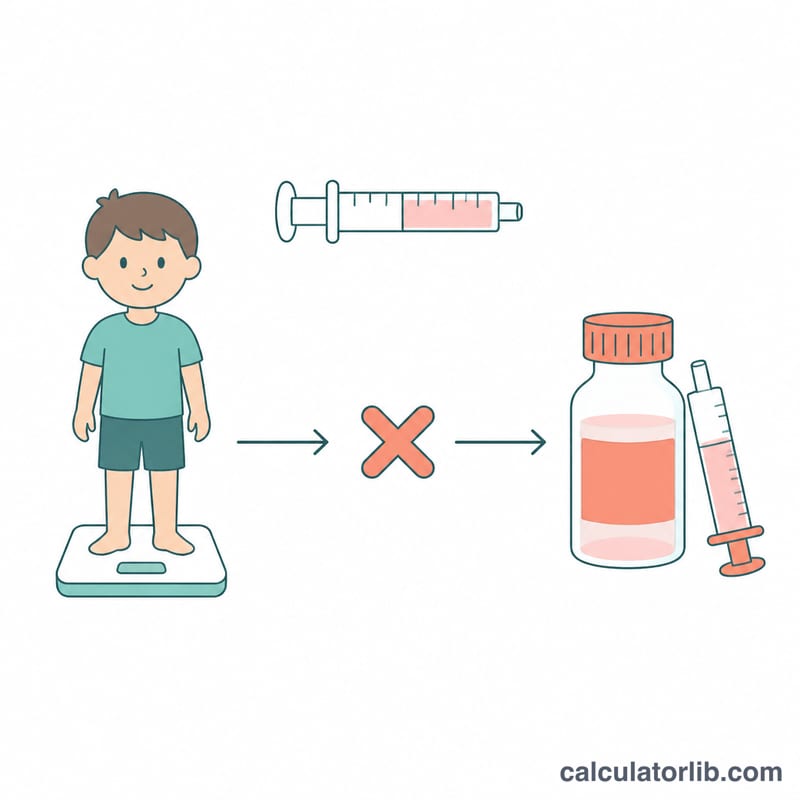
Weigh the child in kilograms and enter that value. Enter the prescribed rate, for example 15 mg/kg per dose. Choose how many doses are given per day, then type the liquid strength printed on the bottle in milligrams per millilitre — a 160 mg / 5 mL suspension is \(160 \div 5 = 32\) mg/mL. Optionally enter a maximum daily dose so the calculator can flag a schedule that goes over the ceiling.
The formula
With \(W\) = weight in kg, \(D\) = prescribed mg/kg per dose, \(C\) = concentration in mg/mL and \(n\) = doses per day:
$$\text{Dose}_{mg} = W \times D \qquad V_{mL} = \frac{W \times D}{C} \qquad \text{Daily}_{mg} = W \times D \times n$$The dosing interval is simply \(24 / n\) hours.
Worked example
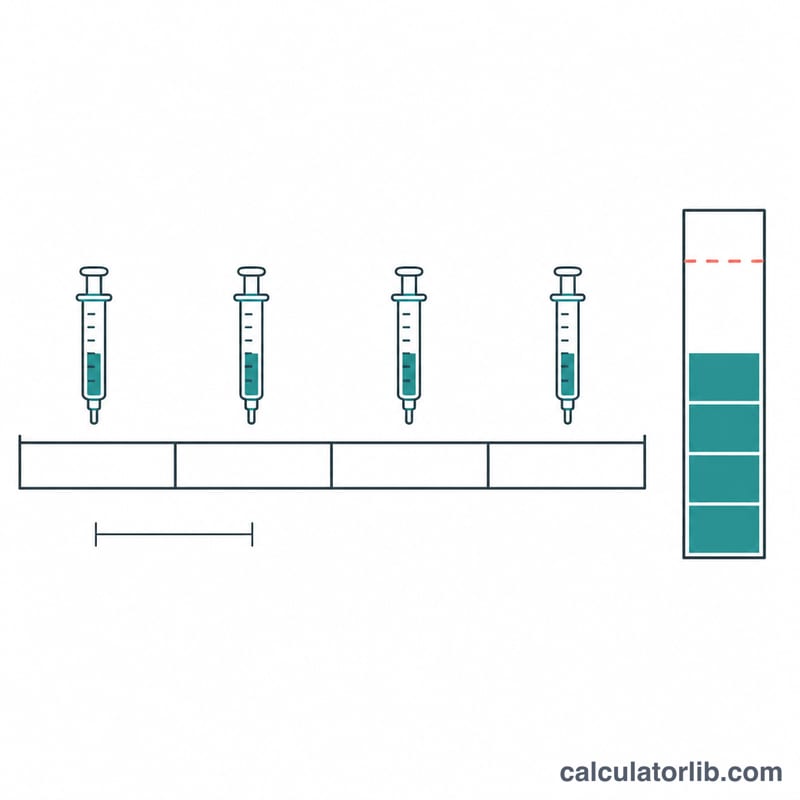
A 15 kg child is prescribed 15 mg/kg per dose, four times a day, from a 32 mg/mL suspension, with a 1000 mg daily ceiling:
$$\text{Dose} = 15 \times 15 = 225\,\text{mg}$$$$V = \frac{225}{32} = 7.03\,\text{mL}$$$$\text{Daily} = 225 \times 4 = 900\,\text{mg} = 90\%\ \text{of the ceiling}$$Interpreting Your Result
The calculator turns a prescriber's weight-based instruction into the four numbers you actually need at the kitchen counter: the milligrams in one dose, the millilitres to draw up, the milligram total for a full day, and how close that day's total sits to the stated ceiling.
- Dose in mg (single dose) — the active drug in one administration, \(D_{\text{single}} = \text{weight (kg)} \times \text{dose (mg/kg)}\). This is a drug quantity, not a liquid quantity; it is the number that should match the mg figure written on the prescription label.
- Volume in mL (per dose) — the amount of liquid to pull into the oral syringe, \(V_{\text{single}} = D_{\text{single}} \div \text{concentration (mg/mL)}\). This is the only output you physically measure. Round it to the nearest graduation your syringe actually has (commonly 0.1 mL on a 5 mL syringe, 0.05 mL on a 1 mL syringe) rather than to a value you cannot see on the barrel.
- Daily total in mg — \(D_{\text{daily}} = D_{\text{single}} \times n\), where \(n\) is doses per day. This is the cumulative exposure over 24 hours and is the figure that safety ceilings are written against.
- Percent of maximum daily dose — \(\%_{\max} = (D_{\text{daily}} \div \text{max daily mg}) \times 100\). A result well under 100% means the regimen sits inside the ceiling you entered; a result near 100% means there is no headroom left for an extra "one more dose" at the end of the day; a result above 100% means the schedule as entered exceeds the ceiling you supplied and must be checked with the prescriber or pharmacist before anything is given.
What the ceiling number depends on. The maximum daily dose is an input, not something the tool knows. Ceilings differ by drug, by country, by product licence and by the child's age and weight — a figure printed on a package in one country is not automatically the figure that applies elsewhere. Enter the ceiling from the prescription or from the label of the exact product you are holding, and treat a percentage above 100% as a prompt to stop and ask, not as a rounding issue.
What the tool does and does not do. It reproduces arithmetic on the mg/kg rate you supply. It does not select a drug, choose a mg/kg rate, decide a frequency, account for renal or hepatic impairment, check for duplicate ingredients across products, or flag interactions. If the mg/kg rate entered is wrong, every output will be confidently wrong. The dispensing label and your pharmacist or prescriber remain the authority; use this as a cross-check on a number you were already given.
Very small volumes are often correct. A result below 1 mL usually signals a concentrated infant-drop formulation rather than a mistake — for example, a product labelled 80 mg per 0.8 mL is 100 mg/mL, so a 60 mg dose is only 0.6 mL. Concentrated drops are supplied with their own small graduated syringe or dropper. The danger with these products is the opposite of a mis-calculation: measuring a concentrated drop with a syringe intended for a dilute suspension can deliver several times the intended dose. Always use the measuring device packed with that bottle.
Accuracy points worth repeating:
- Use a recently measured weight. Children's weights change quickly, and an estimate carried over from a visit months ago propagates straight into the mg figure.
- Enter kilograms, not pounds. A weight typed in pounds inflates the dose by roughly 2.2×.
- The concentration must come from the bottle in your hand. The same drug is sold at several strengths (for example 100 mg/5 mL and 250 mg/5 mL), and switching bottles mid-course without re-checking the mL is a common source of error.
- Confirm whether the prescribed rate is per dose or per day before typing it in — see the glossary below.
Weight and Concentration Conversions
Pounds to kilograms
Dosing is done in kilograms. To convert: \(\text{kg} = \text{lb} \times 0.4536\), or equivalently \(\text{kg} = \text{lb} \div 2.205\).
| Weight (lb) | Weight (kg) |
|---|---|
| 10 | 4.54 |
| 20 | 9.07 |
| 30 | 13.61 |
| 40 | 18.14 |
| 50 | 22.68 |
| 60 | 27.22 |
| 70 | 31.75 |
Pounds are in everyday use mainly in the United States; most of the world weighs children in kilograms already, in which case no conversion is needed. A quick mental check: halve the pounds, then subtract about 10% of that half (50 lb → 25 → about 22.7 kg).
Label strength to mg/mL
Oral liquids are usually labelled as milligrams per a stated volume (often per 5 mL). The calculator wants milligrams per single millilitre: \(\text{mg/mL} = \text{label mg} \div \text{label mL}\).
| Label strength | Concentration (mg/mL) |
|---|---|
| 80 mg / 0.8 mL (infant drops) | 100 |
| 100 mg / 5 mL | 20 |
| 120 mg / 5 mL | 24 |
| 125 mg / 5 mL | 25 |
| 160 mg / 5 mL | 32 |
| 200 mg / 5 mL | 40 |
| 250 mg / 5 mL | 50 |
| 400 mg / 5 mL | 80 |
These are strengths commonly seen on paediatric oral liquids; which ones are actually available depends on the country and the manufacturer, so read the bottle rather than assuming a familiar strength.
Worked check
A child weighing 30 lb is \(30 \div 2.205 = 13.61\) kg. At a prescribed 10 mg/kg per dose from a 160 mg/5 mL suspension (32 mg/mL), given four times a day, one dose is
$$D_{\text{single}} = 13.61 \text{ kg} \times 10 \text{ mg/kg} = \href{}{136.1}\ \text{mg}$$
which is 136.1 mg per dose, or \(136.1 \div 32 = 4.25\) mL to draw into the syringe — in practice measured as 4.2 or 4.3 mL depending on the graduations, with the daily total \(136.1 \times 4 = 544.4\) mg and a dosing interval of \(24 \div 4 = 6\) hours.
Household spoons
| Household measure | Metric equivalent |
|---|---|
| 1 teaspoon (tsp) | 5 mL |
| 1 tablespoon (tbsp) | 15 mL |
| ½ teaspoon | 2.5 mL |
These equivalences are definitions for measuring spoons, not for cutlery. Ordinary kitchen teaspoons vary widely in capacity and have repeatedly been shown to deliver substantially more or less than 5 mL. Use the oral syringe or dosing cup supplied with the medicine; if it has been lost, a pharmacist will supply another.
Key Terms Explained
- Body weight (kg)
- The child's current measured weight in kilograms — the basis for every weight-based calculation. Children's doses scale with body size rather than age, which is why a stated age band is never a substitute for a scale reading. Some specialist regimens use ideal or adjusted body weight instead; this calculator uses the weight you enter as-is.
- mg/kg per dose
- Milligrams of drug for each kilogram of body weight, in one administration. This is what the calculator expects in the dose field. A 12 kg child at 15 mg/kg per dose receives 180 mg each time.
- mg/kg per day (mg/kg/day)
- The total for a full 24 hours, which is then divided among the scheduled doses. If a per-day rate is entered as though it were per-dose, the calculator will multiply it by the number of doses and the daily total will be \(n\) times too high — four times too high on a four-times-daily schedule. Convert first: \(\text{mg/kg per dose} = \text{mg/kg/day} \div n\). If a prescription is ambiguous, ask before dosing.
- Dose (mg)
- The quantity of active drug in one administration, \(\text{weight} \times \text{mg/kg}\). Expressed in milligrams, independent of how the product is formulated.
- Concentration / suspension strength (mg/mL)
- How much drug is contained in each millilitre of liquid. Derived from the label as \(\text{label mg} \div \text{label mL}\). The single most important number to re-read whenever a new bottle is opened.
- Volume per dose (mL)
- The liquid amount to measure, \(\text{dose (mg)} \div \text{concentration (mg/mL)}\). Round to a graduation that exists on your syringe rather than to an unmeasurable precision.
- Doses per day (n) and dosing interval
- How many administrations fall in 24 hours, and the nominal spacing between them, \(t_{\text{interval}} = 24 \div n\). So \(n = 2\) is roughly every 12 hours, \(n = 3\) every 8 hours, \(n = 4\) every 6 hours, \(n = 6\) every 4 hours. Real schedules often shift around sleep; the prescriber's instruction about minimum spacing takes precedence over the arithmetic.
- Maximum daily dose
- A ceiling on cumulative 24-hour exposure, quoted either as an absolute milligram figure or as mg/kg/day. For a weight-based ceiling, multiply by the child's weight to obtain the milligram value to enter. Ceilings vary by drug, product licence and country, and may be lower for small children than the adult figure — take the number from the prescription or the product's own labelling.
- Oral syringe
- A graduated plastic syringe with no needle, designed for measuring and delivering liquid medicine by mouth. Accurate to the volume range printed on it: a 1 mL syringe for small concentrated doses, a 5 or 10 mL syringe for larger ones. Using a syringe far larger than the dose reduces accuracy.
- Suspension
- Solid drug particles dispersed in liquid; they settle on standing, so the bottle must be shaken well immediately before each dose. An unshaken suspension delivers weak doses at the start of the bottle and strong ones at the end.
- Solution
- The drug is fully dissolved and evenly distributed. It does not separate and does not require shaking, though shaking does no harm.
- Infant drops
- A concentrated formulation intended for small volumes, supplied with its own small dropper or syringe. Because the mg/mL is much higher than the matching children's suspension, mixing up the two products or their measuring devices is a recognised overdose risk. Check the mg/mL on every bottle.
- PRN dosing
- From the Latin pro re nata — "as needed". The medicine is given only when a symptom such as fever or pain is present, up to a stated maximum frequency and daily ceiling. With PRN medicines the daily total is an upper bound, not a target; fewer doses are perfectly acceptable if symptoms have settled.
- Scheduled dosing
- Fixed times regardless of symptoms, typical of antibiotics and other courses where a steady drug level matters. Here the full course should be completed as prescribed even after the child appears well.
This section is general information about dosage terminology, not professional medical advice. It does not replace the prescription, the product's own labelling, or the judgement of your doctor, nurse or pharmacist. Do not start, change or stop a child's medicine based on a calculator result; if a number does not match what you were told, contact the prescriber or pharmacist before giving the dose, and seek urgent medical help if you suspect an overdose.
FAQ
Should I use weight or age? Weight, whenever it is known. Age bands on a package are a rough proxy for weight and can badly under- or over-dose a child at the edge of a band.
My bottle says 250 mg / 5 mL. What do I enter? Divide: \(250 \div 5 = 50\) mg/mL.
Can I round the millilitres? Measure with an oral syringe to the nearest 0.1 mL where possible, and never use a kitchen spoon. If the calculated dose exceeds the maximum daily amount, stop and ask a pharmacist rather than adjusting on your own.