What this calculator does
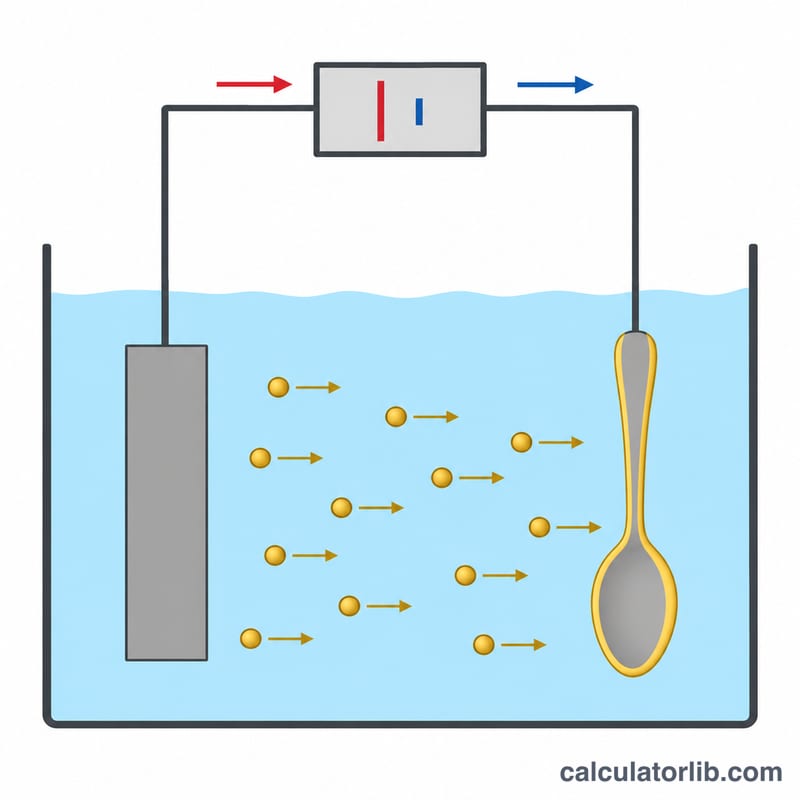
This electroplating thickness calculator estimates how thick a metal layer will be after plating, based on the current density, plating time, part surface area, current efficiency and the metal being deposited. It uses Faraday's laws of electrolysis, which link the electric charge passed through a plating bath to the mass of metal deposited. It works for copper, nickel, zinc, chromium, silver, gold and tin.
How to use it
Select the plating metal, enter the current density in A/dm², the plating time in minutes, the part surface area in dm², and the cathode current efficiency as a percentage. Use 100% for an ideal bath. Acid copper and bright nickel typically run at 95-100%, zinc at 85-95%, and hexavalent chromium often only 10-15%. The result shows thickness in micrometres and mils, the deposition rate, the total current required and the mass of metal deposited.
The formula explained
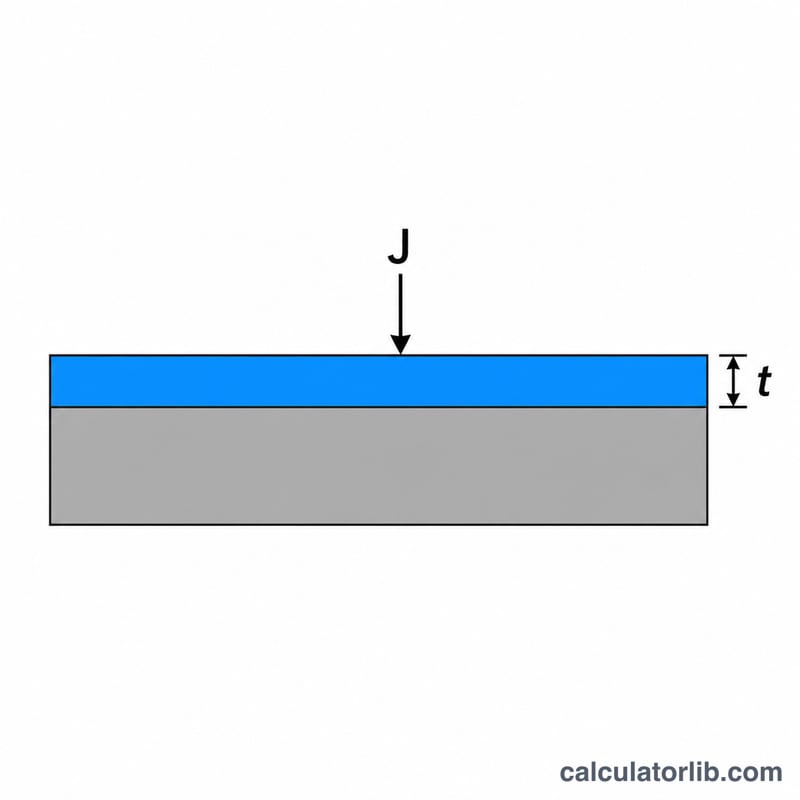
Thickness follows from the charge per unit area, converted to moles of metal, then to mass and finally to volume:
$$t = \frac{J \times T \times M \times \eta}{n \times F \times \rho}$$Here \(J\) is current density in A/cm², \(T\) is time in seconds, \(M\) is molar mass in g/mol, \(\eta\) is current efficiency as a fraction, \(n\) is the number of electrons per ion, \(F = 96485\) C/mol and \(\rho\) is density in g/cm³. The result is in cm and is converted to µm by multiplying by 10,000. Surface area does not change thickness at a fixed current density, but it sets the total current and the mass of metal used.
Worked example
Copper plated at 2 A/dm² for 30 minutes at 100% efficiency. Convert \(J = 0.02\) A/cm² and \(T = 1800\) s:
$$t = \frac{0.02 \times 1800 \times 63.546}{2 \times 96485 \times 8.96} = 0.001323\,\text{cm} \approx 13.23\,\mu\text{m}$$On a 5 dm² part, the total current is 10 A and the deposited copper is about 5.93 g.
Plating Metal Properties Used in the Calculation
The calculator applies Faraday's law with the values below. Here n is the number of electrons transferred per metal ion, M is the molar mass and ρ is the density of the deposited metal.
| Metal | Ion / bath assumption | n | M (g/mol) | Density ρ (g/cm³) |
|---|---|---|---|---|
| Copper | Cu²⁺ | 2 | 63.546 | 8.96 |
| Nickel | Ni²⁺ | 2 | 58.693 | 8.90 |
| Zinc | Zn²⁺ | 2 | 65.38 | 7.14 |
| Chromium | Cr⁶⁺ (chromic acid bath) | 6 | 51.996 | 7.19 |
| Silver | Ag⁺ (cyanide bath) | 1 | 107.868 | 10.49 |
| Gold | Au⁺ (cyanide bath) | 1 | 196.967 | 19.32 |
| Tin | Sn²⁺ (e.g. acid sulfate) | 2 | 118.71 | 7.31 |
Note: the valence of gold and tin depends on the bath chemistry. Cyanide gold baths deposit from Au(I), so n = 1, while some other gold baths use Au(III), so n = 3. Tin deposits from Sn(II) in acid baths (n = 2), but alkaline stannate baths use Sn(IV), so n = 4. Using the wrong n changes the calculated thickness by a factor of 2 to 3. Chromium is also deposited at very low efficiency, so the efficiency input matters a great deal.
Typical Plating Thickness and Current Density Ranges
The figures below are general, approximate industry ranges. Actual values depend on the bath formulation, temperature, agitation and supplier data sheets.
| Bath type | Typical current density (A/dm²) | Typical cathode efficiency |
|---|---|---|
| Acid copper (sulfate) | 2–5 (higher with agitation) | 95–99 % |
| Bright nickel (Watts-type) | 3–6 | 93–97 % |
| Zinc (acid chloride) | 1–4 | 95–98 % (alkaline non-cyanide: roughly 60–80 %) |
| Hard chrome (hexavalent) | 30–60 | 10–15 % |
| Silver (cyanide) | 0.5–2 | 95–100 % |
| Gold (cyanide / acid) | about 0.1–1 | about 30–90 % depending on bath |
| Tin (acid sulfate) | 1–4 | 90–100 % |
| Application | Typical thickness | Standard (US, ASTM) |
|---|---|---|
| Decorative chromium over nickel | 0.25–0.5 µm | ASTM B456 (Cu + Ni + Cr) |
| Nickel under decorative chrome | roughly 10–40 µm, by service condition | ASTM B456 |
| Zinc on steel | 5–25 µm | ASTM B633 (service classes SC 1 to SC 4) |
| Hard (engineering) chrome | 20–250 µm | Specified by drawing or customer |
| Gold on electrical contacts | 0.5–2.5 µm | ASTM B488 (types and codes) |
The required thickness varies with the service class or service condition. A mild indoor environment needs far less than outdoor or marine exposure. These standards are American (ASTM). Other regions use equivalents such as ISO 1456, ISO 2081 and ISO 4521, so always check the specification that applies to your part.
Thickness Comparison Across Metals and Settings
The base case is 2 A/dm² for 30 minutes, which passes 2 × 1800 = 3600 C per dm². Per dm² the mass is \(m = \frac{Q \cdot M \cdot \eta}{n \cdot F}\) with F = 96485 C/mol, and the thickness is \(t = \frac{m}{\rho \cdot A}\) with A = 100 cm². The efficiencies are representative assumptions. The variant column uses 4 A/dm² for 60 minutes, which is four times the charge, and assumes the same efficiency. In practice efficiency changes with current density, especially for chromium and gold.
| Metal | Assumed efficiency | Mass at 2 A/dm², 30 min (g/dm²) | Thickness at 2 A/dm², 30 min (µm) | Mass at 4 A/dm², 60 min (g/dm²) | Thickness at 4 A/dm², 60 min (µm) |
|---|---|---|---|---|---|
| Copper | 98 % | 1.162 | 12.97 | 4.647 | 51.9 |
| Nickel | 95 % | 1.040 | 11.69 | 4.161 | 46.7 |
| Zinc | 95 % | 1.159 | 16.23 | 4.635 | 64.9 |
| Chromium | 12 % | 0.0388 | 0.54 | 0.155 | 2.16 |
| Silver | 99 % | 3.984 | 37.98 | 15.94 | 151.9 |
| Gold (n = 1) | 50 % | 3.674 | 19.02 | 14.70 | 76.1 |
| Tin (n = 2) | 95 % | 2.104 | 28.78 | 8.415 | 115.1 |
Worked check (copper, base case): \(m = \frac{3600 \times 63.546 \times 0.98}{2 \times 96485} = 1.162\) g, so \(t = \frac{1.162}{8.96 \times 100} = 0.001297\) cm, or 12.97 µm.
The comparison shows that the same charge gives very different thicknesses. Gold and silver deposit a large mass but, because gold is dense, only a moderate thickness. Chromium gives a thin layer because its 6-electron reduction and low efficiency yield little metal per coulomb.
FAQ
Is the thickness uniform across the part?
No. The calculator gives an average thickness. Real parts have higher local current density at edges and corners, so those areas plate thicker than recesses.
What current efficiency should I use?
Use your bath data if you have it. If not, assume 95-100% for copper and nickel, about 90% for zinc, and 10-15% for chromium.
How do I convert micrometres to mils?
One mil is 25.4 µm, so divide micrometres by 25.4. The calculator shows both.