What the fuel injector horsepower calculator does
This calculator estimates the maximum horsepower an engine can make before its fuel injectors run out of capacity. Enter the injector rating, the number of injectors, the brake specific fuel consumption (BSFC) of your engine and the highest duty cycle you are willing to run, and it returns the supported crank horsepower.
How to use it
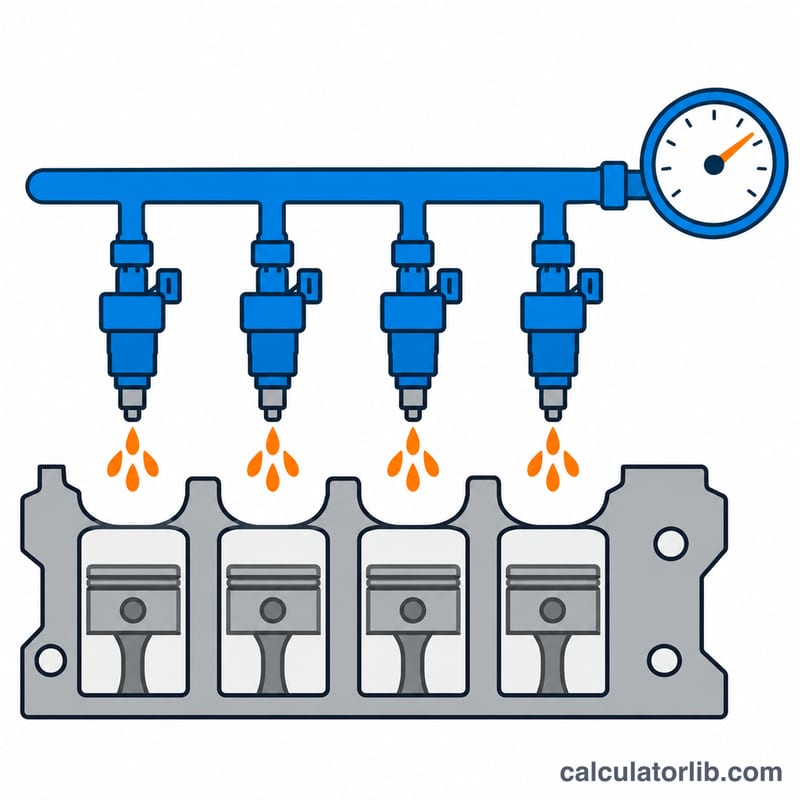
Type the injector size from the manufacturer and choose whether it is in cc/min or lb/hr. Enter how many injectors feed the engine, then pick a BSFC: roughly 0.45 to 0.50 for naturally aspirated gasoline engines and 0.55 to 0.65 for boosted ones. Finally set the max duty cycle; 80% is a common safe limit, and many tuners avoid going above 85%.
The formula explained
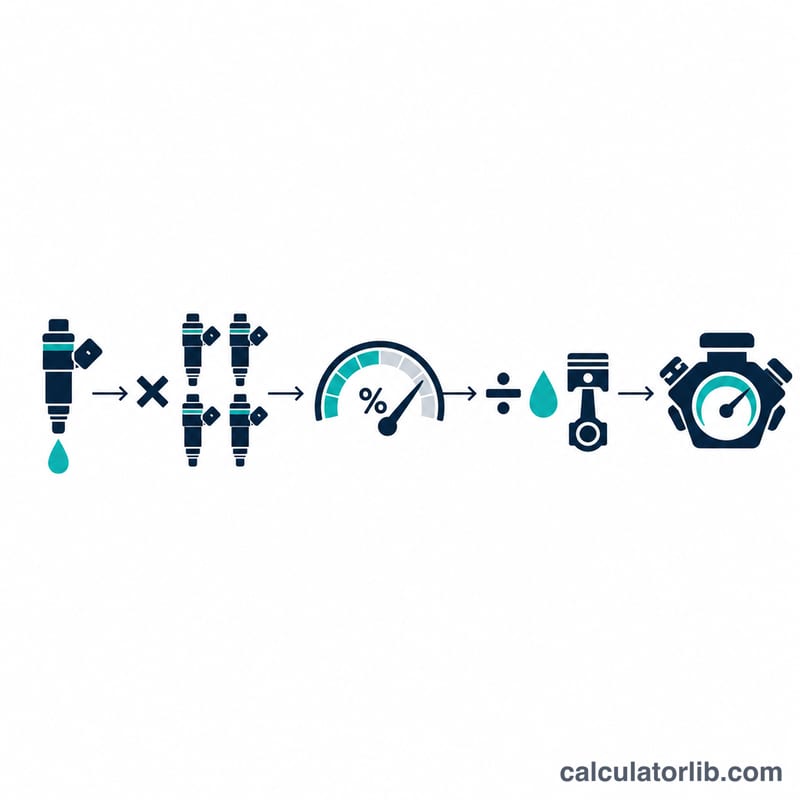
Fuel flow is converted to pounds per hour when needed, scaled by the usable duty cycle, then divided by BSFC, which is the pounds of fuel an engine burns per horsepower per hour.
$$\text{HP} = \frac{ \text{Flow}_{lb/hr} \times N \times DC }{ \text{BSFC} }$$Here \(N\) is the number of injectors and \(DC\) is the duty cycle as a fraction. For gasoline, cc/min is converted with \(\text{lb/hr} = \text{cc/min} \div 10.5\).
Worked example
Four 42 lb/hr injectors, BSFC of 0.50 and an 80% duty cycle:
$$\text{HP} = \frac{42 \times 4 \times 0.80}{0.50} = \frac{134.4}{0.50} = 268.8$$The injectors support about 269 horsepower.
Typical BSFC Values by Engine Type and Fuel
Brake specific fuel consumption (BSFC) is the fuel an engine burns per horsepower per hour, in lb/hp/hr. A higher BSFC means more fuel is needed per horsepower, so the same injectors support less power. The values below are rough approximations. Real numbers vary with engine design, boost level, air/fuel ratio, ignition timing and tune.
| Engine / fuel type | Typical BSFC (lb/hp/hr) |
|---|---|
| Naturally aspirated gasoline | 0.45 – 0.50 |
| Turbocharged / supercharged gasoline | 0.55 – 0.65 |
| E85, naturally aspirated and boosted | 0.75 – 0.85 |
| Diesel | about 0.35 – 0.45 |
When you are unsure, use the more conservative (higher) BSFC for your fuel type. That gives a lower, safer horsepower estimate. Treat the result as an estimate, not a guarantee.
Injector Size vs. Supported Horsepower
Each row uses the calculator's formula at an 80% max duty cycle:
$$\text{HP} = \frac{ \text{flow (lb/hr)} \times N \times 0.80}{\text{BSFC}}$$
Here N is the number of injectors, which equals the cylinder count for a port-injected engine with one injector per cylinder. The cc/min column is the lb/hr rating × 10.5. For example, 8 injectors of 80 lb/hr at BSFC 0.50 give \(80 \times 8 \times 0.80 / 0.50 =\) 1024 HP.
| Injector (lb/hr) | cc/min | BSFC 0.50 (HP) | BSFC 0.60 (HP) | ||||
|---|---|---|---|---|---|---|---|
| 4 cyl | 6 cyl | 8 cyl | 4 cyl | 6 cyl | 8 cyl | ||
| 30 | 315 | 192 | 288 | 384 | 160 | 240 | 320 |
| 42 | 441 | 268.8 | 403.2 | 537.6 | 224 | 336 | 448 |
| 50 | 525 | 320 | 480 | 640 | 266.7 | 400 | 533.3 |
| 60 | 630 | 384 | 576 | 768 | 320 | 480 | 640 |
| 80 | 840 | 512 | 768 | 1024 | 426.7 | 640 | 853.3 |
These are crank-horsepower estimates of what the fuel system can support at the stated duty cycle and BSFC. They do not predict what your engine will actually make. Fuel pressure, fuel type and injector characteristics also matter.
cc/min to lb/hr Injector Conversion
Injector ratings are given in either cc/min or lb/hr. To convert, divide the cc/min rating by 10.5: \(\text{lb/hr} = \text{cc/min} \div 10.5\). To go the other way, multiply lb/hr by 10.5.
| Rating (cc/min) | Equivalent (lb/hr) |
|---|---|
| 200 | 19.05 |
| 310 | 29.52 |
| 440 | 41.90 |
| 550 | 52.38 |
| 750 | 71.43 |
| 1000 | 95.24 |
| 1650 | 157.14 |
The factor of 10.5 assumes a gasoline density of about 0.72 g/cc. Other fuels such as E85 have a different density, so the cc/min to lb/hr relationship shifts for them. Manufacturers usually rate injectors with a test fluid at a stated fuel pressure (often 3 bar / 43.5 psi), so check the rating basis on your injector's data sheet.
FAQ
Why limit duty cycle to 80%?
Above roughly 80 to 85% the injector has little headroom for changes in pressure, voltage or temperature, and the fuel delivery becomes less linear and consistent.
Does this work for E85?
E85 needs about 30% more fuel, so use a higher BSFC, typically 0.75 to 0.85, and note the cc/min conversion assumes gasoline density.
Is the result flywheel or wheel horsepower?
It is an estimate of crank (flywheel) horsepower. Wheel horsepower will be lower because of drivetrain losses.