What is resistor voltage drop?
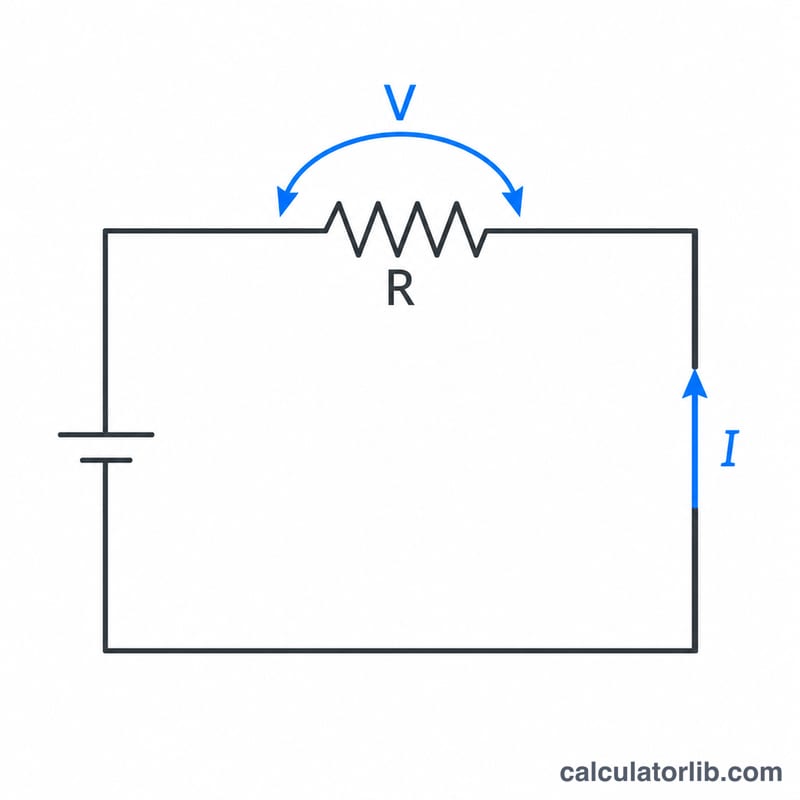
When current flows through a resistor, electrical energy is converted to heat and the electric potential falls from one terminal to the other. That difference is the voltage drop. It is essential when sizing current-limiting resistors for LEDs, designing voltage dividers, or checking that a long wire or shunt does not lose too much voltage.
How to use this calculator
Enter the current flowing through the resistor and pick its unit (A, mA or µA). Then enter the resistance and choose Ω, kΩ or MΩ. The calculator converts everything to base units and returns the voltage drop in volts and millivolts, along with the power dissipated as heat.
The formula explained
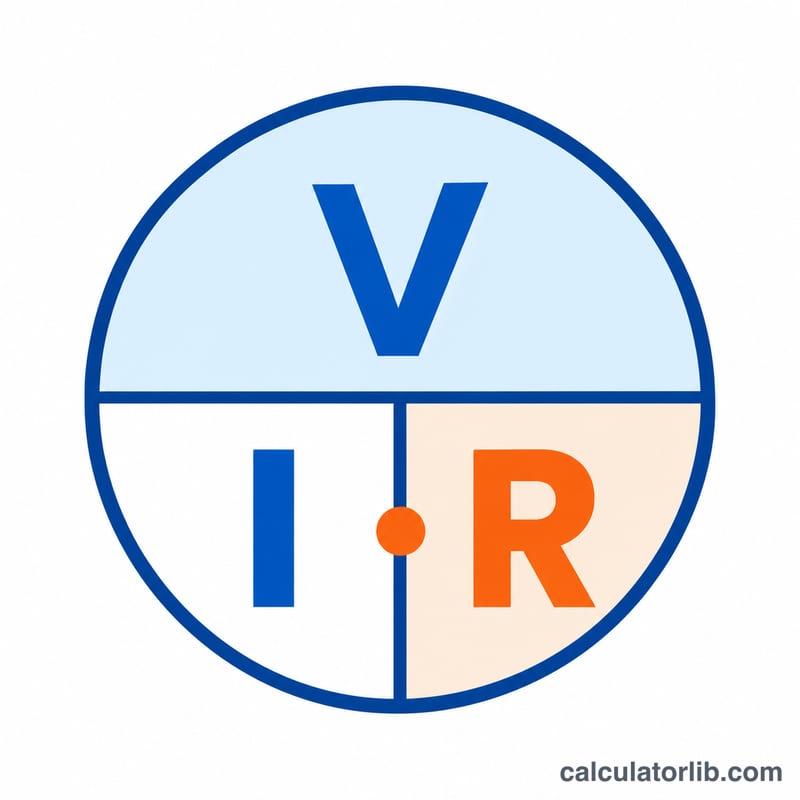
Ohm law states that the voltage drop equals current times resistance:
$$V = I \times R$$Here \(V\) is voltage in volts, \(I\) is current in amperes and \(R\) is resistance in ohms. The power turned into heat is:
$$P = I^{2} \times R$$Check that the resistor power rating exceeds \(P\), ideally with a safety margin of two times.
Worked example
Suppose 10 mA flows through a 4.7 kΩ resistor. Convert to base units: \(I = 0.01\,\text{A}\) and \(R = 4700\,\Omega\).
$$V = 0.01 \times 4700 = 47\,\text{V}$$$$P = 0.01^{2} \times 4700 = 0.47\,\text{W}$$The resistor drops 47 V and dissipates 0.47 W, so a 1 W part would be a sensible choice.
Unit Conversion Table for Current and Resistance
Ohm's law, \(V = I \cdot R\), only gives a correct answer in volts when current is in amperes and resistance is in ohms. The calculator applies these multipliers for you when you pick a unit.
| Quantity | Unit | Equivalent |
|---|---|---|
| Current | 1 A | 1000 mA = 1,000,000 µA |
| Current | 1 mA | 0.001 A = 1000 µA |
| Current | 1 µA | 0.000001 A = 0.001 mA |
| Resistance | 1 kΩ | 1000 Ω |
| Resistance | 1 MΩ | 1,000,000 Ω = 1000 kΩ |
| Voltage | 1 V | 1000 mV |
| Voltage | 1 mV | 0.001 V |
Quick mixed-unit example: 2 mA through 3.3 kΩ. Convert first: \(I = 2 \times 0.001 = 0.002\ \text{A}\) and \(R = 3.3 \times 1000 = 3300\ \Omega\). Then \(V = 0.002 \times 3300 =\) 6.6 V (6600 mV).
Shortcut: mA × kΩ = V, because the two prefixes (10-3 and 103) cancel.
Standard Resistor Power Ratings
Power dissipated in a resistor is \(P = I^{2} \cdot R\) (equivalently \(V \cdot I\) or \(V^{2}/R\)). It must stay below the resistor's rated power. The table lists common ratings; exact values vary by manufacturer and series, so check the datasheet.
| Rating | Watts | Typical form |
|---|---|---|
| 1/16 W | 0.0625 W | SMD 0402 |
| 1/10 W | 0.1 W | SMD 0603 |
| 1/8 W | 0.125 W | SMD 0805; small through-hole |
| 1/4 W | 0.25 W | SMD 1206; the most common through-hole size |
| 1/2 W | 0.5 W | Larger through-hole |
| 1 W | 1 W | Through-hole / power SMD |
| 2 W | 2 W | Through-hole / wirewound |
| 5 W | 5 W | Wirewound or ceramic power resistor |
- 2× derating rule: as a common rule of thumb, choose a resistor rated at least twice the calculated dissipation. For example, a calculated 0.12 W calls for a 1/4 W part or larger.
- Temperature: ratings are normally specified at about 70 °C ambient. At higher ambient temperatures the allowed power falls (derating curves typically reduce it to zero at the maximum rated temperature), so enclosed or hot environments need more margin.
- Resistors also have a maximum working voltage, which can limit a high-value resistor before its power rating does.
More Worked Examples
Example 1: LED current-limiting resistor
An LED is driven at 20 mA through a 150 Ω series resistor.
- Convert to base units: \(I = 20 \times 0.001 = 0.02\ \text{A}\); \(R = 150 \times 1 = 150\ \Omega\).
- Voltage drop: \(V = I \cdot R = 0.02 \times 150 =\) 3 V.
- Power: \(P = I^{2} \cdot R = 0.02^{2} \times 150 = 0.0004 \times 150 = 0.06\ \text{W}\). Check: \(V \cdot I = 3 \times 0.02 = 0.06\ \text{W}\).
Realistic? Yes. A 3 V drop fits a roughly 5 V supply with an LED dropping about 2 V. At 0.06 W, a 1/4 W resistor has plenty of margin, even with 2× derating (0.12 W < 0.25 W).
Example 2: Microamp-level sensing
A current of 50 µA flows through a 2.2 MΩ resistor.
- Convert to base units: \(I = 50 \times 0.000001 = 5 \times 10^{-5}\ \text{A}\); \(R = 2.2 \times 1{,}000{,}000 = 2.2 \times 10^{6}\ \Omega\).
- Voltage drop: \(V = 5 \times 10^{-5} \times 2.2 \times 10^{6} = 110\ \text{V}\).
- Power: \(P = (5 \times 10^{-5})^{2} \times 2.2 \times 10^{6} = 2.5 \times 10^{-9} \times 2.2 \times 10^{6} = 5.5 \times 10^{-3}\ \text{W} = 5.5\ \text{mW}\). Check: \(110 \times 5 \times 10^{-5} = 5.5\ \text{mW}\).
Realistic? The power is tiny, so heating is no concern. The 110 V drop, however, is high for a sensing circuit and may exceed the maximum working voltage of small SMD resistors (often tens to a few hundred volts, depending on size and series). Check the datasheet, or split the value across several resistors in series. In practice, a megohm-range sense resistor usually sees much smaller currents or voltages.
FAQ
Does the voltage drop depend on the supply voltage?
Only indirectly. The drop depends on the current and resistance; the supply voltage and the rest of the circuit determine what current flows.
What if I know the voltage and resistance instead?
Rearrange to \(I = V / R\) to find the current, then use this tool to verify the drop.
Does this work for AC?
For an ideal resistor, yes, if you use RMS current to get the RMS voltage drop. Reactive components need impedance instead.