What is sound power level?
Sound power level describes how much acoustic energy a source emits, in decibels relative to a reference power of one picowatt. Unlike sound pressure level, which changes with distance and room conditions, sound power is an intrinsic property of the source. This is why machinery and appliance noise ratings are quoted as sound power levels.
How to use the calculator
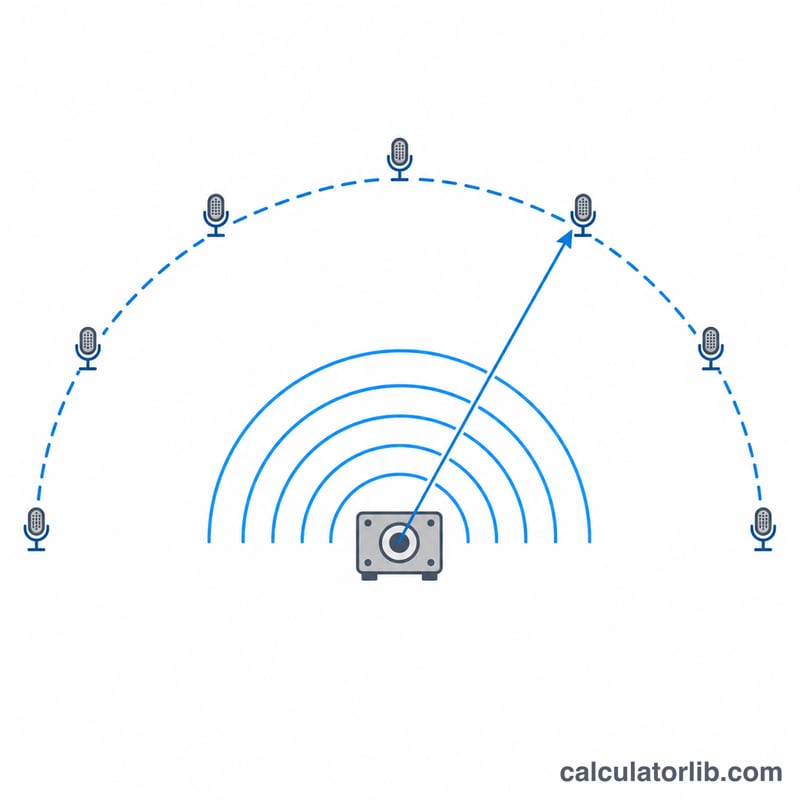
Enter the average sound pressure level over your measurement surface in dB, then the area of that surface and its unit (square metres or square feet). The calculator returns the sound power level, the acoustic power in watts, and the sound intensity. It assumes the sound pressure level is averaged over a surface that encloses the source, in free-field conditions.
The formula explained
The sound power level follows from the pressure level and the surface area:
$$L_W = L_p + 10\log_{10}\left(\frac{S}{S_0}\right)$$Here \(L_p\) is the average sound pressure level in dB, \(S\) is the radiating surface area in m², and \(S_0 = 1\,\text{m}^2\). The power in watts is:
$$W = W_0 \times 10^{L_W/10}, \quad W_0 = 10^{-12}\,\text{W}$$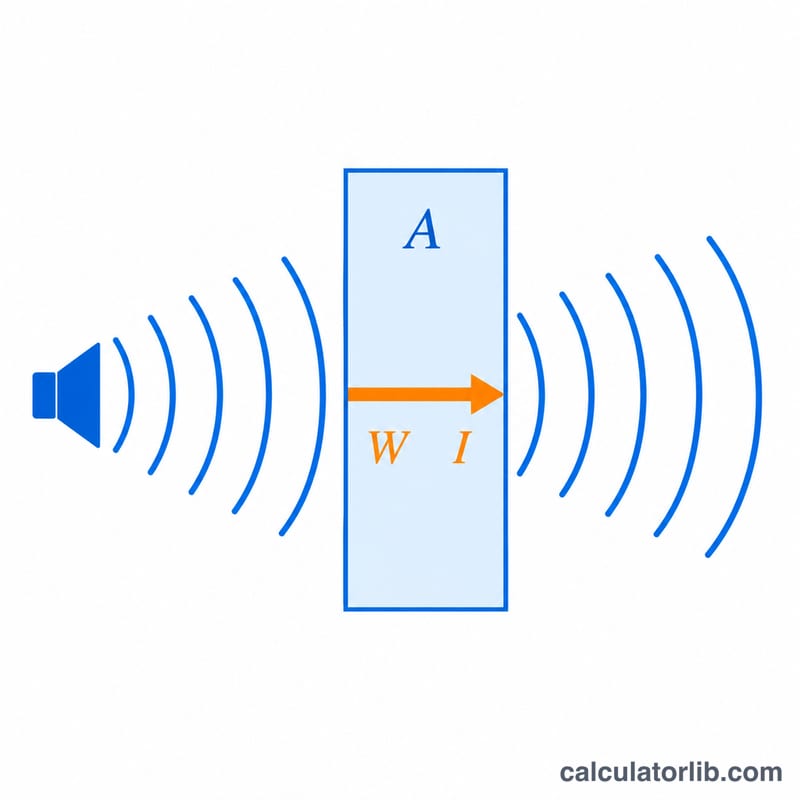
Worked example
Suppose the average sound pressure level is 80 dB over a surface of 10 m².
$$L_W = 80 + 10\log_{10}(10) = 90\,\text{dB}$$$$W = 10^{-12} \times 10^{9} = 10^{-3}\,\text{W} = 1\,\text{mW}$$The source radiates about one milliwatt of acoustic power.
Typical Sound Power Levels of Common Sources
The table lists approximate sound power levels \(L_W\) (dB re 1 pW) for common sources, with the equivalent acoustic power from \(W = 10^{-12}\cdot 10^{L_W/10}\). The values are typical ranges, not exact. Real sources vary widely with model, load and operating conditions.
| Source | Typical \(L_W\) (dB re 1 pW) | Approx. acoustic power |
|---|---|---|
| Whisper / quiet conversation | 50–60 dB | 0.1–1 µW |
| Normal speech | 65–70 dB | about 3–10 µW |
| Vacuum cleaner | 75–85 dB | about 30–300 µW |
| Lawn mower | 90–100 dB | about 1–10 mW |
| Chainsaw | about 110 dB | about 0.1 W |
| Jet engine (large, at high thrust) | 140–150 dB | about 100–1000 W |
Every +10 dB multiplies acoustic power by 10, and every +3 dB roughly doubles it. Acoustic power is only a tiny fraction of a machine's mechanical or electrical power.
Square Feet to Square Metres Conversion
The calculator works in square metres internally. Conversion factors: 1 ft² = 0.092903 m² and 1 m² = 10.7639 ft².
| Area (ft²) | Area (m²) |
|---|---|
| 1 | 0.0929 |
| 5 | 0.4645 |
| 10 | 0.9290 |
| 50 | 4.6452 |
| 100 | 9.2903 |
The area correction term \(10\log_{10}(S)\) is added to the average sound pressure level \(L_p\) to give \(L_W\):
| Area S (m²) | \(10\log_{10}(S)\) (dB) |
|---|---|
| 1 | 0 |
| 2 | 3.01 |
| 10 | 10 |
| 100 | 20 |
Example: an average \(L_p = 70\) dB over a 10 m² surface gives \(L_W = 70 + 10\log_{10}(10) = 70 + 10 = \) 80 dB re 1 pW.
Reference Constants Used
| Quantity | Symbol | Value |
|---|---|---|
| Reference sound power | \(W_0\) | \(10^{-12}\) W (1 pW) |
| Reference area | \(S_0\) | 1 m² |
| Reference sound pressure (air) | \(p_0\) | 20 µPa |
| Reference sound intensity | \(I_0\) | \(10^{-12}\) W/m² |
These are the standard acoustic reference values used in ISO 80000-8 and in sound power measurement standards such as the ISO 3744 family. Sound power levels computed with other references, for example in water, are not comparable with these values.
The formula \(L_W = L_p + 10\log_{10}(S/S_0)\) assumes \(L_p\) is the surface-averaged sound pressure level over a measurement surface of area S. It also assumes negligible background noise and reflections, which is approximately the condition ISO 3744 targets.
FAQ
What is the difference between sound power and sound pressure?
Sound pressure is what a microphone or ear measures at one location and depends on distance and surroundings. Sound power is the total energy output of the source and does not depend on where you measure.
Why does a larger area increase the power level?
The same pressure level spread over a bigger surface means more total energy is passing through it, so the source must be radiating more power.
Is the result exact in a normal room?
No. The formula assumes free-field conditions with no reflections. In reverberant rooms, corrections are required, and standardized methods such as ISO 3744 should be followed for certified values.