What is a multi-pallet freight class calculator?
LTL carriers in the United States price shipments by NMFC freight class, from 50 to 500. For many general commodities the class is driven mainly by density: how many pounds the freight weighs per cubic foot of space it occupies. This calculator combines several pallet lines with different sizes and weights into one shipment density and returns the matching class. It uses US units (inches and pounds) and a common density-to-class table.
How to use it
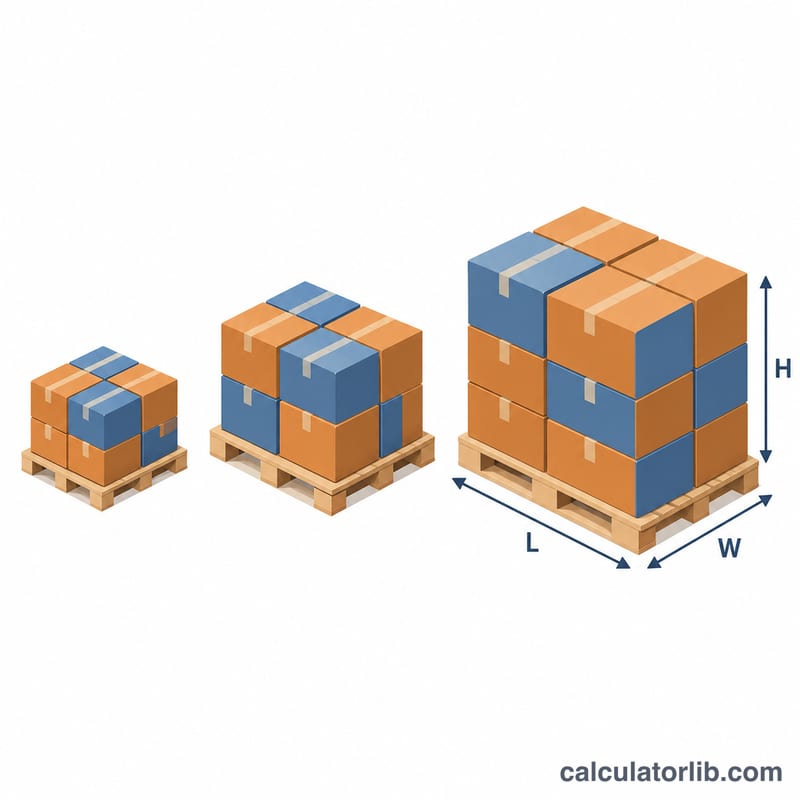
For each pallet line enter the quantity, length, width, height (inches, including any overhang) and the weight of one pallet in pounds. Leave unused lines blank. The calculator adds up all the volume and weight, computes the density and shows the class.
The formula
Volume in cubic feet comes from cubic inches divided by 1,728. Density is total weight over total volume:
$$D = \frac{\sum n_i W_i}{\sum n_i L_i w_i h_i / 1728}$$Here \(n_i\) is the quantity on line \(i\), \(W_i\) is the weight of one pallet, and \(L_i, w_i, h_i\) are its dimensions in inches. The density is then matched to a class: for example 9 to 10.5 lb/ft³ is class 100, 15 to 22.5 is class 70, and 6 to 7 is class 150.
Worked example
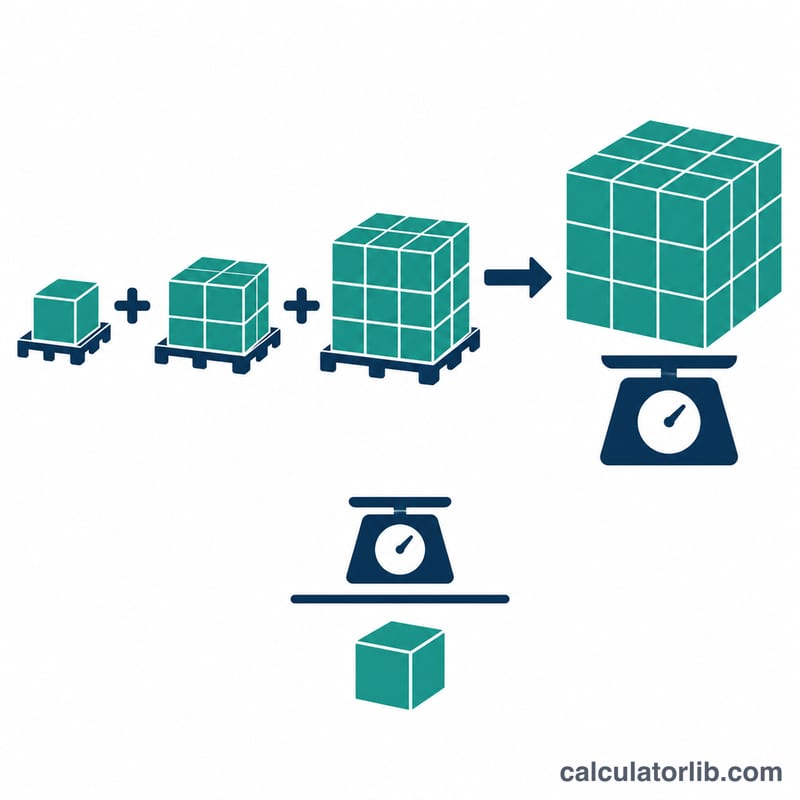
Two identical pallets of 48 × 40 × 48 in at 500 lb each, plus one pallet of 48 × 48 × 60 in at 800 lb:
$$V = \frac{2 \times 92160 + 138240}{1728} = 186.67\,\text{ft}^3$$$$D = \frac{1000 + 800}{186.67} = 9.64\,\text{lb/ft}^3$$A density of 9.64 falls in the 9 to 10.5 band, so the estimated class is 100.
Density-to-Freight-Class Table
This table shows the commonly used density-based guideline bands for LTL freight in North America under the NMFC (National Motor Freight Classification) system, which is published by the Commercial Freight Classification Association. Density is calculated as total weight in pounds divided by total volume in cubic feet (\(\text{cubic inches} \div 1728\)). Values are given in lb/ft³.
| Density (lb/ft³) | Freight Class |
|---|---|
| Under 1 | 500 |
| 1 to under 2 | 400 |
| 2 to under 3 | 300 |
| 3 to under 4 | 250 |
| 4 to under 5 | 200 |
| 5 to under 6 | 175 |
| 6 to under 7 | 150 |
| 7 to under 8 | 125 |
| 8 to under 9 | 110 |
| 9 to under 10.5 | 100 |
| 10.5 to under 12 | 92.5 |
| 12 to under 13.5 | 85 |
| 13.5 to under 15 | 77.5 |
| 15 to under 22.5 | 70 |
| 22.5 to under 30 | 65 |
| 30 to under 35 | 60 |
| 35 to under 50 | 55 |
| 50 or more | 50 |
Important: these are common density-based guideline bands, not a universal rule for every commodity. Many items have their own NMFC item number with a specific class (or density-based tiers), and the item-specific class in the NMFC governs over any generic density table. Factors such as stowability, handling and liability can also affect the class.
Interpreting Your Freight Class Result
The calculator adds up quantity × weight and quantity × length × width × height across all pallet lines, then divides total weight by total cubic feet to get one combined density. That density is matched to the class bands above.
- Lower density means a higher class number. Light, bulky freight takes up more truck space per pound, so it is assigned a higher class (for example 300 or 400), which generally carries a higher LTL rate per hundredweight (cwt).
- Higher density means a lower class number. Compact, heavy freight is assigned a lower class (for example 55 or 70), which generally carries a lower rate per cwt.
- The result is an estimate. It is based on density only. The carrier applies NMFC item rules and may inspect, re-weigh and re-measure the shipment, then reclassify it and issue a corrected invoice if the declared class does not match.
- Band edges matter. If your density falls close to a boundary (for example 7.9 vs. 8.0 lb/ft³), small measurement or weight differences can move the class up or down. Measure carefully and check the result against your carrier's tariff.
- Overhang and added dimensions lower density. Carriers measure each piece at its widest, longest and tallest points, including pallet, overhang, and any packaging or stretch-wrap bulges. Extra length, width or height increases the cubic volume without adding weight, which lowers density and can push the shipment into a higher class. Keep freight within the pallet footprint and avoid unnecessary height.
- Mixed pallets are blended. Combining dense and light pallets yields one average density, which can differ from the class each pallet would receive alone. Some carriers classify by individual line item instead, so confirm how your carrier handles multi-pallet shipments.
This is general information; confirm the final class with your carrier or the current NMFC.
FAQ
Is this the official class my carrier will use?
No. It is an estimate. The carrier applies the NMFC item rules, which also weigh stowability, handling and liability, and may reclassify after inspection.
Should I measure the pallet or just the boxes?
Measure the full footprint and height of the loaded pallet at its widest, tallest points, since carriers charge for the space occupied.
Can pallets be shipped in more than one class?
Different commodities may carry different classes, but this tool treats the whole shipment as a single combined density, which is typical for a mixed load on one bill of lading estimate.