What is the Freight Shipping Cost Calculator?
The Freight Shipping Cost Calculator gives you a fast, transparent estimate of what it costs to move a freight shipment. It combines the three factors carriers weigh most heavily — the weight of the goods, the distance they travel, and the freight class that reflects how easy the cargo is to handle and store. The result is a working estimate you can use to budget a shipment or compare options before requesting a formal carrier quote.
How to use it
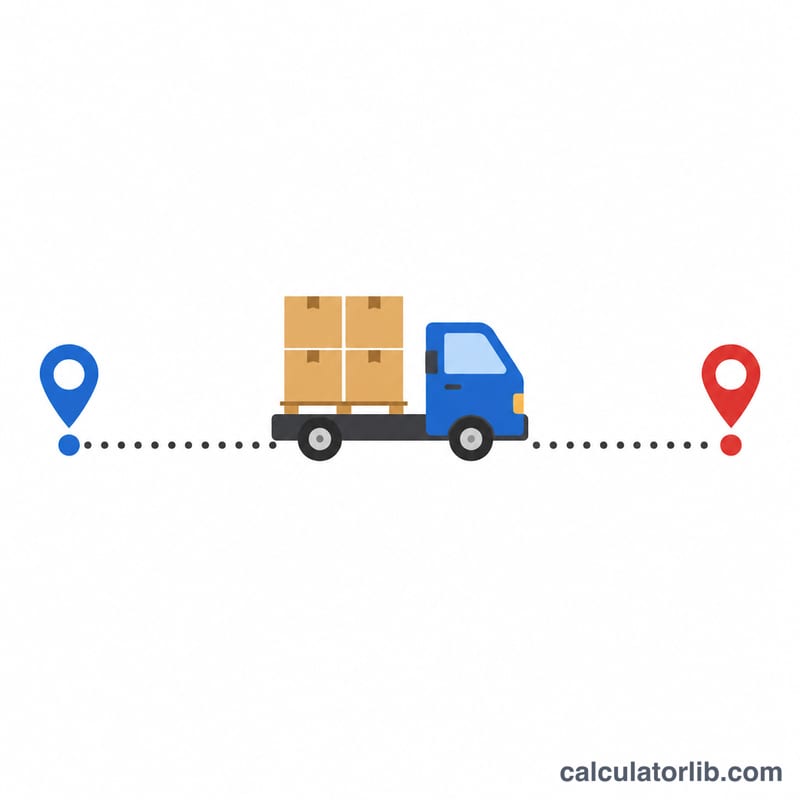
Enter the shipment weight in kilograms, the shipping distance in kilometers, and select the freight class that best matches your goods. Dense, compact cargo (like Class 50) is cheapest to move, while light, bulky cargo (like Class 400) costs more per unit of weight because it fills trailer space quickly. Press calculate to see the base fee, the freight charge, and the combined total.
The formula explained
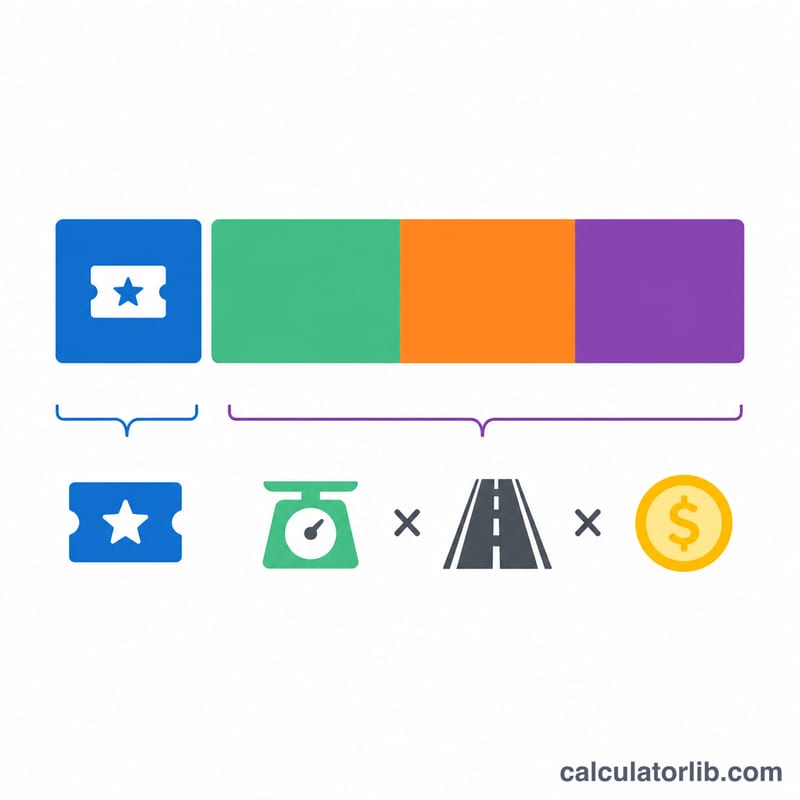
The estimate uses a flat handling fee plus a variable freight charge:
$$\text{Cost} = \text{Base} + (W \times D \times r \times m)$$Here \(W\) = weight in kg, \(D\) = distance in km, \(r\) = the base rate of \(0.0004\) per kg-km, and \(m\) = the freight class multiplier (ranging from \(1.0\) for Class 50 to \(3.0\) for Class 400). The base fee \(\text{Base} = \$30\) covers pickup and documentation.
Worked example
Suppose you ship \(500\) kg over \(1000\) km at Class 100 (multiplier \(1.3\)). The freight charge is:
$$500 \times 1000 \times 0.0004 \times 1.3 = \$260$$Adding the base fee gives a total of \(\$30 + \$260 = \$290\).
Freight Class Multipliers
Freight class is defined by the US National Motor Freight Classification (NMFC), maintained by the National Motor Freight Traffic Association (NMFTA). It is a United States standard; other countries do not use these class numbers. Class is driven mainly by density (weight per cubic foot), along with stowability, handling and liability — lower, denser freight earns a low class, while light, bulky or fragile freight earns a high class.
This calculator applies a class multiplier \(m\) in its cost model \(\text{Cost} = \text{Base} + (W \times D \times r \times m)\), scaling from \(m = 1.0\) at Class 50 up to \(m = 3.0\) at Class 400. The multiplier values below are specific to this calculator; the density ranges follow the commonly published NMFC density guideline. This tool's form accepts the classes 50, 100, 150, 250 and 400 — for an in-between class, choose the nearest available value.
| Freight class | Multiplier \(m\) | Typical density (lb/ft³) | Typical commodities / handling |
|---|---|---|---|
| 50 | 1.0 | over 50 | Very dense, durable, easy to stow (e.g. sand, bricks, nuts & bolts) |
| 55 | 1.1 | 35–50 | Bricks, cement, hardwood flooring |
| 60 | 1.15 | 30–35 | Car accessories, steel cabling |
| 65 | 1.2 | 22.5–30 | Car parts, bottled beverages, books |
| 70 | 1.25 | 15–22.5 | Auto engines, packaged food |
| 77.5 | 1.3 | 13.5–15 | Tires, bathroom fixtures |
| 85 | 1.35 | 12–13.5 | Crated machinery, cast-iron stoves |
| 92.5 | 1.45 | 10.5–12 | Computers, monitors, refrigerators |
| 100 | 1.5 | 9–10.5 | Boat covers, canvas, cased wine |
| 110 | 1.6 | 8–9 | Cabinets, framed artwork |
| 125 | 1.7 | 7–8 | Small household appliances |
| 150 | 2.0 | 6–7 | Auto sheet metal, bookcases |
| 175 | 2.15 | 5–6 | Clothing, upholstered furniture |
| 200 | 2.3 | 4–5 | Mattresses, aircraft parts |
| 250 | 2.5 | 3–4 | Bamboo furniture, flat-panel TVs |
| 300 | 2.75 | 2–3 | Wood cabinets, tables, model boats |
| 400 | 3.0 | 1–2 | Very light, bulky, hard-to-handle goods (e.g. deer antlers) |
Higher classes cost more per pound because low-density freight consumes trailer space out of proportion to its weight, so carriers price it up through the multiplier.
Unit Conversions (lb/mi to kg/km)
This calculator expects weight in pounds (lb) and distance in miles (mi), the customary units for US domestic LTL freight. If your shipping documents use metric units, convert them first. The four exact factors used here are:
| Convert from | To | Multiply by |
|---|---|---|
| Pounds (lb) | Kilograms (kg) | 0.4536 |
| Kilograms (kg) | Pounds (lb) | 2.2046 |
| Miles (mi) | Kilometers (km) | 1.6093 |
| Kilometers (km) | Miles (mi) | 0.6214 |
Formally, \(1\ \text{lb} = 0.4536\ \text{kg}\), \(1\ \text{kg} = 2.2046\ \text{lb}\), \(1\ \text{mi} = 1.6093\ \text{km}\) and \(1\ \text{km} = 0.6214\ \text{mi}\). Worked single-unit conversions:
- 1,500 lb to kg: \(1500 \times 0.4536 = 680.4\ \text{kg}\)
- 680.4 kg back to lb: \(680.4 \times 2.2046 = 1500.0\ \text{lb}\)
- 600 mi to km: \(600 \times 1.6093 = 965.58\ \text{km}\)
- 965.58 km back to mi: \(965.58 \times 0.6214 = 599.97\ \text{mi}\)
Example — converting a metric shipment before entering it. Suppose a quote lists a load of 500 kg moving 800 km, but you need lb and mi for the form:
$$W = 500\ \text{kg} \times 2.2046 = 1102.3\ \text{lb}$$
$$D = 800\ \text{km} \times 0.6214 = 497.12\ \text{mi}$$
Enter weight = 1102.3 and distance = 497.12, then pick the appropriate freight class. Rounding to the nearest whole pound and mile (1,102 lb and 497 mi) is fine for an estimate, since LTL carriers bill on rounded weight brackets anyway.
FAQ
Is this an exact carrier quote? No. It is a planning estimate; actual rates vary by carrier, fuel surcharges, and accessorial fees.
Why does freight class matter? Class reflects density and handling difficulty. Lower classes are denser and cheaper to ship per kilogram.
Can I use pounds and miles? The model expects kilograms and kilometers; convert your values first for an accurate estimate.