What is the Container CBM Calculator?
CBM stands for cubic meter, the standard volume unit used in international freight and container loading. This calculator converts the length, width and height of a carton (in centimeters) plus the number of cartons into total cubic meters, so you can estimate how much container space your cargo needs and compare freight quotes.
The formula explained
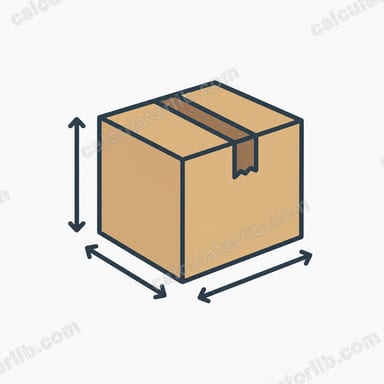
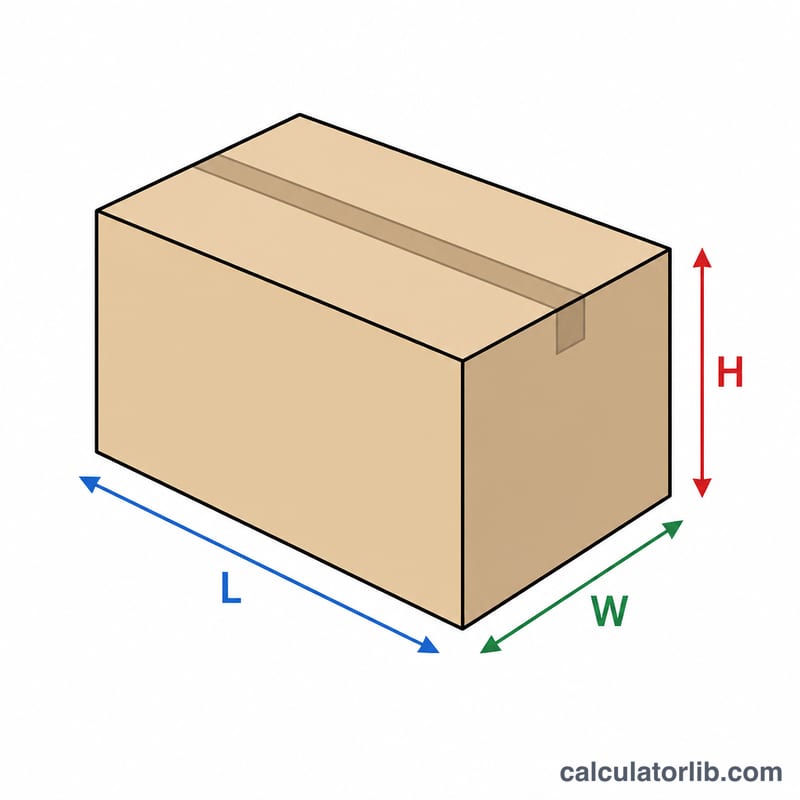
Volume is length times width times height. Because the dimensions are in centimeters, we divide by \(1{,}000{,}000\) to convert cubic centimeters to cubic meters, then multiply by the quantity \(Q\):
$$\text{CBM} = \frac{L \times W \times H}{1{,}000{,}000} \times Q$$Here \(L\), \(W\) and \(H\) are the carton length, width and height in centimeters, and \(Q\) is the number of identical cartons.
How to use it
Measure one representative carton in centimeters, enter its length, width and height, and type how many cartons you are shipping. The tool shows the CBM per carton and the total shipment volume. Compare the total against typical container capacities (about 28 CBM for a 20 ft and 58 CBM for a 40 ft container) to plan loading.
Worked example
A carton measuring 120 cm by 80 cm by 100 cm, shipped as 10 cartons:
$$\text{CBM}_{unit} = \frac{120 \times 80 \times 100}{1{,}000{,}000} = 0.96\ \text{m}^3$$$$\text{CBM}_{total} = 0.96 \times 10 = 9.6\ \text{m}^3$$So the shipment occupies \(9.6\) cubic meters.
Standard Container Capacities
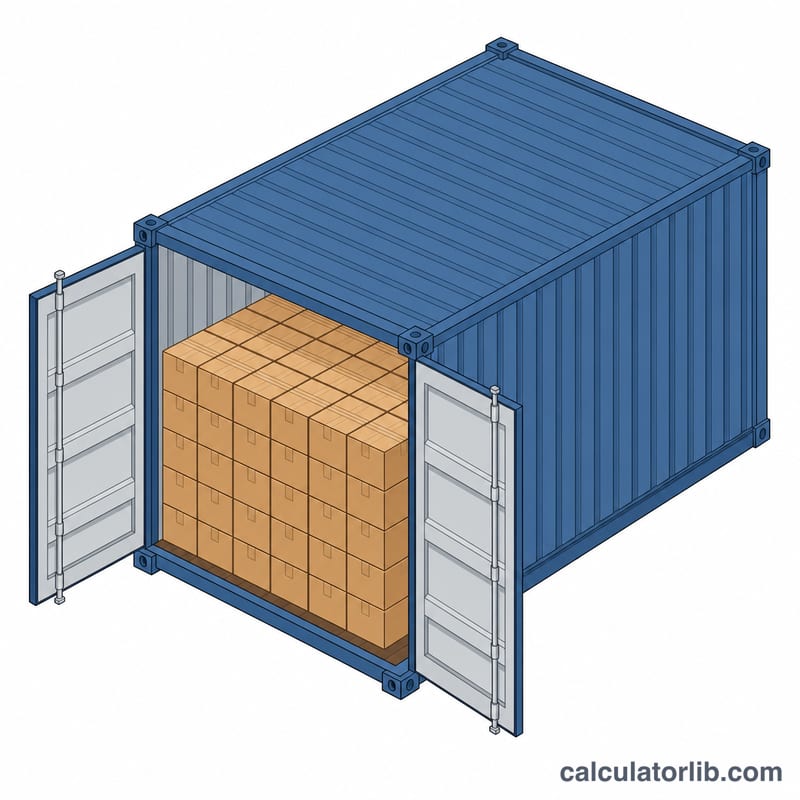
The table below lists internal volumes and realistic usable (loadable) capacities for common ISO ocean shipping containers, along with typical maximum payload and internal dimensions. All figures are approximate: exact values vary by manufacturer, container age, and build, so always confirm against the specific unit's CSC plate or the carrier's specification.
| Container type | Internal volume (m³) | Usable capacity (CBM) | Typical max payload | Internal L × W × H (approx.) |
|---|---|---|---|---|
| 20 ft standard | ~33 m³ | ~28 CBM | ~28,000 kg | 5.90 × 2.35 × 2.39 m |
| 40 ft standard | ~67 m³ | ~58 CBM | ~26,500–28,800 kg | 12.03 × 2.35 × 2.39 m |
| 40 ft High Cube | ~76 m³ | ~68 CBM | ~28,500 kg | 12.03 × 2.35 × 2.69 m |
The gap between internal volume and usable CBM reflects space lost to packing, so plan cargo against the usable figure rather than the raw internal volume.
FAQ
What units should I use? Enter dimensions in centimeters; the result is in cubic meters. To use meters directly, multiply your meter figures accordingly or remove the conversion.
Does CBM include container empty space? No. CBM measures the cargo volume only. Real loading efficiency is usually 80-90 percent because of stacking gaps and pallet spacing.
How is chargeable weight related? Freight carriers often compare CBM-based volumetric weight with actual weight and charge the greater of the two.