What is the Anchor Rope Length Calculator?
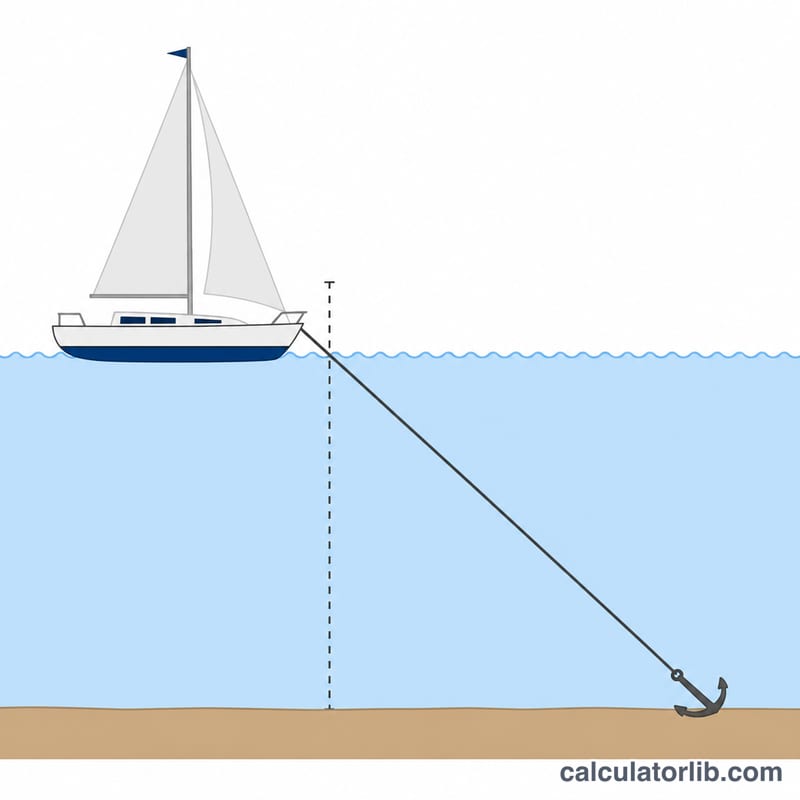
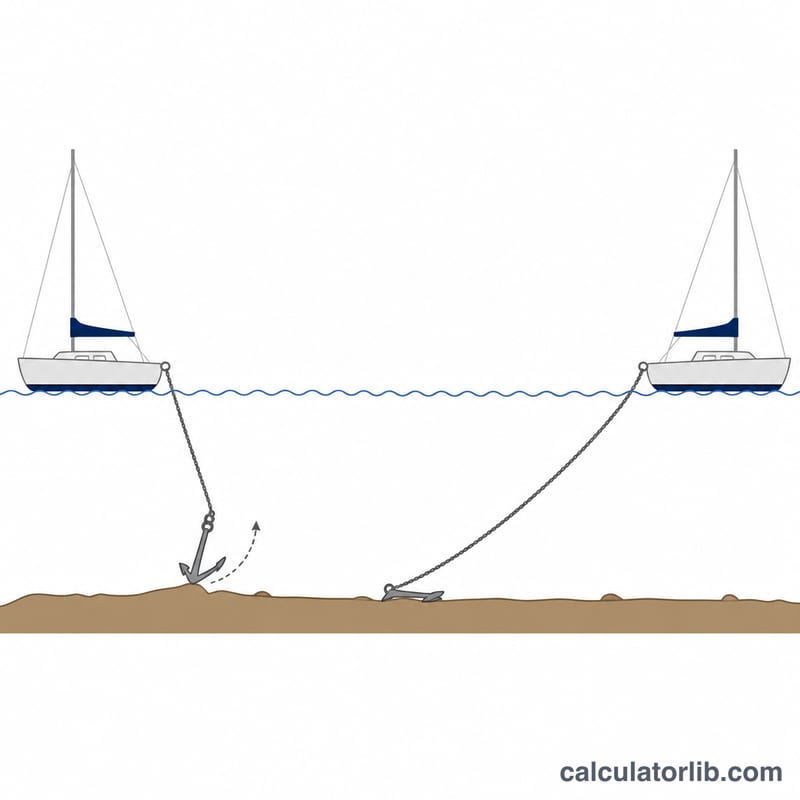
The Anchor Rope Length Calculator tells you how much anchor rode (rope and chain) to let out so your boat holds securely. The amount of rode you deploy is governed by the scope ratio — the ratio between the length of rode paid out and the vertical distance from the seabed to your bow roller. A larger scope lays the rode at a flatter angle, which lets the anchor dig in and hold instead of pulling straight up.
The formula explained
The recommended rode length is:
$$L = (D + H) \times S$$where \(L\) = rode length to deploy, \(D\) = water depth measured from the surface, \(H\) = height of the bow roller above the water, and \(S\) = scope ratio. Adding \(H\) to \(D\) matters because the rode runs from the seabed up to the bow, not just to the waterline. A common all-chain scope is \(5{:}1\), while nylon rode or rough weather calls for \(7{:}1\) or more.
How to use it
Enter the water depth at high tide, the height of your bow roller above the water, and your desired scope ratio. The calculator multiplies the total vertical height by the scope to give the total rode length. Always mark your rode so you can confirm how much you have deployed.
Worked example
Suppose the water depth is \(10\) ft, the bow height is \(2\) ft, and you want a \(7{:}1\) scope:
$$L = (10 + 2) \times 7 = 84\,\text{ft}$$So you would deploy \(84\) feet of rode for a secure set.
Rode Length Across Common Scenarios
The rode length is found with \(L = (D + H) \times S\), where \(D\) is water depth, \(H\) is the height of the bow roller above the water, and \(S\) is the scope ratio. Because depth and bow height always act together, the table below is organized by their sum, the total vertical height \((D + H)\), across four commonly used scope ratios. All values are in feet.
| Total vertical height \((D+H)\) | 4:1 | 5:1 | 7:1 | 10:1 |
|---|---|---|---|---|
| 8 ft | 32 | 40 | 56 | 80 |
| 12 ft | 48 | 60 | 84 | 120 |
| 16 ft | 64 | 80 | 112 | 160 |
| 25 ft | 100 | 125 | 175 | 250 |
Reading across a row shows how much extra rode a larger scope demands: at a 12 ft total height, moving from 5:1 to 7:1 adds 24 ft of rode, and moving to 10:1 doubles the deployed length compared with 5:1. Higher scope lays the pull on the anchor more horizontally, which improves holding but requires both more line in the locker and more swinging room.
Practical Anchoring Recommendations
Use the calculated length as a working minimum, then adjust it for real conditions on the water:
- Round up to the next marked increment. If your rode is marked every 25 ft and the formula gives 60 ft, pay out 75 ft. Rounding up is always the safe direction and makes the deployed length easy to read from the markings.
- Confirm your rode locker actually holds that length. Before relying on a target scope, verify you carry at least that much line and chain. Knowing your total rode length (and its markings) prevents discovering a shortfall after the anchor is already down.
- Increase scope in wind, waves, or poor holding. In calm conditions a lower scope may hold, but as wind and chop build, or over grass, rock, or soft mud, work toward 7:1 to 10:1 so the pull on the anchor stays low and horizontal.
- Recalculate for high-tide depth. Where tides are significant, use the maximum expected depth during your stay for \(D\), not the depth at the moment you anchor, so the scope does not shrink and leave you short as the tide rises.
- Keep a reserve of extra rode. Retain additional line beyond the calculated length for swinging room, for letting out more scope if the wind pipes up overnight, and for re-anchoring if the first set does not hold.
Scope ratios such as 5:1 and 7:1 are widely used rules of thumb rather than a single legal standard; the right value depends on your ground tackle, bottom type, and conditions. This is general anchoring guidance, not a substitute for local knowledge, official charts, or the seamanship judgment of the vessel's skipper.
FAQ
What scope ratio should I use? Use \(5{:}1\) for calm conditions with all-chain rode, and \(7{:}1\) or higher for rope rode or heavy weather.
Should I account for tide? Yes — always calculate depth at the expected high tide so you do not come up short when the water rises.
Does chain change the math? Chain adds catenary weight that improves holding, so all-chain setups can safely use a smaller scope than rope rode.