What This Calculator Does
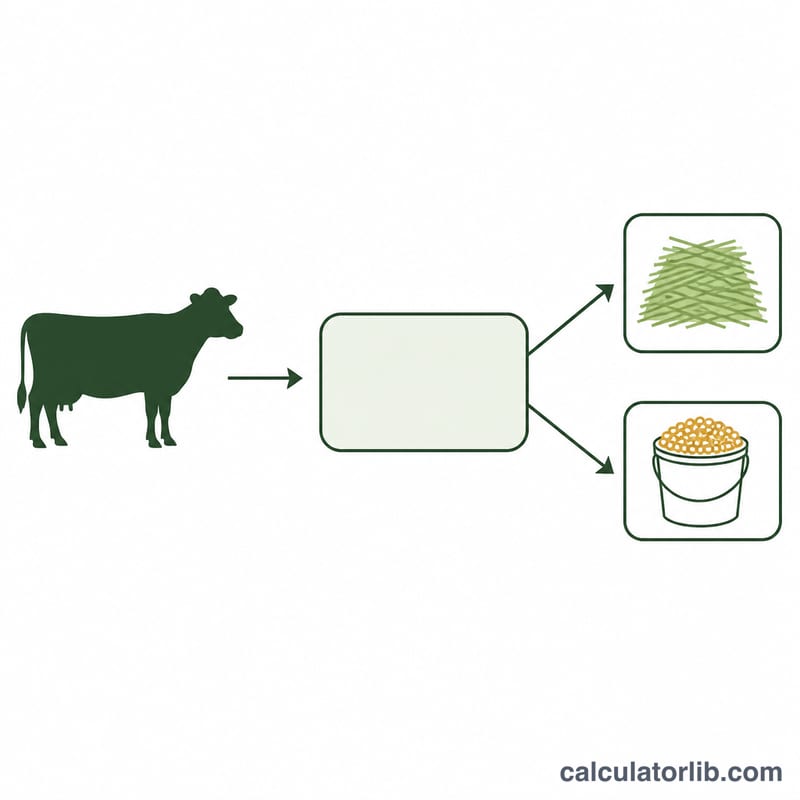
The Livestock Feed Ration Calculator estimates how much feed an animal should eat each day and how that feed should be split between forage (hay, silage, pasture) and concentrate (grain, protein supplements). It is a planning tool for cattle, sheep, goats, and other ruminants where daily intake is commonly expressed as a percentage of body weight on a dry-matter basis.
How To Use It
Enter the animal body weight in kilograms, the target dry matter intake (DMI) as a percentage of body weight, and the forage portion of the ration as a percentage. Typical DMI values range from about 2% to 3.5% of body weight depending on species, production stage, and feed quality. The calculator returns the total daily dry matter and the forage and concentrate amounts.
The Formula Explained
Total daily dry matter intake is body weight \(W\) multiplied by the intake percentage:
$$\text{DMI} = W \times \frac{\text{DMI percent}}{100}$$
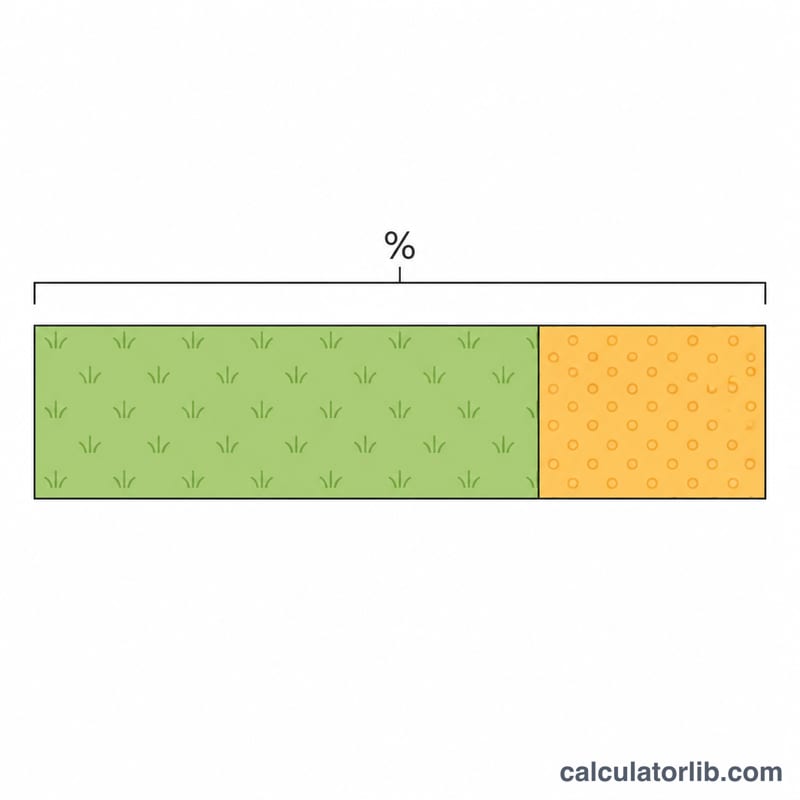
The ration is then split, where the forage share is set by the forage percentage and the concentrate is whatever remains:
$$\text{Forage} = \text{DMI} \times \frac{\text{Forage percent}}{100}, \qquad \text{Concentrate} = \text{DMI} - \text{Forage}$$
Here \(W\) = body weight in kg, DMI percent = target intake as a fraction of body weight, and Forage percent = share of the ration provided as forage.
Worked Example
Consider a 600 kg beef cow at 2.5% DMI with a 60% forage ration:
$$\text{DMI} = 600 \times \frac{2.5}{100} = 15\,\text{kg}$$
$$\text{Forage} = 15 \times \frac{60}{100} = 9\,\text{kg}, \qquad \text{Concentrate} = 15 - 9 = 6\,\text{kg}$$
So the animal needs 15 kg of dry matter per day, made up of 9 kg forage and 6 kg concentrate.
Typical Dry Matter Intake and Forage Ratios by Animal Class
The table gives commonly cited approximate ranges for voluntary dry matter intake (DMI, as a % of body weight on a dry matter basis) and forage share of the ration dry matter. They are consistent in general with the NRC nutrient requirement publications (for example Nutrient Requirements of Beef Cattle, Nutrient Requirements of Dairy Cattle, and Nutrient Requirements of Small Ruminants). Actual values vary with feed quality, forage digestibility, climate, body condition, breed, and production stage, so treat them as starting points and not as targets.
| Animal class | Typical DMI (% of body weight) | Typical forage share (% of ration DM) |
|---|---|---|
| Maintenance beef cow (dry, mid-gestation) | 1.8–2.2% | 90–100% |
| Growing steer / backgrounding | 2.5–3.0% | 50–80% |
| Finishing feedlot cattle | 2.0–2.5% | 8–15% |
| Lactating beef cow | 2.2–2.8% | 85–100% |
| Lactating dairy cow | 3.0–4.0% | 40–60% |
| Dry dairy cow | 1.8–2.2% | 70–100% |
| Sheep | 2.5–3.5% | 70–100% |
| Goats | 3.0–4.0% | 60–100% |
Intake generally falls when forage is high in fiber and low in digestibility, and rises with higher-quality feed. A nutritionist or a ration-balancing program that uses your own feed analysis should confirm any final ration.
Dry Matter to As-Fed Conversion
The calculator reports amounts on a dry matter (DM) basis. Animals are fed fresh (as-fed) material that contains water, so convert each feed with:
$$\text{As-fed amount} = \frac{\text{DM amount}}{\text{DM fraction}}$$
| Feed | Typical dry matter (%) |
|---|---|
| Grass hay | 85–90% |
| Corn silage | 30–35% |
| Haylage (baleage) | 40–60% |
| Fresh pasture | 15–25% |
| Corn grain | about 88% |
| Soybean meal | about 90% |
Example: a ration needs 6 kg DM of corn silage at 35% DM (fraction 0.35). As-fed = \(6 \div 0.35 = 17.14\) kg. For 9 kg DM of grass hay at 88% DM: \(9 \div 0.88 = 10.23\) kg as-fed.
These percentages are typical figures only. Moisture varies widely between lots, cuttings, and weather conditions, so replace them with laboratory analysis of your own feed whenever possible.
Ration Comparison Across Animal Scenarios
Each row applies the formula: DMI = body weight × DMI% ÷ 100, forage = DMI × forage% ÷ 100, concentrate = DMI − forage. All amounts are kg of dry matter per day.
| Scenario | Body weight (kg) | DMI (%) | Forage (%) | Total DM (kg) | Forage (kg) | Concentrate (kg) |
|---|---|---|---|---|---|---|
| Growing calf | 250 | 3.0 | 70 | 7.5 | 5.25 | 2.25 |
| Beef cow | 600 | 2.5 | 60 | 15 | 9 | 6 |
| Lactating dairy cow | 650 | 3.5 | 50 | 22.75 | 11.375 | 11.375 |
| Sheep | 60 | 3.0 | 80 | 1.8 | 1.44 | 0.36 |
Worked check for the dairy cow: \(650 \times 3.5 \div 100 = 22.75\) kg DM; forage \(22.75 \times 50 \div 100 = 11.375\) kg; concentrate \(22.75 - 11.375 = 11.375\) kg. These are illustrative scenarios, not feeding recommendations; real rations should be balanced for energy, protein, minerals, and vitamins with professional guidance.
FAQ
Is this dry matter or as-fed weight? The output is on a dry-matter basis. To convert to as-fed, divide each amount by the feed dry-matter fraction (for example, silage at 35% DM).
What DMI percentage should I use? Around 2% for maintenance, 2.5-3% for growing or lactating animals, and higher for high-producing dairy stock. Always adjust to your own herd data.
Does it guarantee a balanced ration? No. It sizes intake and splits forage versus concentrate, but you should still balance for energy, protein, minerals, and vitamins with a nutritionist.