
What is the Cattle Ration Calculator?
This tool estimates how much feed to deliver to cattle each day. It works from the animal body weight, a target dry matter intake (DMI) expressed as a percentage of body weight, and how the ration is split between forage and concentrate. Because feeds vary in moisture, it also converts the dry matter requirement back into the actual as-fed weight you scoop into the bunk. Results are shown per head and scaled to the whole group.
How to use it
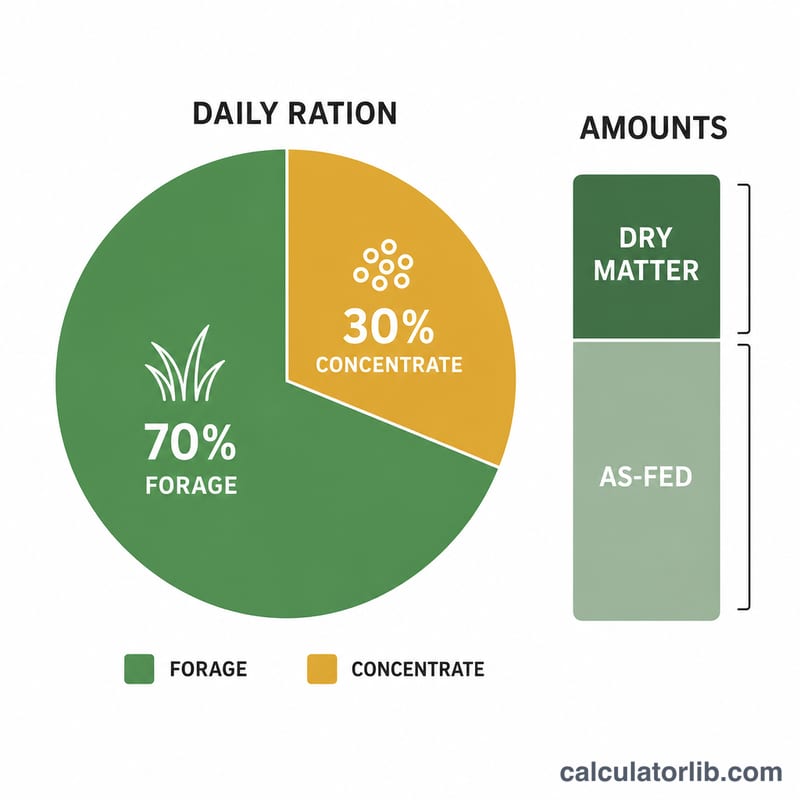
Enter the average animal body weight in pounds, the dry matter intake target (typically 2.0–3.0% of body weight for growing or lactating cattle), the number of head, and the forage share of the ration. Then enter the dry matter content of your forage and concentrate (as a percentage). The calculator returns dry matter and as-fed amounts.
The formula
Dry matter intake per head is the body weight \(W\) times the intake rate \(I\):
$$\text{DMI} = W \times \frac{I}{100}$$That dry matter is split by the forage percentage \(F\), and each portion is converted to as-fed weight using its dry matter content \(DM\):
$$\text{As-fed} = \frac{\text{DMI} \times (F/100)}{DM/100}$$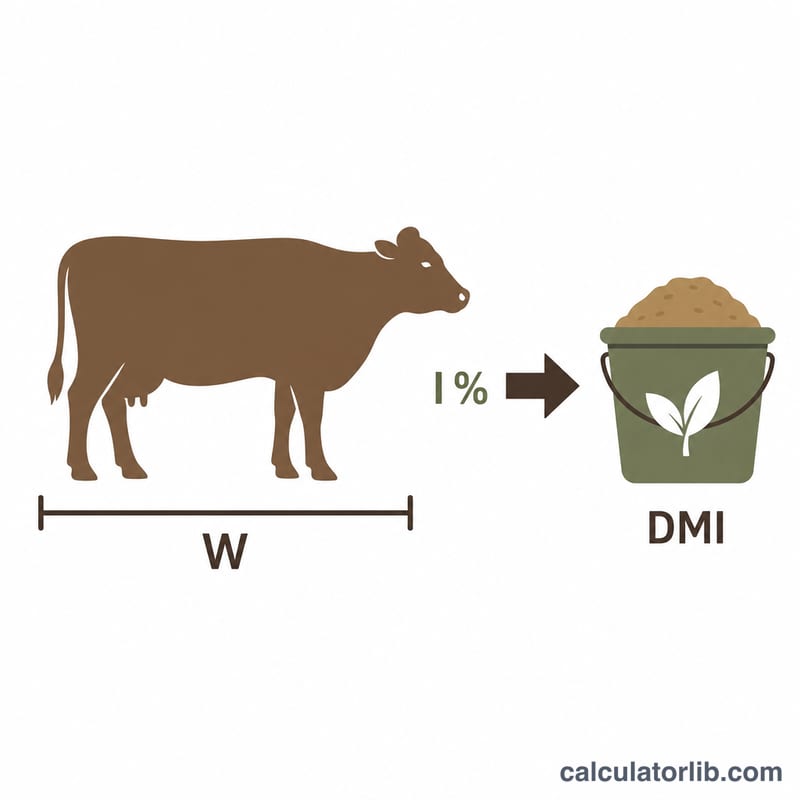
Worked example
A 1200 lb cow eating 2.5% of body weight, on a 60% forage / 40% concentrate ration, with forage at 45% DM and concentrate at 88% DM:
$$\text{DMI} = 1200 \times \frac{2.5}{100} = 30\,\text{lb}$$$$\text{Forage as-fed} = \frac{30 \times 0.60}{0.45} = 40\,\text{lb}$$$$\text{Conc. as-fed} = \frac{30 \times 0.40}{0.88} = 13.64\,\text{lb}$$Total as-fed per head \(= 40 + 13.64 = 53.64\,\text{lb}\) per day.
Typical Dry Matter Intake by Cattle Class
Dry matter intake (DMI) is the amount of feed an animal eats expressed on a moisture-free basis. It is most useful expressed as a percentage of body weight, because larger animals eat more in absolute terms but a fairly predictable fraction of their weight. The values below are typical planning ranges; actual intake varies with feed quality, weather, stage of production, and genetics.
| Cattle Class | DMI (% of body weight) | Notes |
|---|---|---|
| Beef cow, dry (mid-gestation) | 1.8 – 2.2% | Maintenance; lower intake on dormant or low-quality forage |
| Beef cow, lactating | 2.2 – 2.7% | Peak demand early lactation |
| Growing steer/heifer (backgrounding) | 2.5 – 3.0% | High intake relative to weight while growing |
| Finishing steer (feedlot) | 2.0 – 2.5% | Declines as cattle approach finish weight |
| Replacement heifer | 2.2 – 2.6% | Targeted moderate gain (~1.5 lb/day) |
| Dry dairy cow | 1.8 – 2.2% | Controlled intake before calving |
| Lactating dairy cow | 3.5 – 4.0% | Very high; high-producing cows may exceed 4% |
As a worked example, a 1,300 lb lactating beef cow fed at 2.5% of body weight has a dry matter intake of \(1300 \times \frac{2.5}{100} = \)32.5 lb of dry matter per day.
Typical Dry Matter Content of Common Feeds
Because rations are balanced on a dry matter basis but fed on an as-fed (as-received) basis, you must know each feed's dry matter content to convert. As-fed weight is calculated as \(\text{As-Fed} = \frac{\text{Dry Matter Needed}}{\text{DM\%}/100}\). The wetter the feed, the more as-fed pounds are required to deliver the same dry matter.
| Feed | Typical Dry Matter % | Category |
|---|---|---|
| Lush spring pasture | 18 – 25% | Forage |
| Mature/dormant pasture | 40 – 60% | Forage |
| Grass or legume hay | 85 – 90% | Forage |
| Corn silage | 30 – 38% | Forage |
| Haylage (grass/legume silage) | 40 – 55% | Forage |
| Shelled corn grain | 86 – 89% | Concentrate |
| Soybean meal | 88 – 90% | Concentrate |
| Wet distillers grains | 30 – 35% | Concentrate |
| Dried distillers grains (DDGS) | 88 – 90% | Concentrate |
| Total mixed ration (typical) | 45 – 55% | Mixed |
For example, delivering 20 lb of dry matter as corn silage at 34% DM requires \(\frac{20}{0.34} \approx 58.8\) lb as-fed, whereas the same 20 lb of dry matter as hay at 88% DM requires only \(\frac{20}{0.88} \approx 22.7\) lb as-fed.
Practical Feeding Recommendations
- Build in 5–10% for refusal and waste. Cattle sort, trample, and refuse feed, and bunk losses add up. If a group needs 1,000 lb of as-fed daily, plan to deliver roughly 1,050–1,100 lb so every animal can reach its target intake.
- Adjust DMI for cold weather. Below the lower critical temperature, maintenance energy needs rise and cattle eat more. A common rule of thumb is to increase energy intake about 1% for each degree Fahrenheit below the critical temperature; wind and wet hair coats increase the effect further.
- Weigh feed instead of estimating by volume. Hay bales and scoops vary widely in actual weight and moisture. Use a scale or load cells so the dry matter delivered matches the calculated ration rather than guessing by "flakes" or "buckets."
- Monitor body condition score (BCS). Ration math is a starting point, not a guarantee. Score cattle regularly (beef on a 1–9 scale, dairy on a 1–5 scale) and adjust intake percentage up or down if animals are losing or gaining condition.
- Scale up to per-group daily totals for purchasing and storage. Multiply per-head as-fed amounts by head count to size daily, weekly, and seasonal feed needs. For example, a pen of 50 finishing steers each eating about 22 lb of dry matter delivers a group dry matter total of \(22 \times 50 = 1{,}100\) lb per day — use that figure to plan silage face removal rates, hay inventory, and bulk concentrate deliveries.
- Re-test feed dry matter periodically. Silage and haylage moisture drift over a storage season and with weather. Recalculate as-fed amounts when a new lot is opened or when forage looks noticeably wetter or drier.
This is general information for ration planning, not professional nutrition or veterinary advice. For balanced rations meeting specific energy, protein, and mineral requirements, consult a livestock nutritionist or your local extension service.
FAQ
What intake percentage should I use? Beef cows commonly eat 2.0–2.5% of body weight in dry matter; high-producing dairy cows can reach 3.0–4.0%. Use values appropriate to your class of cattle.
Why convert to as-fed? Rations are balanced on a dry matter basis, but feed is weighed wet. Wet forages (silage) need a much larger as-fed weight than the dry matter figure.
Is this a substitute for a nutritionist? No. This estimates quantities; it does not balance protein, energy, or minerals. Consult a nutritionist for a balanced diet.