What is the Drip Irrigation Flow Rate Calculator?
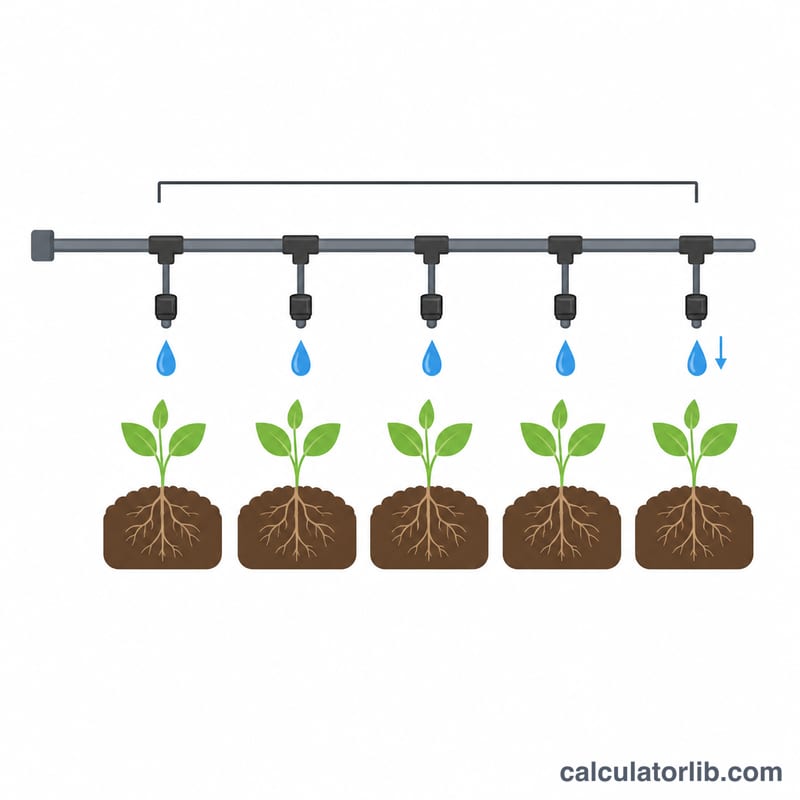
This tool helps gardeners, farmers, and landscapers size a drip irrigation system by turning three simple inputs into two practical numbers: the total flow rate your system delivers and how long you need to run it. Instead of guessing, you get the exact runtime required to apply a target amount of water to your plants or beds.
How to use it
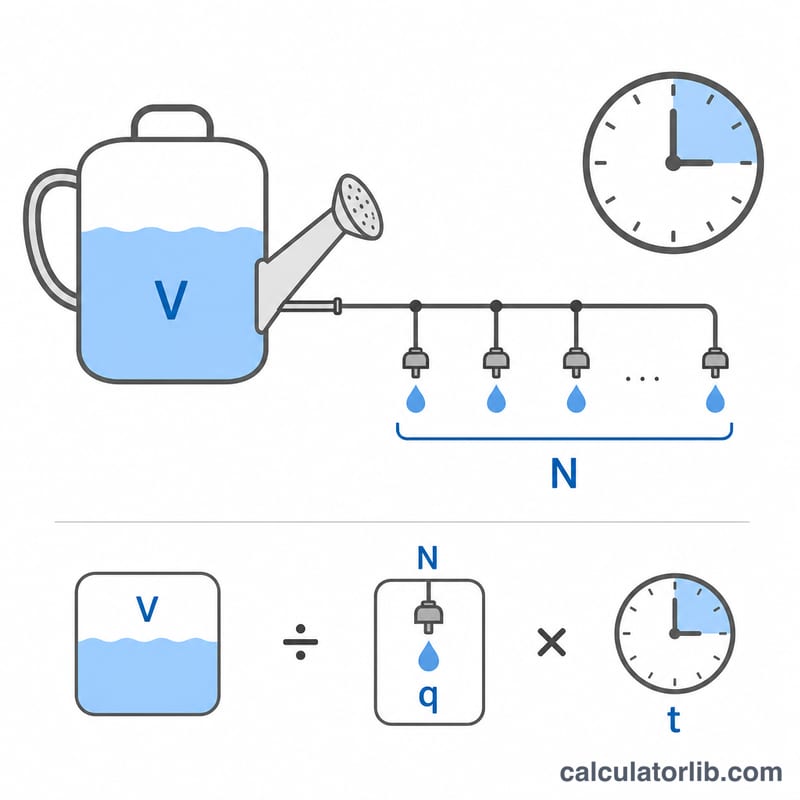
Enter the number of emitters (drippers) on the line, the rated flow of each emitter in liters per hour, and the total volume of water you want to deliver in liters. The calculator returns the combined flow rate and the runtime in both hours and minutes.
The formula explained
The total system flow rate is the sum of every emitter running at once:
$$Q = N \times q$$where \(N\) = number of emitters and \(q\) = flow per emitter in L/h. The runtime needed to deliver a target volume \(V\) (in liters) is:
$$t = \frac{V}{Q} = \frac{V}{N \times q}$$Multiply \(t\) by 60 to convert hours to minutes.
Worked example
Suppose you have 20 emitters, each rated at 4 L/h, and you want to apply 80 liters of water. First find the total flow:
$$Q = 20 \times 4 = 80\,\text{L/h}$$Then the runtime is:
$$t = \frac{80}{80} = 1\,\text{h} = 60\,\text{min}$$So running the zone for one hour delivers exactly 80 liters.
Unit Conversion Reference
Drip irrigation is specified in two common unit systems: US customary (gallons, gallons per hour) and metric (liters, liters per hour). Because the runtime formula \(t = \dfrac{V}{N \times q}\) divides a volume by a flow rate, the target volume \(V\) and the per-emitter flow \(q\) must be expressed in the same system before you compute. The emitter count \(N\) is a pure count and is unitless.
| Quantity | From | To |
|---|---|---|
| Volume | 1 US gallon | 3.785 liters |
| Volume | 1 liter | 0.264 US gallon |
| Flow rate | 1 GPH (gallon/hour) | 3.785 L/h |
| Flow rate | 1 L/h | 0.264 GPH |
Note: 1 US gallon = 3.785 L is the US liquid gallon; the UK (imperial) gallon is larger (about 4.546 L), so confirm which gallon your equipment is rated in. If \(V\) is in liters, use \(q\) in L/h so the runtime \(t\) comes out in hours; if \(V\) is in gallons, use \(q\) in GPH. Mixing systems (for example liters divided by GPH) gives a meaningless result.
Typical Emitter Flow Rates and Watering Amounts
The figures below are typical starting points drawn from general horticultural and university/agricultural extension guidance. They are not fixed rules: the right emitter, spacing, and daily volume depend on your climate, soil type, plant species, root depth, and season. Always adjust based on how your own plants and soil respond.
| Parameter | Common range | Notes |
|---|---|---|
| Point-source emitter rating | 1, 2, 4, and 8 L/h (roughly 0.5–2 GPH for the smaller sizes) | Manufacturers sell fixed discrete ratings; 2 L/h and 4 L/h are widely used for beds and containers. |
| Inline dripper spacing | ~30 cm (12 in) common; often 15–60 cm (6–24 in) | Closer spacing suits sandy soils and closely planted rows; wider spacing suits clay soils that spread water laterally. |
| Per-plant / per-bed daily water | Highly variable — small plants may need well under a liter/day; large shrubs and trees need several liters/day | Extension references generally recommend sizing to the plant's root zone and replacing water lost to evapotranspiration rather than a single universal number. |
Because emitters come in discrete ratings, it is usually easier to fix \(N\) and \(q\) from your hardware and let the calculator solve for runtime \(t\) to deliver your target volume \(V\). Sandy soils drain fast and favor shorter, more frequent cycles; clay soils hold water and favor longer intervals. This is general information — verify against a local extension service or the guidance for your specific crop.
FAQ
What flow rate should each emitter have? Common drip emitters are rated 2 L/h or 4 L/h; check the label or manufacturer spec for your product.
Does water pressure matter? Yes. Pressure-compensating emitters hold their rated flow across a wide pressure range, while non-compensating emitters vary, so the calculated runtime is an estimate for the rated pressure.
Can I use gallons instead of liters? Keep the volume and emitter flow in the same unit system; if both are in gallons and gallons per hour, the runtime result stays correct.