What is the Pallet Loading Calculator?
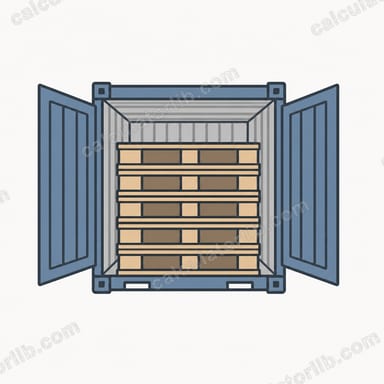
This tool estimates how many loaded pallets fit into a defined space such as a truck trailer, shipping container, or warehouse bay. It uses simple axis-aligned block stacking: it packs pallets on the floor in the orientation that fits best, then stacks identical layers up to the available height. It is a fast planning aid for logistics, shipping quotes, and storage layout.
How to use it
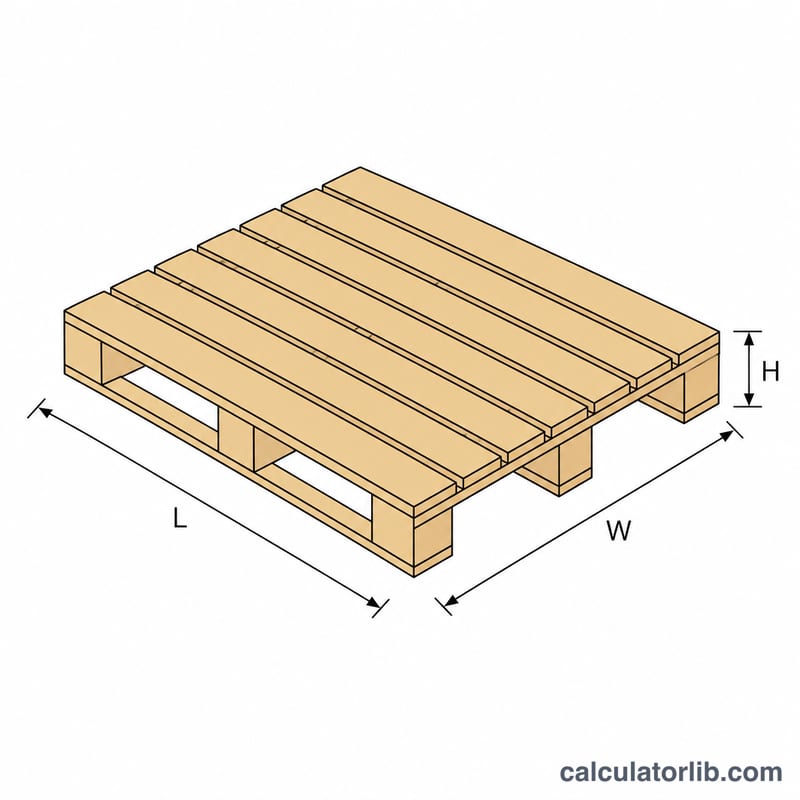
Enter the footprint and loaded height of a single pallet, then the internal length, width, and height of the space. All values use the same unit (centimetres in the examples). The calculator returns pallets per floor layer, the number of stack layers, and the total pallet count.
The formula explained
The number of pallets per floor layer \(P\) is the larger of the two footprint orientations, where \(L_p, W_p\) are pallet length and width and \(L_s, W_s\) are space length and width:
$$P = \max\left( \left\lfloor \tfrac{L_s}{L_p} \right\rfloor \left\lfloor \tfrac{W_s}{W_p} \right\rfloor,\ \left\lfloor \tfrac{L_s}{W_p} \right\rfloor \left\lfloor \tfrac{W_s}{L_p} \right\rfloor \right)$$The total pallet count \(N\) multiplies \(P\) by the number of stack layers, where \(H_s\) is space height and \(H_p\) is loaded pallet height:
$$N = P \times \left\lfloor \frac{H_s}{H_p} \right\rfloor$$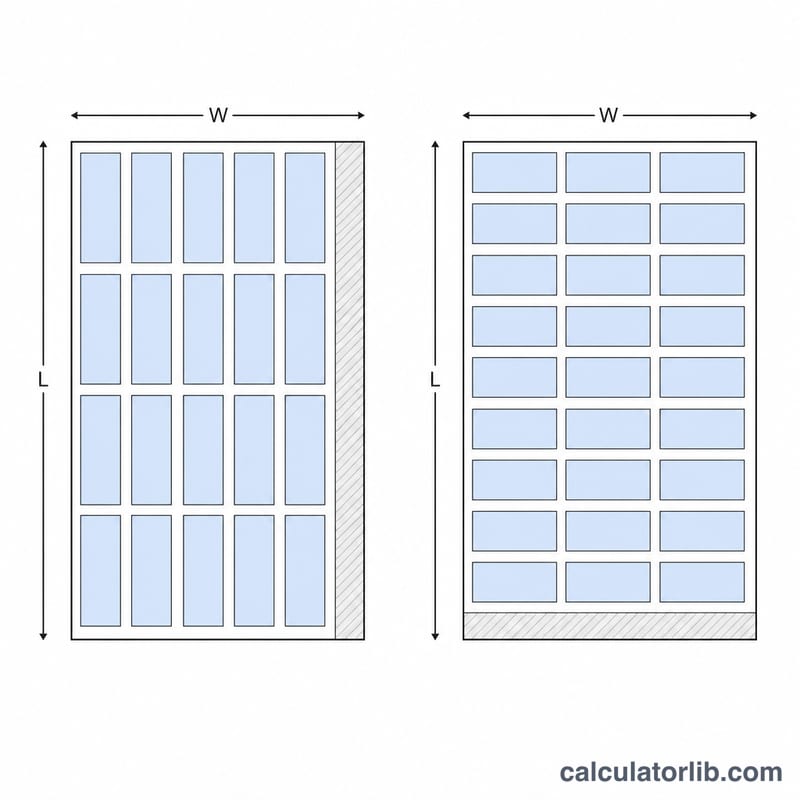
Worked example
A pallet is \(120 \times 80\) cm and \(150\) cm tall. The space is \(1200 \times 240 \times 300\) cm. Orientation one gives \(\lfloor 1200/120 \rfloor \times \lfloor 240/80 \rfloor = 10 \times 3 = 30\), and orientation two gives \(\lfloor 1200/80 \rfloor \times \lfloor 240/120 \rfloor = 15 \times 2 = 30\), so \(P = 30\). Layers are \(\lfloor 300/150 \rfloor = 2\), giving:
$$N = 30 \times 2 = 60 \text{ pallets}$$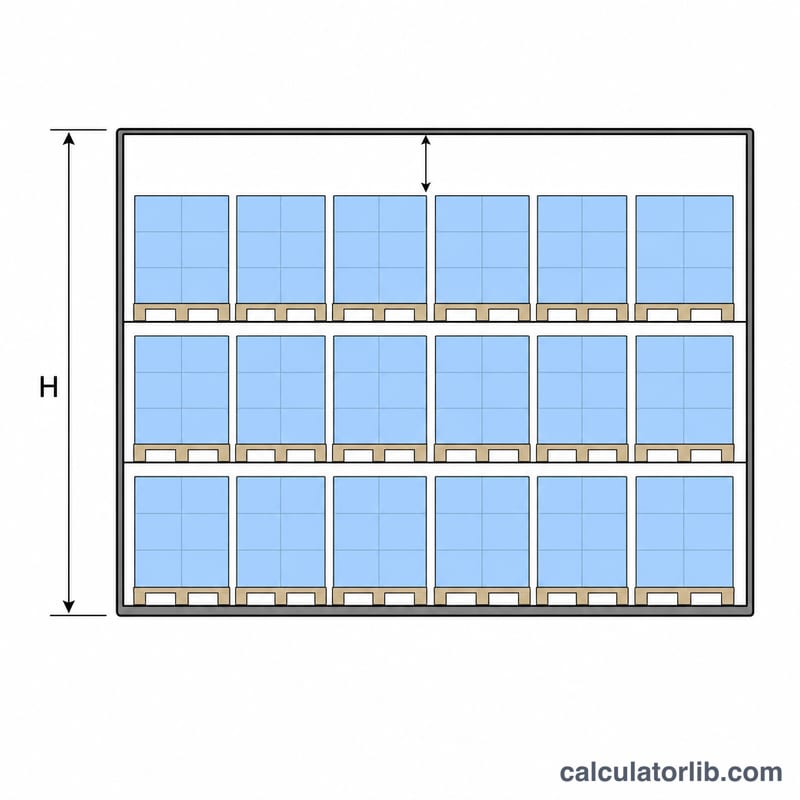
Standard Pallet, Truck & Container Dimensions
The values below are the widely-documented nominal footprints for common pallet standards and typical internal (usable) dimensions for common shipping equipment. Actual internal dimensions vary by manufacturer, build year and equipment type, so always confirm against the spec sheet for the specific unit you are loading. Dimensions are given as length × width × height.
| Pallet standard | Footprint (metric) | Footprint (imperial) | Region / notes |
|---|---|---|---|
| EUR / EPAL 1 | 120 × 80 cm (1200 × 800 mm) | ≈ 47.2 × 31.5 in | European standard (EPAL) |
| US / GMA | ≈ 122 × 102 cm (1219 × 1016 mm) | 48 × 40 in | North American standard (GMA) |
| ISO (1210) | 100 × 120 cm (1000 × 1200 mm) | ≈ 39.4 × 47.2 in | ISO 6780 size; common in Asia/Oceania |
| Equipment | Typical internal L × W × H (metric) | Typical internal L × W × H (imperial) | Notes |
|---|---|---|---|
| 20 ft ISO container (standard dry) | ≈ 5.90 × 2.35 × 2.39 m | ≈ 19.4 × 7.7 × 7.8 ft | ISO intermodal |
| 40 ft ISO container (standard dry) | ≈ 12.03 × 2.35 × 2.39 m | ≈ 39.5 × 7.7 × 7.8 ft | ISO intermodal |
| 53 ft dry van (semi-trailer) | ≈ 16.0 × 2.55 × 2.79 m | ≈ 52.5 × 8.4 × 9.2 ft | North American road standard |
| Standard road trailer (EU curtainsider / tautliner) | ≈ 13.6 × 2.45 × 2.70 m | ≈ 44.6 × 8.0 × 8.9 ft | European standard semi-trailer |
Door openings are typically a few centimetres smaller than the internal cross-section, and the usable height is reduced by anything on the floor (dunnage, ramps) or ceiling. Use the true usable space, not the nominal external size, when entering space_length, space_width and space_height.
Practical Loading Recommendations
This calculator returns a geometric maximum from dimensions only. The number of pallets per layer times the number of stackable layers, with the layer count floored, gives the upper bound of what physically fits: \( N = P \times \left\lfloor \frac{ {H_s}}{H_p} \right\rfloor \). Treat that floored result as a ceiling to plan against, then apply the checks below before you commit a load.
- Check weight and axle limits, not just volume. A container or trailer usually "weighs out" before it "cubes out." Multiply your per-pallet gross weight by the pallet count and confirm it stays under the vehicle's payload rating and any legal axle-load and gross-vehicle-weight limits, which are set by national road regulations and differ by country. Volume fit does not guarantee legal or safe weight.
- Leave door and side clearance. Subtract a realistic margin (commonly a few centimetres per side and at the doors) so pallets can be pushed in, secured and removed without jamming. Enter the usable interior, not the nominal size.
- Confirm pallets are actually stackable. The layer count assumes loads can be stacked to the full height. Verify each pallet's compression/top-load rating and whether the product, packaging or a "do not double-stack" instruction allows another pallet on top. If not, force the layer count to 1.
- Account for non-uniform SKUs. The formula assumes one uniform pallet size and one orientation. Mixed footprints, overhang, irregular heights or fragile items that must ride on top reduce the real count below the calculated maximum.
- Balance and secure the load. Distribute weight for axle balance, place heavier pallets low and toward the front, and plan bracing, straps or airbags to stop shifting in transit.
This is general logistics guidance, not a substitute for your carrier's loading rules or applicable transport regulations. Always verify against the specific equipment spec sheet and the weight and safety limits that apply in your jurisdiction.
FAQ
Does it allow stacking? Yes - it stacks identical layers based on loaded pallet height. Set the pallet height equal to the space height to force a single layer.
Does it rotate pallets? It checks both 90-degree orientations for the whole floor and keeps the better one, but it does not mix orientations within one layer.
Why round down? Partial pallets and partial layers cannot ship, so every division is floored to whole pallets.