What this calculator does
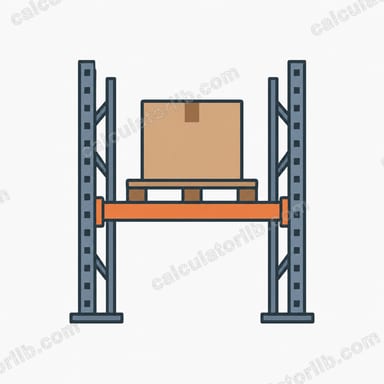
This tool estimates how much weight a single pallet racking bay carries and compares it against the rated capacities of its beams and upright frames. A bay is the space between two upright frames, with pairs of horizontal beams at each storage level. Enter your pallet weight, the number of pallets per level and the number of levels to get the total load, the load per beam and the utilization percentages.
How to use it
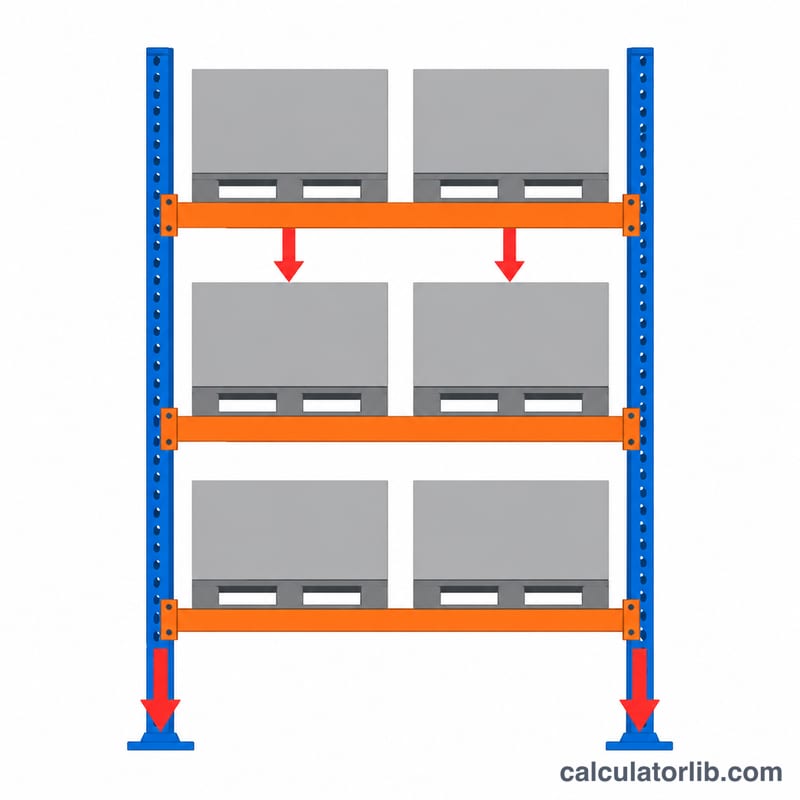
Enter the weight of one fully loaded pallet in kg, how many pallets sit on each beam level, and how many levels the bay has. Then enter the beam pair rated capacity per level (from the manufacturer load plate, assuming a uniformly distributed load) and the upright frame rated capacity. Always use the plate values for your exact rack configuration.
The formulas
Let \(w_p\) be pallet weight, \(n\) pallets per level and \(L\) levels.
$$W_{\text{bay}} = w_p \times n \times L$$Each level is supported by two beams, so each beam carries half the level load, and utilization compares the level load with the beam pair rating \(C_{\text{beam}}\):
$$w_{\text{beam}} = \frac{w_p \times n}{2},\quad U = \frac{w_p \times n}{C_{\text{beam}}} \times 100$$The bay load is shared between two frames, so each frame carries \(W_{\text{bay}}/2\).
Worked example
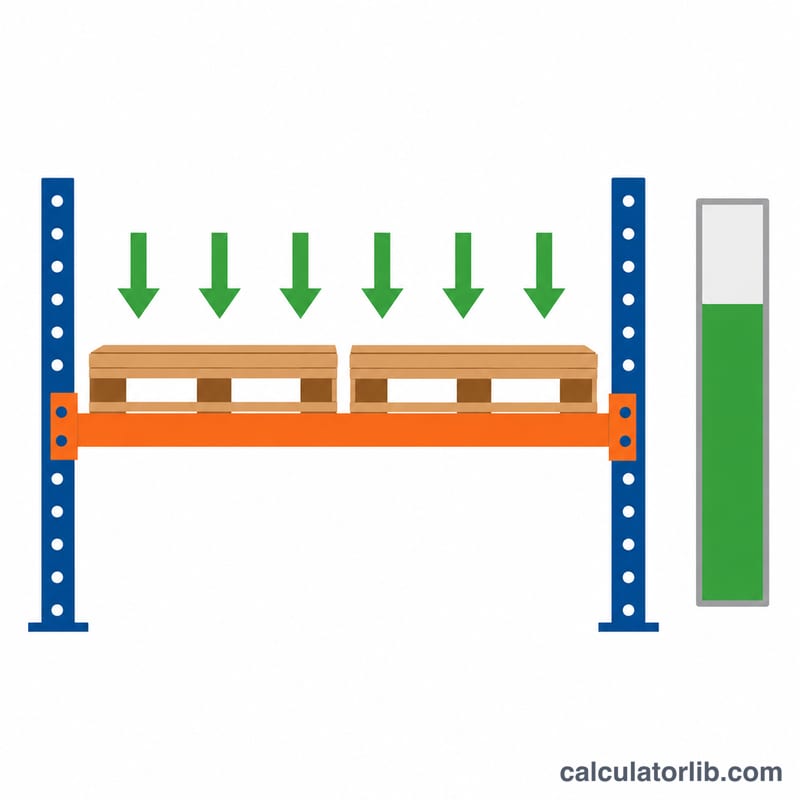
Three levels, two pallets per level, 800 kg per pallet, a beam pair rating of 2,700 kg and a frame rating of 8,000 kg:
$$W_{\text{level}} = 800 \times 2 = 1600\,\text{kg}$$$$W_{\text{bay}} = 1600 \times 3 = 4800\,\text{kg}$$$$U_{\text{beam}} = \frac{1600}{2700} \times 100 = 59.26\%$$Each frame carries 2,400 kg, which is 30% of its rating, so the bay is within limits.
Interpreting Your Utilization Result
Utilization compares the load your configuration puts on a component with that component's rated capacity. The calculator reports two figures: beam utilization \(U_{beam} = L_{level} / \text{beam pair capacity} \times 100\) and frame utilization \(U_{frame} = (L_{total}/2) / \text{frame capacity} \times 100\). The frame figure assumes each bay is supported by two upright frames that share the total bay load equally.
- Under 100%: the load is within the rated capacity of that component.
- 100% or more: the component is at or beyond its rating. Treat it as overloaded and unload or reconfigure the bay.
The governing (highest) utilization controls the bay. If beams are at 74% and frames at 50%, the beams govern and the bay is only as safe as its beams. A low figure on one component never offsets a high figure on another.
Where the ratings come from
Use only the capacities shown on the manufacturer's load plate or in the supplier's load tables for your exact beam, upright and configuration. Do not estimate them. Load notices and safe working load (SWL) signage must be displayed on the racking, and the loads stored must not exceed them. Many jurisdictions and standards require this, and the specific rules depend on your country.
What affects your real margin
- Beam height and level spacing: frame capacity usually depends on the height of the first beam level and the spacing between levels. A single rated figure may not apply to every configuration, so check the load table for your layout.
- Beam deflection limits: beams are commonly rated so that deflection under rated load does not exceed about span/200. Beams at or near 100% will sag by close to that amount, and small overloads leave little reserve.
- Uniformly distributed load (UDL) assumption: beam pair ratings normally assume the load is spread evenly. Concentrated loads, uneven pallets, overhanging pallets or a single heavy point load can stress a beam more than the same total weight spread evenly.
This calculator is for information and planning only. It is not a structural certification, inspection or design approval. Have a competent person or the racking supplier verify your installation.
Racking Terms and Definitions
- Bay: the section of racking between two upright frames, containing one or more beam levels. The calculator evaluates one bay at a time.
- Upright frame: the vertical assembly of two posts joined by bracing that carries the beam loads to the floor. Each bay is supported by two frames, and the calculator assumes they share the bay load equally.
- Beam pair: the two horizontal beams, front and back, that span a bay at one level and support the pallets. The beam pair capacity is the total load rating for the pair.
- Level: one horizontal storage tier in a bay, defined by a beam pair. The level load is the total weight stored on that tier.
- Pallet position: one pallet storage space on a level. Pallets per level is the number of positions across the bay.
- Uniformly distributed load (UDL): a load spread evenly along the beam span. Beam ratings normally assume UDL.
- Point load: a load concentrated at one location, such as a single heavy item. It can bend a beam more than the same weight spread evenly.
- Rated capacity / load plate: the maximum load the manufacturer certifies for a beam or frame in a stated configuration, shown on the load plate or in the load tables.
- Utilization: applied load divided by rated capacity, as a percentage. Under 100% is within the rating, and 100% or more is overloaded.
- Safe working load (SWL): the maximum load permitted to be stored, shown on the load notice or signage. It must not be exceeded.
- Beam deflection: the downward sag of a beam under load. Limits such as span/200 under rated load are commonly applied, and the exact limit depends on the standard and manufacturer.
FAQ
Is this a structural certification?
No. It is a planning aid. Final capacities depend on the rack manufacturer, beam height, frame bracing, floor condition and local standards, so confirm with a qualified rack engineer.
Why is the bay capacity the smaller of two values?
The bay is only as strong as its weakest component: either all beam levels at full rating or both frames at full rating.
What if pallets are not evenly distributed?
Point loads reduce beam capacity compared with a uniformly distributed load. Use the point-load rating from the manufacturer for such cases.