What is the Truck Load Capacity Calculator?
This calculator estimates how much cargo a truck can legally and physically carry. A truck can be limited in two ways: by weight (the gross vehicle weight rating, or GVWR) and by space (the size of the cargo area). The tool checks both and tells you which limit you hit first. Units are metric: kilograms and metres.
How to use it
Enter the GVWR from the door-jamb plate or registration, the empty (curb) weight, and the weight of the driver, passengers, fuel and equipment. Then enter the cargo area length, width and height, and the average density of your cargo in kg/m³ (for example, dry sand is about 1,600, packed boxes of goods often 150 to 400, and lumber 500 to 700). Check the local legal limits as well, since axle limits can be stricter than GVWR.
The formula explained
Payload capacity is the GVWR minus everything that is not cargo:
$$P = \text{GVWR} - \text{Curb} - \text{Other}$$The cargo area volume is \(V = L \times W \times H\), so a full load weighs \(V \times \rho\), where \(\rho\) is the density. The maximum cargo load is the smaller of the two:
$$M = \min\left(P,\ V \times \rho\right)$$If \(P\) is smaller, weight is the limiting factor; otherwise volume is.
Worked example
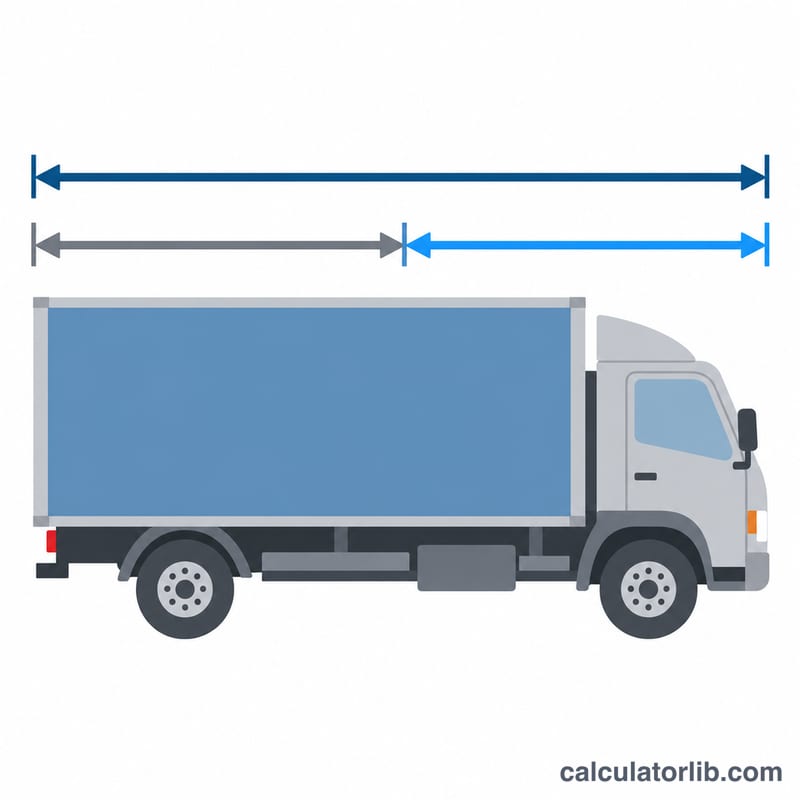
A truck has GVWR 7,500 kg, curb weight 3,200 kg and 150 kg of driver and fuel. The cargo area is 4.5 m by 2 m by 1.5 m and the cargo density is 300 kg/m³.
$$P = 7500 - 3200 - 150 = 4150\,\text{kg}$$$$V = 4.5 \times 2 \times 1.5 = 13.5\,\text{m}^3,\quad V\rho = 13.5 \times 300 = 4050\,\text{kg}$$$$M = \min(4150,\ 4050) = 4050\,\text{kg}$$Here the cargo area fills up first (volume-limited), using about 97.6% of the payload.
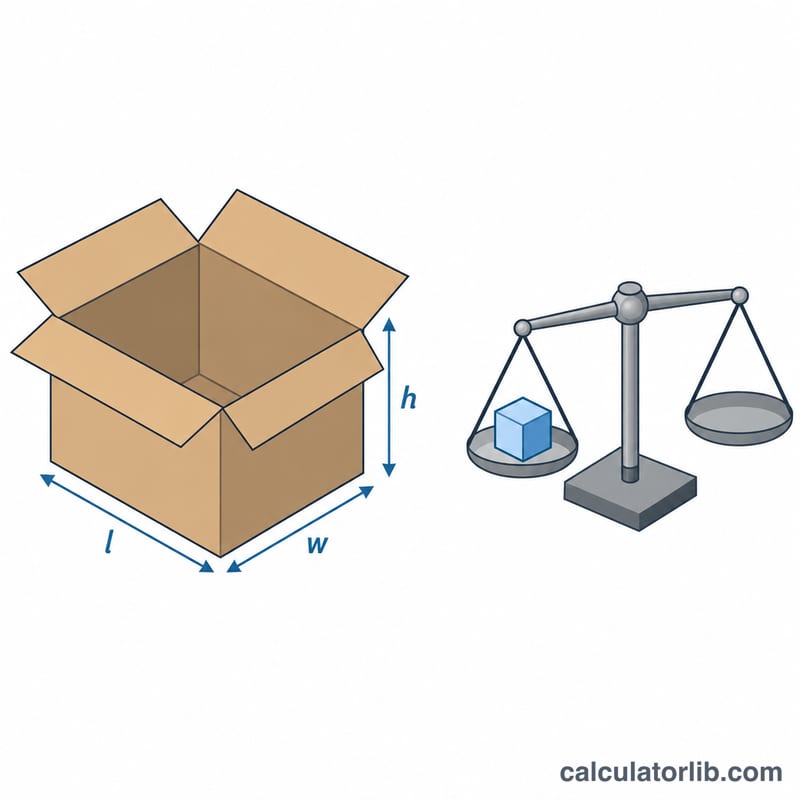
Typical Cargo Densities by Material
Use this table to pick a starting value for the cargo density field. All values are approximate bulk densities in kg/m³. They vary with moisture content, particle size, compaction and how tightly the load is packed, so treat them as estimates and check your actual material where you can.
| Material | Approx. bulk density (kg/m³) |
|---|---|
| Foam / light packaging | under 50 |
| Packed boxes (mixed goods) | 150–400 |
| Lumber (sawn timber) | 500–700 |
| Bulk grain | 700–800 |
| Water | 1,000 |
| Gravel | 1,500–1,800 |
| Dry sand | about 1,600 |
| Wet soil | 1,600–2,000 |
| Concrete | about 2,400 |
| Steel (solid) | about 7,850 |
Solid steel is shown as the material density. Steel parts stacked on a bed leave gaps, so the effective density of the load is lower. In practice, heavy dense cargo is nearly always weight-limited, and light bulky cargo is nearly always volume-limited.
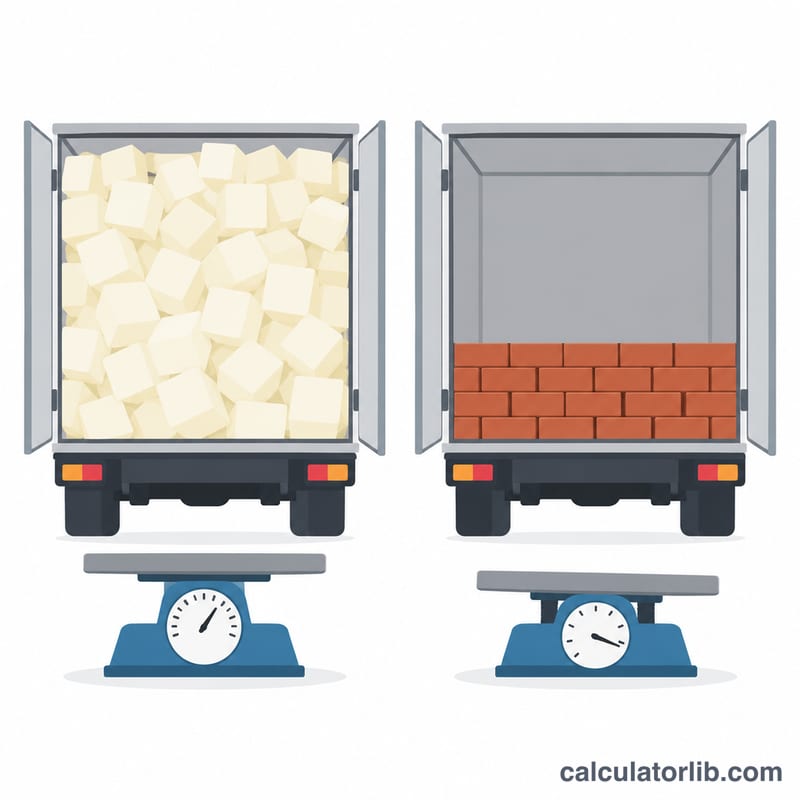
Scenario Comparison: Weight-Limited vs Volume-Limited
The same truck is used in every row: GVWR 7,500 kg, curb weight 3,200 kg, 150 kg for driver, fuel and equipment, and a 13.5 m³ cargo area (for example 5 × 2.25 × 1.2 m). The payload is \(P = 7{,}500 - 3{,}200 - 150 = 4{,}150\) kg. The break-even density is \(P / V = 4{,}150 / 13.5 \approx 307.4\) kg/m³. Below this density the cargo area fills first. Above it the weight limit is reached first.
| Cargo density ρ (kg/m³) | Volume-fit weight V×ρ (kg) | Max cargo M (kg) | Limiting factor | Max usable volume P/ρ (m³) |
|---|---|---|---|---|
| 100 | 1,350 | 1,350 | Volume | 41.5 (more than the bed holds, so the full 13.5 is used) |
| 300 | 4,050 | 4,050 | Volume | 13.83 (more than the bed holds, so the full 13.5 is used) |
| 307.4 (break-even) | about 4,150 | 4,150 | Both limits at once | 13.5 |
| 800 | 10,800 | 4,150 | Weight | 5.19 |
| 1,600 | 21,600 | 4,150 | Weight | 2.59 |
For 800 kg/m³ the volume-fit weight is \(13.5 \times 800 = 10{,}800\) kg, which is far above the 4,150 kg payload. So \(L_{max} = \min(4{,}150,\ 10{,}800) = 4{,}150\) kg, and only \(4{,}150 / 800 \approx 5.19\) m³ of the bed can be used. For the lightest cargo the weight limit is never reached, so extra payload capacity goes unused.
Practical Loading Recommendations
- Keep a safety margin. Load 5–10% below the computed maximum. Cargo density, curb weight and fuel level are all estimates.
- Verify axle loads and legal limits. The calculator checks only total weight (GVWR). Each axle has its own rating, and legal limits for weight, height and length differ by country and region. Check the vehicle's plate or manual and the rules where you drive.
- Distribute weight well. Spread the load evenly, keep heavy items low, and place them slightly forward of the rear axle. Secure everything against shifting.
- Count everything in the payload. Passengers, fuel, tools, racks, tie-downs and trailer tongue weight all use up payload. Enter them in the driver, fuel and equipment field.
- Weigh when near the limit. A weighbridge gives the real gross and axle weights. This is worthwhile for dense loads such as sand, gravel or steel, or when the estimated load is within about 10% of the maximum.
- Split the load or use a larger vehicle. If the cargo exceeds both the weight limit and the volume limit, make more trips or use a vehicle with a higher GVWR and a bigger cargo area.
This is general information, not professional or legal advice. Follow the manufacturer's ratings and local regulations.
FAQ
Is payload the same as towing capacity?
No. Payload is weight carried on the truck. Towing capacity is a separate rating, and tongue weight of a trailer counts toward payload.
Why does density matter?
Dense cargo such as gravel reaches the weight limit long before the bed is full, while light cargo such as foam fills the space first.
Does this replace a weighbridge?
No. Use it for planning only; always confirm against axle limits and local regulations.