What this calculator does
True airspeed (TAS) is the speed of an aircraft relative to the surrounding air. Jets cruise by Mach number, but flight plans, wind triangles and fuel calculations need TAS in knots. This calculator converts a Mach number into TAS using the air temperature at your flight level.
How to use it
Enter the Mach number and pressure altitude in feet. Choose whether to use the International Standard Atmosphere (ISA) temperature for that altitude, or enter your own outside air temperature in °C (use static air temperature, not total air temperature). The tool returns TAS in knots, km/h, mph and m/s, plus the local speed of sound and your deviation from ISA.
The formula explained
The speed of sound depends only on temperature:
$$a = \sqrt{\gamma R T}$$where \(\gamma = 1.4\), \(R = 287.05\,\text{J/(kg}\cdot\text{K)}\) and \(T\) is the static air temperature in kelvin. Then:
$$\text{TAS} = M \times a$$In ISA, temperature is \(15 - 0.0019812\,h\) °C up to 36,089 ft and a constant \(-56.5\) °C above that, where \(h\) is altitude in feet.
Worked example
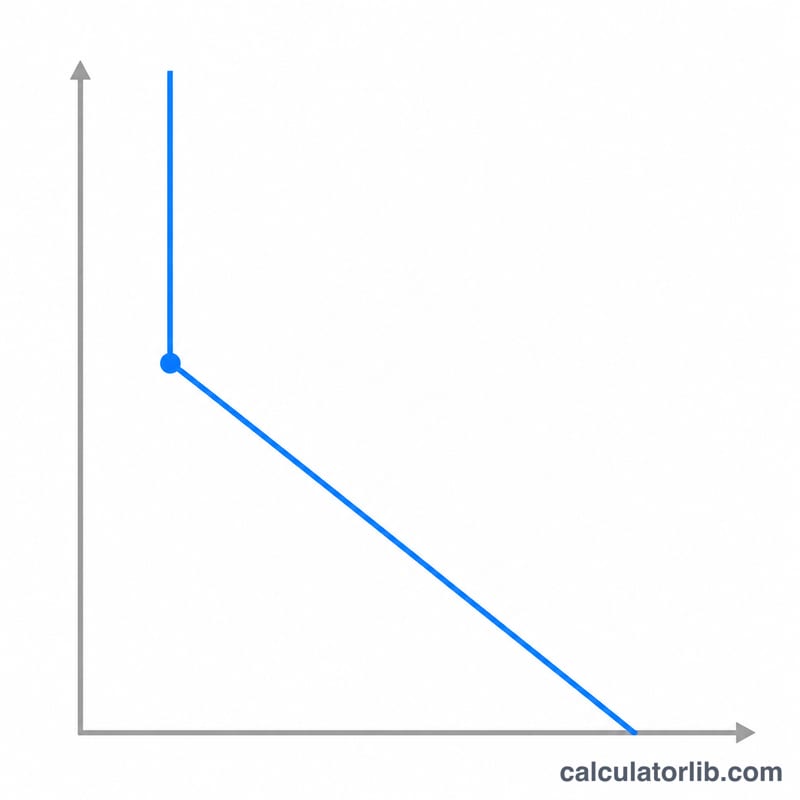
At Mach 0.85 and 40,000 ft in ISA, the temperature is \(-56.5\) °C, so \(T = 216.65\,\text{K}\).
$$a = \sqrt{1.4 \times 287.05 \times 216.65} \approx 295.07\,\text{m/s}$$$$\text{TAS} = 0.85 \times 295.07 \approx 250.8\,\text{m/s} \approx 487.5\,\text{kt}$$TAS at Common Mach Numbers and Flight Levels
The table shows true airspeed (TAS) in knots from \(\text{TAS} = M \cdot a\), with \(a = \sqrt{1.4 \times 287.05 \times T_K}\) in m/s, converted using 1 m/s = 1.943844 kt. Flight levels are treated as pressure altitudes in the ISA troposphere (15 °C minus 1.9812 °C per 1,000 ft) up to 36,089 ft, and a constant -56.5 °C above that. Values are rounded to the nearest knot.
| Case | SAT (°C) | Speed of sound (kt) | M0.78 TAS (kt) | M0.80 TAS (kt) | M0.85 TAS (kt) | M0.90 TAS (kt) |
|---|---|---|---|---|---|---|
| ISA, FL300 | -44.4 | 589.3 | 460 | 471 | 501 | 530 |
| ISA, FL350 | -54.3 | 576.4 | 450 | 461 | 490 | 519 |
| ISA, FL400 | -56.5 | 573.6 | 447 | 459 | 488 | 516 |
| Temperature deviation case (FL350, M0.80) | SAT (°C) | Speed of sound (kt) | TAS (kt) |
|---|---|---|---|
| ISA-10 | -64.3 | 563.1 | 450 |
| ISA (reference) | -54.3 | 576.4 | 461 |
| ISA+10 | -44.3 | 589.4 | 472 |
Takeaways: at a fixed Mach number, TAS falls as you climb in the troposphere because the air gets colder. Above the tropopause (36,089 ft) it stays constant for a given Mach number. A 10 °C temperature change at FL350 shifts M0.80 TAS by roughly 11 kt.
Constants and ISA Reference Values
| Quantity | Value |
|---|---|
| Ratio of specific heats, γ (dry air) | 1.4 |
| Specific gas constant of dry air, R | 287.05 J/(kg·K) |
| ISA sea-level temperature | 15 °C (288.15 K) |
| ISA tropospheric lapse rate | 6.5 °C/km (1.9812 °C per 1,000 ft) |
| ISA tropopause | 36,089 ft (11,000 m), -56.5 °C (216.65 K) |
| Speed of sound at ISA sea level | 340.29 m/s (661.47 kt) |
| Knots to m/s | 1 kt = 0.514444 m/s |
| Knots to km/h | 1 kt = 1.852 km/h |
| Knots to mph | 1 kt = 1.15078 mph |
These are the International Standard Atmosphere (ISA) values used in aviation worldwide. The speed of sound depends only on air temperature: \(a = \sqrt{\gamma R T}\), with T in kelvin (\(T_K = T_C + 273.15\)).
Key Terms: TAS, Mach, SAT, TAT, ISA
- TAS (true airspeed): the speed of the aircraft relative to the surrounding air mass.
- CAS / IAS: calibrated airspeed is indicated airspeed corrected for instrument and position error. Both are based on dynamic pressure, so they read lower than TAS at altitude.
- Mach number: the ratio of TAS to the local speed of sound, \(M = \text{TAS}/a\).
- Speed of sound: the speed at which small pressure disturbances travel through air. It depends on air temperature only, not on pressure or altitude directly.
- SAT (static air temperature): the real temperature of the undisturbed air. It is the temperature to use for the speed of sound.
- TAT (total air temperature): the temperature measured by a probe after the air is brought to rest. It is warmer than SAT because of ram rise. Approximately, \(T_{TAT} = T_{SAT}\,(1 + 0.2\,r\,M^2)\) in kelvin, where r is the probe recovery factor (near 1).
- ISA (International Standard Atmosphere): a reference atmosphere with 15 °C at sea level, a 6.5 °C/km lapse rate up to 11 km, and a constant -56.5 °C above that.
- ISA deviation: actual temperature minus the ISA temperature at the same altitude, written for example as ISA+10 or ISA-10.
- Pressure altitude: the altitude shown when the altimeter is set to 1013.25 hPa (29.92 inHg).
- Flight level (FL): pressure altitude in hundreds of feet, so FL350 means 35,000 ft on the standard setting.
- Tropopause: the boundary between the troposphere and stratosphere. In ISA it is at 36,089 ft, and temperature stays constant above it.
- Ground speed: the aircraft's speed over the ground, which is TAS combined with the wind vector.
FAQ
Does altitude change TAS directly?
Only through temperature. Speed of sound depends on temperature, so altitude matters because the air is colder higher up (until the tropopause).
Why does the same Mach give different TAS on a hot day?
Warmer air has a higher speed of sound, so a given Mach number corresponds to a higher TAS.
Is this the same as ground speed?
No. Ground speed is TAS adjusted for wind. This tool gives TAS only.