What the Beef Cooking Time Calculator Does
This calculator estimates how long a beef roast needs in the oven based on its weight, the doneness you want and whether the joint is boneless or bone-in. It assumes a moderate oven at 325°F (163°C), a common temperature for roasting beef, and also gives the internal temperature at which to pull the meat out.
How to Use It
Enter the weight of the beef and choose pounds or kilograms. Select your desired doneness from rare to well-done, then pick boneless or bone-in. The result shows total minutes, hours and minutes, the pull temperature and a suggested 15 minute rest.
The Formula Explained
Cooking time scales roughly with weight. The calculator uses:
$$t = W_{\text{lb}} \times r \times f$$where \(t\) is time in minutes, \(W_{\text{lb}}\) is weight in pounds, \(r\) is minutes per pound for the doneness (20 rare, 22 medium-rare, 25 medium, 28 medium-well, 32 well-done) and \(f\) is a bone factor (1.0 boneless, 1.1 bone-in). Kilograms convert with \(W_{\text{lb}} = W_{\text{kg}} \times 2.20462\).
Worked Example
A 4 lb boneless roast cooked to medium:
$$t = 4 \times 25 \times 1.0 = 100\,\text{min}$$That is 1 hour 40 minutes. Pull the roast at 140°F (60°C), then rest it about 15 minutes; the temperature will keep rising a few degrees.
Doneness Pull Temperatures and Minutes per Pound
The calculator uses a 325°F (163°C) oven. Time is estimated as \(T = W \cdot r \cdot f\), where \(W\) is weight in pounds, \(r\) is minutes per pound for the doneness, and \(f\) is 1.1 for bone-in or 1 for boneless. Pull the roast when the thermometer reaches the pull temperature, because it keeps rising while it rests.
| Doneness | Minutes per lb at 325°F | Pull temperature | Final temperature after carryover |
|---|---|---|---|
| Rare | 20 | about 120°F (49°C) | about 125–130°F (52–54°C) |
| Medium-rare | 22 | about 130°F (54°C) | about 135–140°F (57–60°C) |
| Medium | 25 | about 140°F (60°C) | about 145–150°F (63–66°C) |
| Medium-well | 28 | about 150°F (66°C) | about 155–160°F (68–71°C) |
| Well-done | 32 | 155–160°F (68–71°C) | about 165°F or higher (74°C+) |
Bone-in note: multiply the estimated time by 1.1 for bone-in roasts.
Example: a 5 lb boneless roast cooked to medium-rare: \(T = 5 \times 22 \times 1 = 110\) minutes. The same roast bone-in: \(5 \times 22 \times 1.1 = 121\) minutes.
These times are estimates. Roast shape, starting temperature, oven accuracy and fat content all change the real time, so a probe or instant-read thermometer is the reliable guide.
Recommended Internal Temperatures and Rest Times
Food-safety guideline (USDA, United States): the minimum safe internal temperature for whole cuts of beef is 145°F (63°C), measured with a food thermometer, followed by a rest of at least 3 minutes. Rare and medium-rare roasts are served below this minimum, so that is a personal choice. Other countries' food-safety agencies may give different guidance. Ground or mechanically tenderized beef follows different, higher rules.
| Doneness | Typical final serving range (°F) | Typical final serving range (°C) |
|---|---|---|
| Rare | 125–130°F | 52–54°C |
| Medium-rare | 130–140°F | 54–60°C |
| Medium | 140–150°F | 60–66°C |
| Medium-well | 150–160°F | 66–71°C |
| Well-done | 160°F and above | 71°C and above |
Resting the roast
- Rest time: typically 15–30 minutes, with the shorter end for smaller roasts (about 2–3 lb) and the longer end for large roasts. Tent loosely with foil to keep it warm.
- Carryover cooking: the internal temperature usually rises another 5–10°F (about 3–6°C) during the rest. Larger, thicker roasts rise more, and a hotter oven also increases the rise.
- Why rest: resting lets the juices redistribute, so less runs out when you slice.
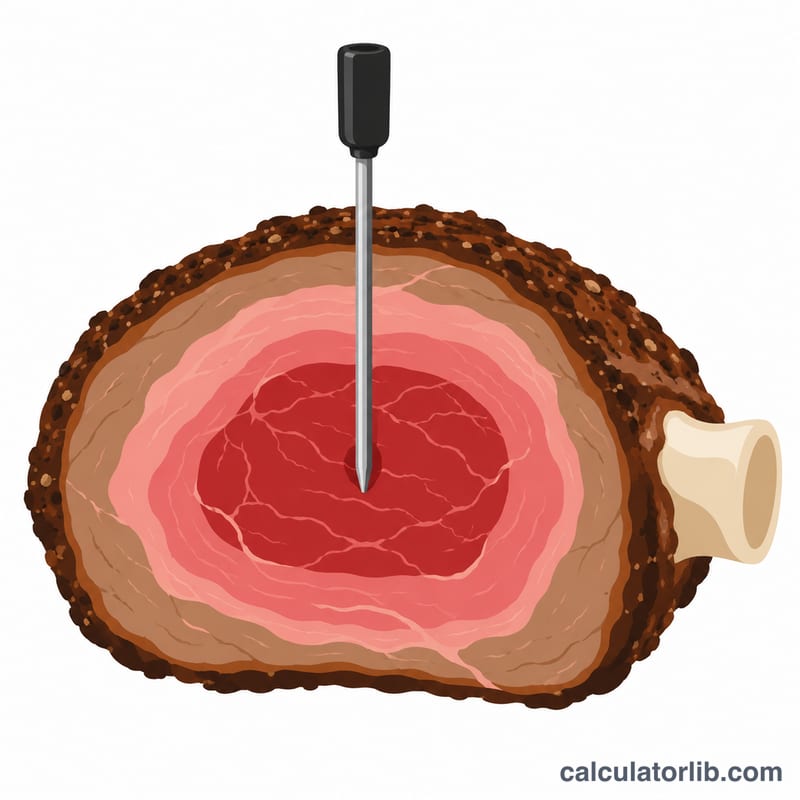
Insert the thermometer into the thickest part of the meat, away from bone and large fat pockets, and begin checking about 20–30 minutes before the estimated finish time.
FAQ
Is this accurate for steaks?
No. It is designed for oven roasts. Steaks cook in minutes and depend on thickness and pan or grill heat.
Why pull the beef before the final temperature?
Carryover cooking raises the internal temperature by roughly 5 to 10°F during the rest, so pulling early prevents overcooking.
Do I still need a thermometer?
Yes. Oven variation, shape and starting temperature change the time, so a thermometer is the only reliable way to judge doneness. Food safety agencies recommend at least 145°F (63°C) with a rest for whole cuts.