
What is the barley seeding rate?
The barley seeding rate is the weight of seed you need to sow per hectare to reach a target plant stand. Because barley seed size varies a lot between varieties and seed lots, seeding by weight alone (the same kg/ha every year) can leave you with too many or too few plants. Calculating the rate from seed number and kernel weight is far more accurate and is the basis for calibrating a drill or seeder.
How to use this calculator
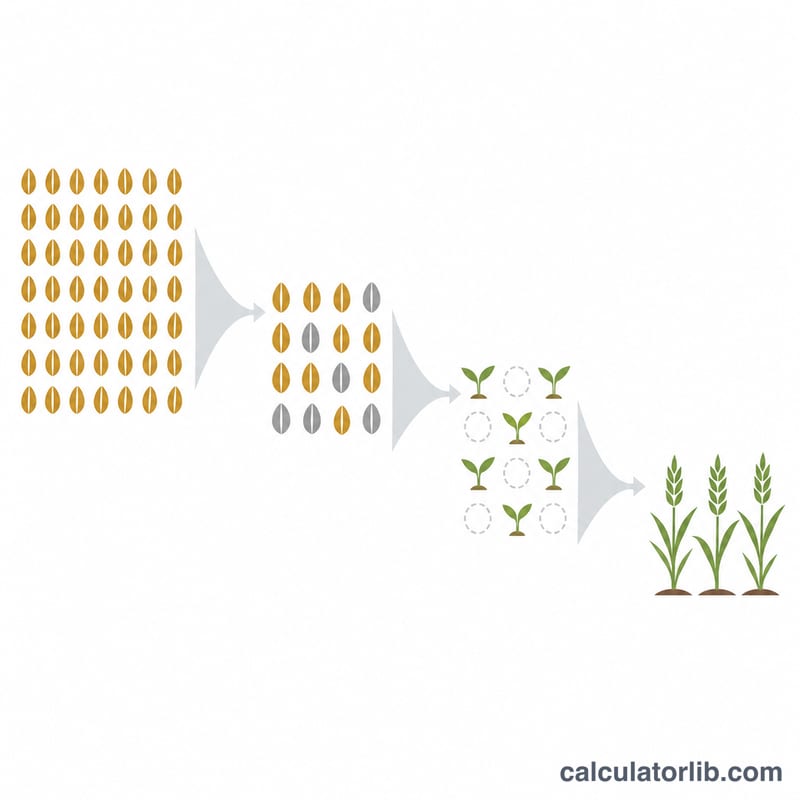
Enter the target plant population in plants per m² (often 200 to 300 for spring barley), the thousand-kernel weight (TKW) from your seed test, the germination percentage, and the expected field emergence or survival percentage. Add your field area in hectares to get the total seed to order. The result shows the seeds to sow per m², the rate in kg/ha and lb/ac, and the total kilograms required.
The formula explained
First, correct the target stand for losses, where \(P\) is the target plants per m², \(G\) is germination as a fraction and \(E\) is field emergence as a fraction:
$$S = \frac{P}{G \times E}$$Then convert seeds per m² to kg/ha using the thousand-kernel weight in grams:
$$R = \frac{S \times \text{TKW}}{100}$$The factor 100 comes from 1000 seeds per TKW unit and 10 to convert g/m² into kg/ha.
Worked example
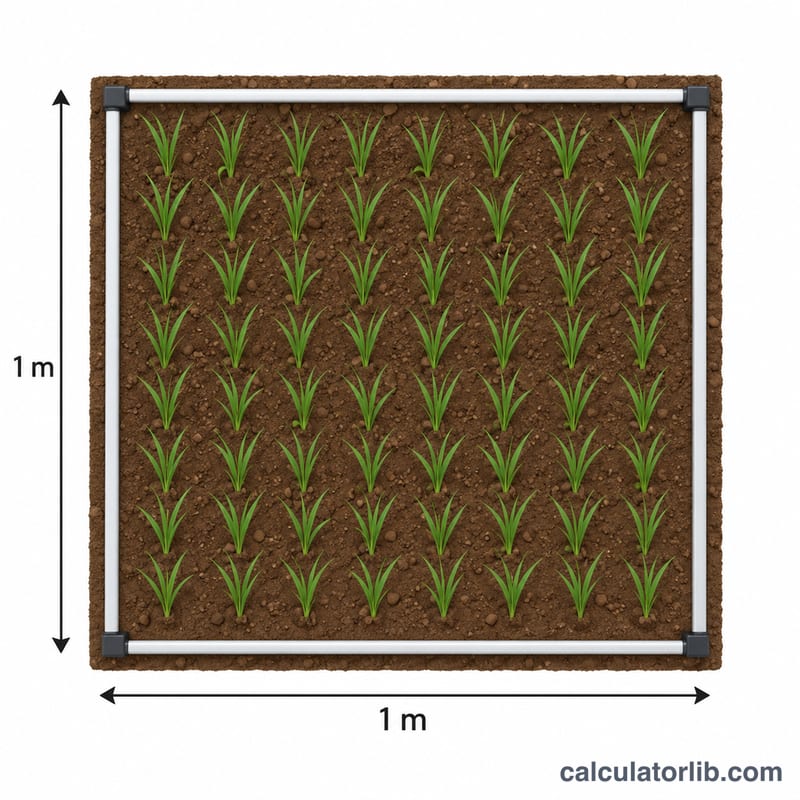
Target 250 plants/m², TKW 45 g, germination 95 %, emergence 85 %, field of 10 ha:
$$S = \frac{250}{0.95 \times 0.85} = 309.6\,\text{seeds/m}^2$$$$R = \frac{309.6 \times 45}{100} = 139.3\,\text{kg/ha}$$$$\text{Total} = 139.3 \times 10 = 1{,}393\,\text{kg}$$
Typical Barley Target Plant Populations and Seeding Rates
The calculator converts a target plant stand into a seed rate: required seeds/m² = plants/m² ÷ (germination × emergence), and kg/ha = seeds/m² × TKW (g) ÷ 100. The table below uses typical mid-range values of TKW = 45 g, germination = 95% and field emergence = 85% (combined survival ≈ 0.8075). These are general agronomic ranges only. Your local extension service, seed company or agronomist guidance prevails.
| Crop type | Typical target (plants/m²) | Resulting seeds/m² | Resulting rate (kg/ha) |
|---|---|---|---|
| Spring 2-row | 250–300 | ≈ 310–370 | ≈ 139.3–167 |
| Spring 6-row | 220–280 | ≈ 272–347 | ≈ 123–156 |
| Winter barley (timely autumn sowing) | 200–250 | ≈ 248–310 | ≈ 112–139 |
Example substitution (spring 2-row, low end): \(S = \dfrac{250}{0.95 \times 0.85} \approx 309.6\) seeds/m², then \(309.6 \times 45 / 100 \approx 139.3\) kg/ha.
Typical input ranges
- Thousand-kernel weight (TKW): roughly 35–50 g. Always use the figure from your own seed lot or label, since it changes the kg/ha considerably.
- Germination: roughly 90–98% for certified seed (use the lab test value).
- Field emergence: roughly 75–90%, depending on seedbed, moisture, seed depth, soil temperature and disease pressure.
How sowing date and seedbed shift targets
- Late sowing: spring crops sown late, and winter crops sown after the optimum window, have less time to tiller, so target stands are usually raised, often by about 10–25%.
- Poor seedbeds (cloddy, crusted, dry, cold or wet soils, or heavy residue) lower emergence. Enter a lower emergence percentage rather than just adding seed by guesswork.
- Early or ideal sowing in good conditions: targets can sit at the lower end of the range, because plants tiller more.
- Lodging risk, malting-barley quality requirements (which favor even, not overly dense stands) and variety type also influence the target.
kg/ha to lb/ac and Seed Density Conversions
Key factors: 1 kg/ha = 0.8922 lb/ac (the calculator uses 0.892179), so 1 lb/ac = 1.1209 kg/ha. Also, 1 ha = 2.471 ac.
| Rate (kg/ha) | Rate (lb/ac) | Rate (bu/ac at 48 lb/bu) |
|---|---|---|
| 80 | 71.4 | 1.49 |
| 100 | 89.2 | 1.86 |
| 120 | 107.1 | 2.23 |
| 140 | 124.9 | 2.60 |
| 160 | 142.7 | 2.97 |
| 180 | 160.6 | 3.35 |
Seed density
- 1 seed/m² = 10,000 seeds/ha, because 1 ha = 10,000 m². For example, 300 seeds/m² = 3,000,000 seeds/ha.
- Seeds/m² × TKW (g) ÷ 100 = kg/ha.
lb/ac to bu/ac
The standard test weight for barley in the United States (and commonly used in Canada) is 48 lb per bushel. So bushels per acre = lb/ac ÷ 48. For example, \(\dfrac{125\ \text{lb/ac}}{48\ \text{lb/bu}} \approx 2.60\) bu/ac. Seeding rates are normally set by weight and kernel count, not by volume, because the bulk density of seed varies with variety and moisture.
FAQ
Where do I find thousand-kernel weight?
Weigh a counted sample of seeds (for example 500) and scale to 1000, or use the value on your seed analysis certificate. Typical barley TKW is 35 to 50 g.
What field emergence should I assume?
Between 80 and 90 % is common in good seedbeds; use a lower value for cold, dry, cloddy or late-sown conditions.
Should I adjust for seed treatment or sowing date?
Yes. Many growers increase the rate for late sowing, and local agronomy advice should override generic target populations.