What is a power bank size calculator?
A power bank size calculator tells you how large a portable battery you need to recharge a phone, tablet, camera or other gadget a certain number of times. Because no power bank transfers all of its stored energy to your device, the rated capacity printed on the box is always larger than the charge you actually receive.
How to use it
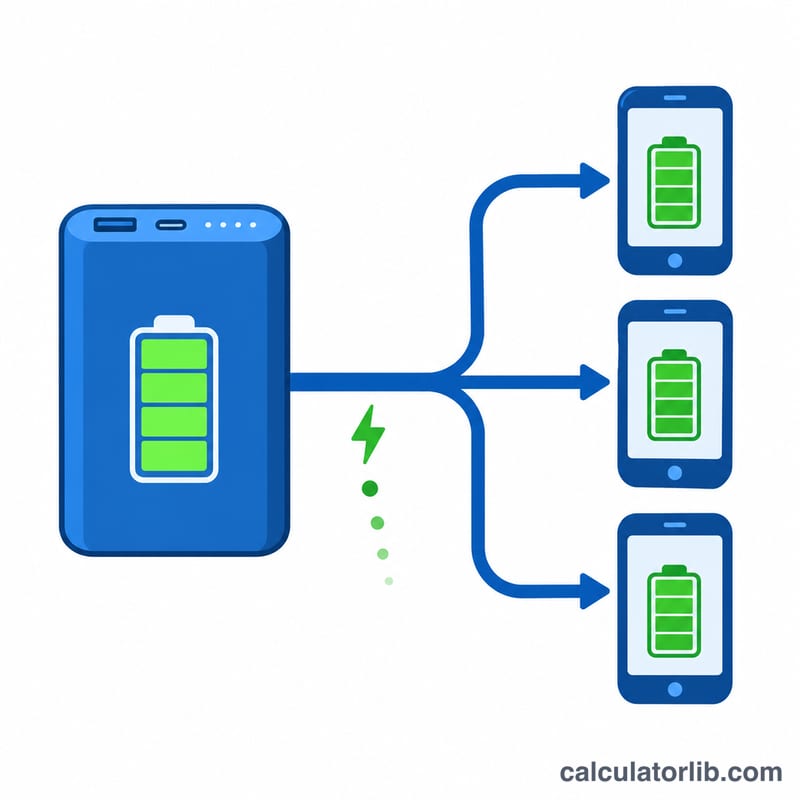
Enter your device battery capacity in mAh (found in the specs), how many full recharges you want, the expected efficiency of the power bank, and the device battery voltage (3.7 V for most lithium-ion phones, around 3.85 V for many newer ones). Real-world efficiency is usually between 60% and 85%, so 70% is a sensible default.
The formula explained
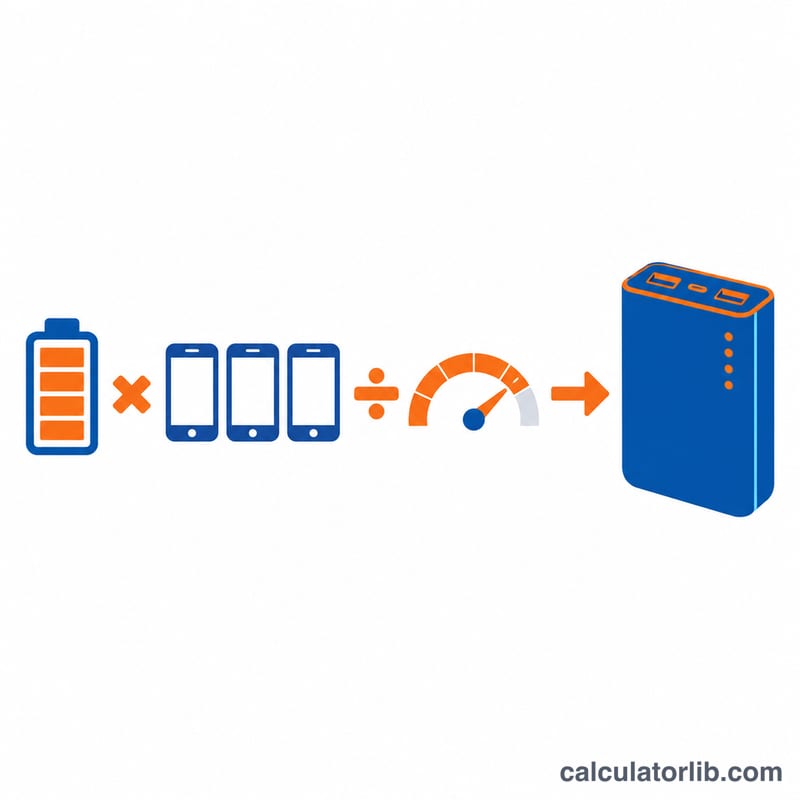
The charge delivered is the device capacity \(C_{\text{device}}\) multiplied by the number of recharges \(N\). Dividing by the efficiency \(\eta\) (as a decimal) gives the rated power bank capacity:
$$C_{\text{bank}} = \frac{C_{\text{device}} \times N}{\eta}$$The energy in watt-hours is \(E = C_{\text{bank}} \times V / 1000\), where \(V\) is the battery voltage. Wh is useful for checking airline limits, which are commonly 100 Wh per battery.
Worked example
A phone with a 4,000 mAh battery, three full recharges, and 70% efficiency:
$$C_{\text{bank}} = \frac{4000 \times 3}{0.70} \approx 17{,}143\,\text{mAh}$$$$E = \frac{17143 \times 3.7}{1000} \approx 63.4\,\text{Wh}$$A 20,000 mAh power bank would therefore be a comfortable choice, leaving some margin for battery ageing and cold weather.
Typical Device Battery Capacities and Voltages
Use these approximate values as a starting point for the Device mAh and Voltage fields. Actual capacities vary by model, so check your device's spec sheet or battery settings page for the exact rated figure.
| Device | Typical capacity (mAh) | Nominal voltage (V) |
|---|---|---|
| Budget smartphone | about 4,000–5,000 | about 3.85 |
| Flagship smartphone | about 4,500–5,000 (some models higher) | about 3.85–3.9 |
| Tablet | about 7,000–10,000 | about 3.8 |
| Wireless earbuds charging case | about 400–600 | about 3.7 |
| Smartwatch | about 300–500 | about 3.7–3.85 |
| Handheld game console | about 4,000–6,000 for compact models; larger models are often listed in Wh instead | about 3.7–7.7 depending on pack design |
| Action camera | about 1,200–1,800 | about 3.85 |
Energy in watt-hours is \(\text{Wh} = \frac{\text{mAh} \times V}{1000}\). For example, a 5,000 mAh phone battery at 3.85 V holds \(\frac{5000 \times 3.85}{1000} = 19.25\) Wh. These figures are approximations, not specifications for any one product.
Common Power Bank Sizes and Airline Limits
Power bank capacity is usually printed in mAh at the internal lithium cell voltage of about 3.7 V. The approximate energy is \(\text{Wh} = \frac{\text{mAh} \times 3.7}{1000}\).
| Rated capacity (mAh) | Approx. energy at 3.7 V (Wh) | Typical carry-on status (common rule) |
|---|---|---|
| 5,000 | 18.5 | Under 100 Wh: generally allowed |
| 10,000 | 37 | Under 100 Wh: generally allowed |
| 20,000 | 74 | Under 100 Wh: generally allowed |
| 26,800 | about 99.2 | Just under 100 Wh: generally allowed |
| 30,000 | 111 | 100–160 Wh: usually needs airline approval |
A bank rated at about 27,000 mAh comes to roughly 100 Wh, which is why many 26,800 mAh models are sold as the largest size that avoids the approval requirement.
Commonly cited carry-on rule
- Up to 100 Wh: allowed in carry-on without airline approval.
- 100–160 Wh: typically needs airline approval, and the number you can carry is often limited (commonly two).
- Above 160 Wh: generally prohibited on passenger aircraft.
Power banks are normally allowed in carry-on baggage only, not in checked luggage. These limits follow widely used international guidance, but rules vary by airline and country. Check your airline's current policy before you travel. The Wh figure printed on the bank's label is the one to rely on if it is shown.
The mAh rating describes the internal cell. Because of conversion losses, the usable capacity at the output is lower, which is why the calculator applies an efficiency percentage.
Typical Power Bank Efficiency Ranges
A power bank never delivers its full rated capacity to your device. The rated mAh is measured at the cell's nominal voltage (usually about 3.7 V). Energy is lost when the bank boosts that voltage to 5 V or higher, and more is lost as heat and in the cable. The calculator accounts for this with an efficiency percentage, and it uses 70% by default.
| Condition | Approximate efficiency |
|---|---|
| Cheaper banks, or higher-voltage fast charging | about 60-70% |
| Good-quality banks at standard charging | about 70-85% |
| Cold temperatures | lower than the ranges above |
| Wireless charging | lower than the ranges above |
These figures are rough guides, not a formal standard. Real efficiency varies with the specific product, the charging load, the cable, the device's battery state and the temperature. If you know your bank performs better or worse, change the efficiency field to match.
The effect on the result is direct. The required capacity is \(C_{\text{bank}} = \frac{C \times N}{\eta}\), so dropping from 85% to 60% efficiency raises the required bank size by roughly 40%.
Choosing and Rounding Up to a Real Power Bank Size
The calculator gives a minimum capacity, but power banks are sold in standard sizes. Always round up to the next common size, such as 10,000, 20,000 or 26,800 mAh. For example, a 4,500 mAh phone recharged twice at 70% efficiency needs \(\frac{4500 \times 2}{0.70} \approx 12{,}857\) mAh, so a 20,000 mAh bank is the sensible choice. A 10,000 mAh bank would fall short.
- Add a margin. Lithium cells lose capacity as they age, and cold weather reduces usable output. If you travel in winter or plan to use the bank for years, add roughly 10-20% on top of the calculated figure.
- Check the Wh rating for flights. Many airlines and aviation authorities apply a limit of 100 Wh for power banks in carry-on bags, and power banks generally must not go in checked luggage. Estimate Wh as mAh × 3.7 V ÷ 1000. A 20,000 mAh bank is about 74 Wh, and a 26,800 mAh bank is about 99 Wh. A 30,000 mAh bank is about 111 Wh, which exceeds 100 Wh. Always check the rules of your airline and country, and the rating printed on the bank.
- Look at output power, not just capacity. A large bank with a low-wattage port will charge a laptop or a fast-charging phone slowly. Match the port's wattage and supported fast-charging protocol to what your device can accept.
- Consider the device's own charging speed. Your phone may limit how fast it draws power, so a more powerful bank will not always shorten charging time.
This is general information and not a product recommendation. Check the specifications of the particular bank and device you use.
FAQ
Why is efficiency not 100%? Power banks boost their cell voltage (about 3.7 V) to 5 V or more for USB output, and the conversion, cable resistance, and heat waste energy.
Does a higher voltage charger change the result? The mAh-based estimate uses the device battery voltage, so fast charging mainly affects speed, though it can slightly lower efficiency.
Should I buy exactly the calculated size? Round up to the next common size, since batteries lose capacity over time.