What is a beer recipe scaling calculator?
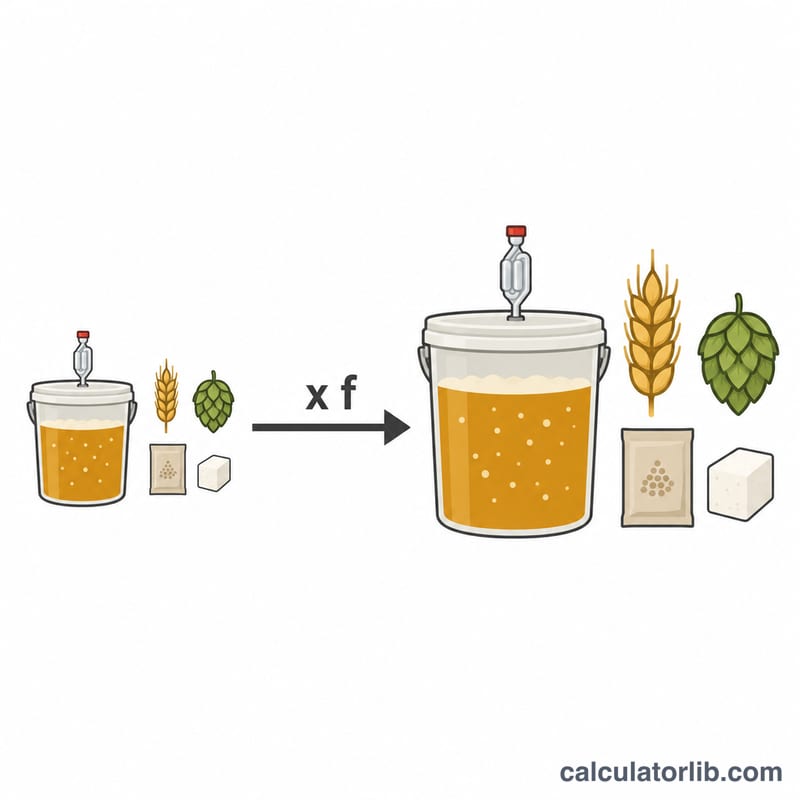
Homebrew recipes are written for a specific batch size, often 19 or 20 liters. If you own a bigger kettle, or want a small experimental batch, every ingredient has to be resized in proportion. This calculator multiplies your grain, hops, yeast and priming sugar by the ratio of the new batch to the original batch.
How to use it
Enter the original batch size and the size you want to brew, both in liters. Then enter the quantities from the original recipe: grain bill in kilograms and hops, yeast and priming sugar in grams. The calculator shows the scaling factor and the new amount of each ingredient.
The formula explained
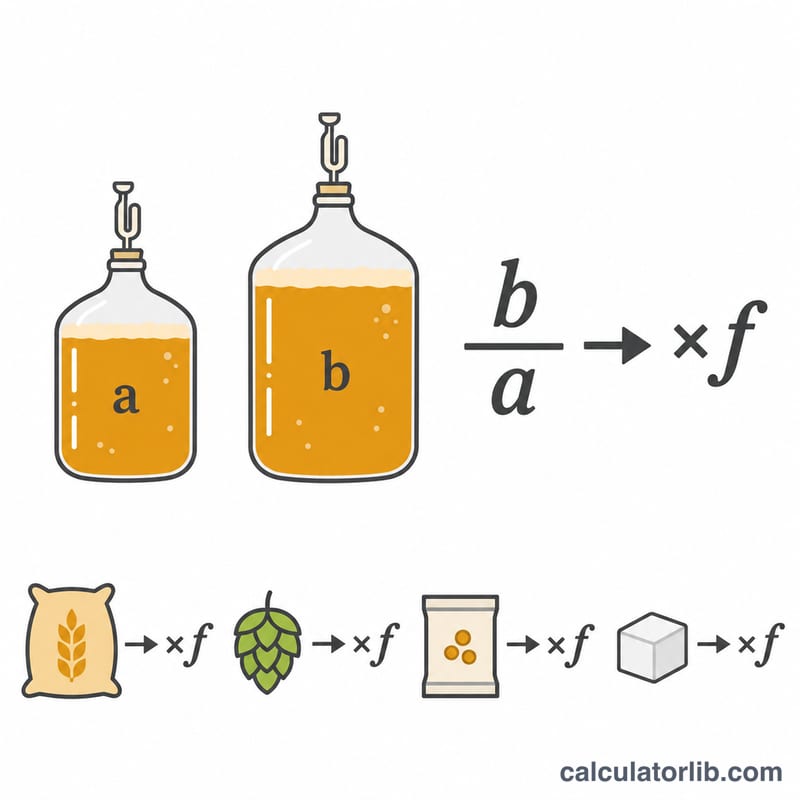
The scaling factor is the ratio of the two volumes:
$$f = \frac{V_{\text{new}}}{V_{\text{old}}}$$where \(V_{\text{new}}\) is the new batch size and \(V_{\text{old}}\) is the original batch size. Each ingredient is then:
$$Q_{\text{new}} = Q_{\text{old}} \times f$$Linear scaling keeps the gravity and the bitterness ratios close to the original, though real-world factors such as boil-off, kettle geometry and hop utilization can shift results a little on very large or small batches.
Worked example
Scaling a 20 L recipe to 5 L with 6 kg of grain and 80 g of hops:
$$f = \frac{5}{20} = 0.25$$$$\text{Grain} = 6 \times 0.25 = 1.5\,\text{kg}$$$$\text{Hops} = 80 \times 0.25 = 20\,\text{g}$$Scaling Factors for Common Batch Sizes
The scaling factor is \(f = \frac{V_{\text{new}}}{V_{\text{orig}}}\), and every ingredient is multiplied by it. The table below scales an example 20 L recipe (5 kg grain, 60 g hops, 11.5 g yeast, 100 g priming sugar). Yeast values are rounded to two decimals.
| New batch | Volume (L) | Factor f | Grain (kg) | Hops (g) | Yeast (g) | Priming sugar (g) |
|---|---|---|---|---|---|---|
| 1 gal | 3.8 | 0.19 | 0.95 | 11.4 | 2.19 | 19 |
| 2.5 gal | 9.5 | 0.475 | 2.375 | 28.5 | 5.46 | 47.5 |
| 5 gal | 19 | 0.95 | 4.75 | 57 | 10.93 | 95 |
| 10 gal | 38 | 1.9 | 9.5 | 114 | 21.85 | 190 |
| 50 L | 50 | 2.5 | 12.5 | 150 | 28.75 | 250 |
Example: scaling to 50 L gives \(f = \frac{50}{20} = 2.5\), so grain is \(5 \times 2.5 = \) 12.5 kg.
Batch Size and Weight Conversions
| Unit | Equivalent |
|---|---|
| 1 US gallon | 3.785 L |
| 1 imperial (UK) gallon | 4.546 L |
| 1 lb | 0.4536 kg = 453.6 g |
| 1 oz | 28.35 g |
| Common US batch size | Liters |
|---|---|
| 1 US gal | 3.785 L |
| 2.5 US gal | 9.46 L |
| 5 US gal | 18.93 L |
| 10 US gal | 37.85 L |
The scaling factor \(f\) is unitless as long as both volumes use the same unit. For example, 10 gal ÷ 5 gal gives the same \(f = 2\) as 37.85 L ÷ 18.93 L. Mixing units, such as US gallons with liters, will give a wrong factor. Note that US and imperial gallons differ, so check which one your recipe uses.
Practical Tips When Scaling Your Batch
- Yeast: round to whole packs, or build a starter if the scaled amount falls between pack sizes. Underpitching is a more common problem than slightly overpitching.
- Small hop additions: weigh them on a scale with 0.1 g resolution. When scaling down, a 2 g addition can easily be off by 10% or more on a coarse scale.
- Water volumes: boil-off and equipment losses (trub, kettle deadspace, grain absorption) do not scale in a perfectly linear way. Adjust your pre-boil water to match your own system.
- Hop utilization: large scale-ups can change bittering efficiency because of different boil volumes, kettle geometry and gravity. Check the IBU with a brewing calculator and adjust the bittering hops if needed.
- Equipment capacity: check that the kettle and fermenter can hold the new volume, with headspace for the boil and for fermentation foam (commonly 20–30% of the fermenter volume).
- Priming sugar: recalculate it for the final packaged volume and your target carbonation level, taking into account the beer's temperature. Linear scaling works only if the target carbonation stays the same.
FAQ
Does the water scale the same way? Roughly, yes, but boil-off is usually a fixed amount per hour, so adjust your total water for your own system.
Should yeast scale linearly? Pitch rate is based on cell count per liter, so scaling yeast with volume keeps the rate constant. Packs are often rounded up.
Is hop bitterness exactly preserved? Not perfectly. Larger boils can change hop utilization, so taste and adjust the next batch.