What the outboard fuel burn calculator does
This calculator estimates how much gasoline an outboard motor burns per hour and how much fuel a trip will need. It uses engine horsepower, the average throttle load, the engine type and the hours you expect to run. It is a planning estimate, not a measurement, so always carry a reserve.
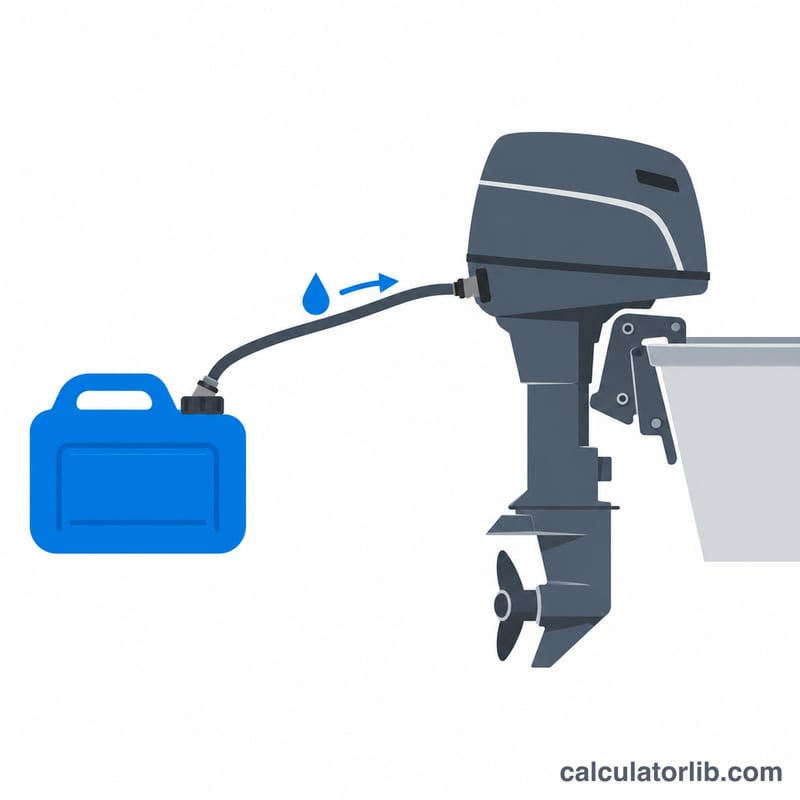
How to use it
Enter the rated horsepower of the engine, the average throttle load as a percentage of full power (cruising is often 60 to 75 percent, wide open throttle is 100 percent), and the running time in hours. Choose the engine type, because a 4-stroke EFI engine is more efficient than a carbureted 2-stroke. The result shows gallons and liters per hour plus total fuel for the trip.
The formula explained
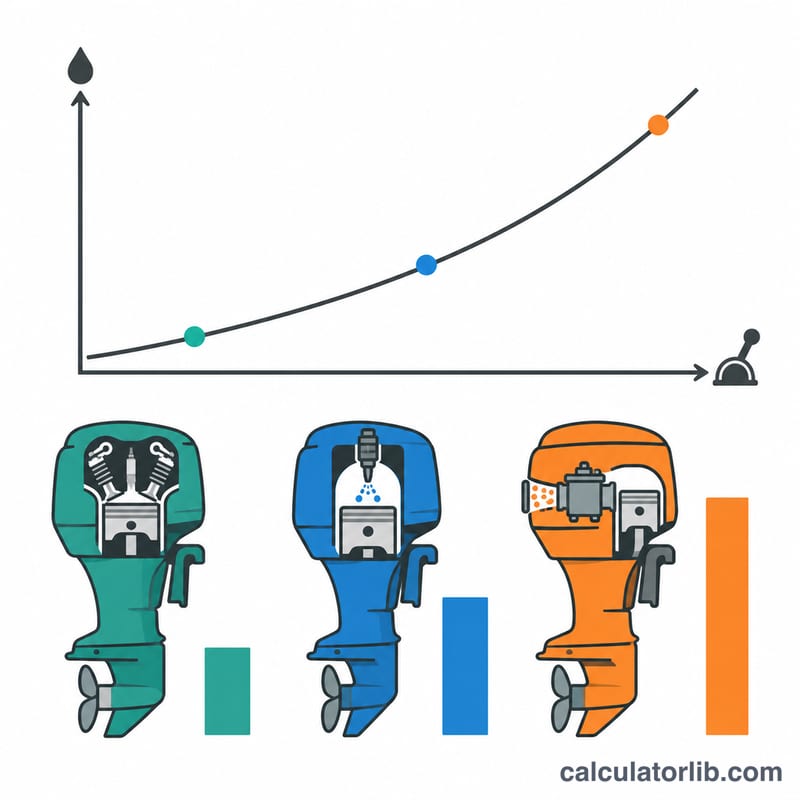
A common marine rule says a gasoline engine burns about 0.50 lb of fuel per horsepower-hour at full power. Gasoline weighs about 6.1 lb per US gallon.
$$\text{GPH} = \frac{ \text{HP} \times \text{BSFC} \times \text{Load} }{6.1}$$Here \(\text{HP}\) is horsepower, \(\text{BSFC}\) is brake specific fuel consumption in lb per HP-hr (0.50 for 4-stroke, 0.55 for 2-stroke direct injection, 0.70 for carbureted 2-stroke) and \(\text{Load}\) is the throttle fraction. Total fuel is \(\text{GPH} \times t\), and liters are gallons multiplied by 3.78541.
Worked example
A 150 HP 4-stroke running at 75 percent load for 4 hours:
$$\text{GPH} = \frac{150 \times 0.50 \times 0.75}{6.1} = 9.22\,\text{gal/hr}$$$$\text{Fuel} = 9.22 \times 4 = 36.89\,\text{gal} \approx 139.6\,\text{L}$$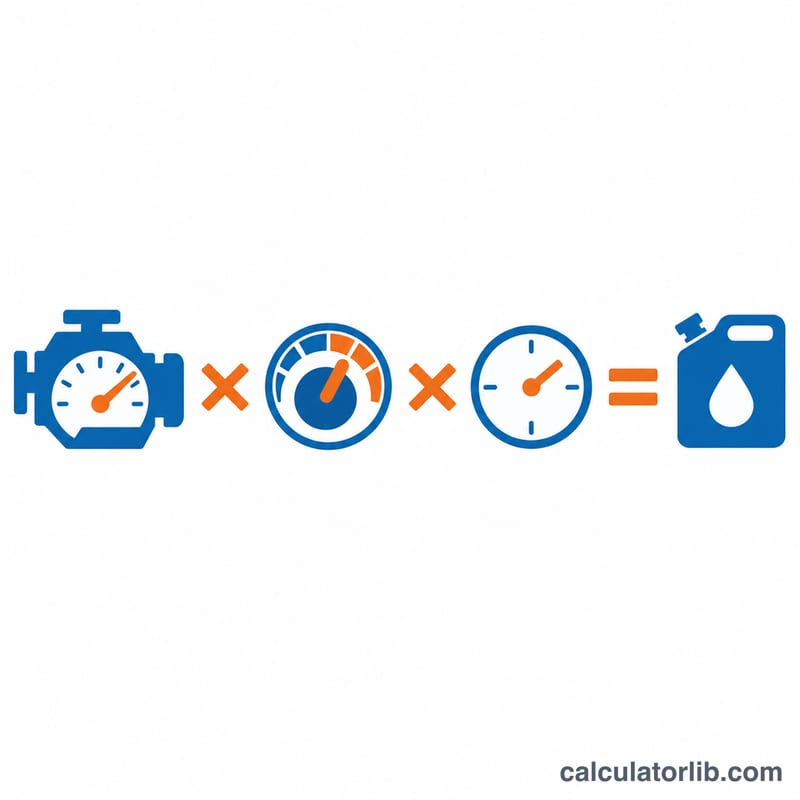
Fuel Burn Comparison by Engine Size and Throttle
The table uses the rule-of-thumb formula \(\text{GPH} = \text{HP} \times \text{BSFC} \times \text{Load} / 6.1\), with BSFC 0.50 for a 4-stroke EFI engine, 0.55 for a 2-stroke DI and 0.70 for a carbureted 2-stroke. Fuel is in US gallons for a 4-hour trip at a constant load. Results are rounded to two decimals.
| Engine | Load | Fuel burn (GPH) | Fuel for 4 hours (gal) |
|---|---|---|---|
| 90 HP 4-stroke | 50% | 3.69 | 14.75 |
| 90 HP 4-stroke | 75% | 5.53 | 22.13 |
| 90 HP 4-stroke | 100% | 7.38 | 29.51 |
| 150 HP 4-stroke | 50% | 6.15 | 24.59 |
| 150 HP 4-stroke | 75% | 9.22 | 36.89 |
| 150 HP 4-stroke | 100% | 12.30 | 49.18 |
| 300 HP 4-stroke | 50% | 12.30 | 49.18 |
| 300 HP 4-stroke | 75% | 18.44 | 73.77 |
| 300 HP 4-stroke | 100% | 24.59 | 98.36 |
| 150 HP 2-stroke carbureted | 75% | 12.91 | 51.64 |
Worked comparison for the last two rows: the 4-stroke burns \(150 \times 0.50 \times 0.75 / 6.1 = 56.25 / 6.1 \approx 9.22\) GPH. The carbureted 2-stroke burns \(150 \times 0.70 \times 0.75 / 6.1 = 78.75 / 6.1 \approx 12.91\) GPH. Over 4 hours that is about 14.75 gallons more, or 40% more fuel, for the carbureted engine.
Constants and Fuel Reference Values
| Quantity | Value |
|---|---|
| BSFC, 4-stroke EFI | 0.50 lb/HP-hr |
| BSFC, 2-stroke direct injection | 0.55 lb/HP-hr |
| BSFC, carbureted 2-stroke | 0.70 lb/HP-hr |
| Gasoline weight | about 6.1 lb per US gallon |
| 1 US gallon | 3.78541 L |
| 1 liter | 0.264172 US gal |
| 1 imperial gallon | 1.20095 US gal |
BSFC (brake specific fuel consumption) is the pounds of fuel an engine burns per horsepower-hour. The values above are rule-of-thumb approximations, not manufacturer data. Actual fuel burn depends on the engine model, propeller, hull, load, trim, sea conditions and fuel density. Treat the results as planning estimates and keep a reserve; a common guideline is the one-third rule (one third out, one third back, one third in reserve).
Typical Throttle Load Ranges
| Operating condition | Approximate load |
|---|---|
| Idle / trolling | about 10–25% |
| Displacement or economy cruise | about 40–60% |
| Planing cruise | about 60–75% |
| Fast cruise | about 75–85% |
| Wide open throttle (WOT) | 100% |
These are general approximations and vary with the boat, engine, propeller and load carried. Engine load is not the same as a percentage of maximum RPM. Manufacturers set the maximum rated RPM range for each engine, so check your owner's manual and keep the engine within that range at wide open throttle. For trip planning, estimate how many hours you will spend at each load, calculate each leg separately and add the results.
Frequently asked questions
Is this accurate for my boat?
It is a rule-of-thumb estimate. Real burn depends on hull, load, trim, propeller, sea state and engine condition. Part-throttle efficiency is often better than this model, so the estimate is usually conservative.
Does it work for 2-stroke engines?
Yes. Select the 2-stroke type to apply a higher BSFC. The figure covers gasoline and oil is not included separately.
How much reserve should I carry?
The common one-third rule suggests one third for going out, one third for coming back and one third in reserve.