What is the Surgical Apgar Score?
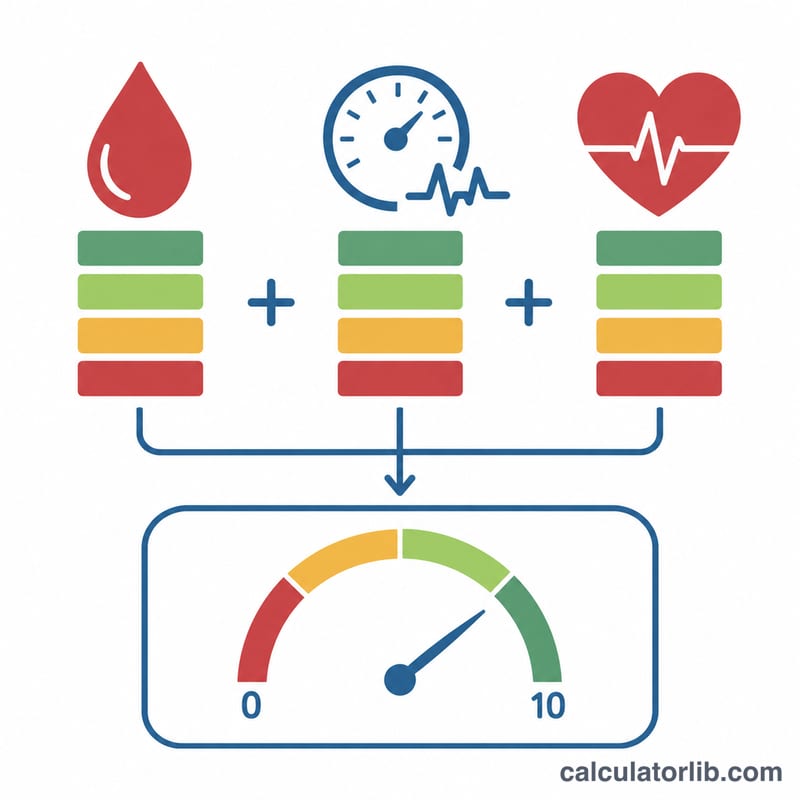
The Surgical Apgar Score (SAS), introduced by Gawande and colleagues in 2007, is a simple 10-point score calculated at the end of an operation. It uses three intraoperative values: estimated blood loss, the lowest mean arterial pressure (MAP) and the lowest heart rate. Lower scores are associated with a higher chance of major complications or death within 30 days of surgery.
How to use this calculator
Enter the estimated blood loss in millilitres, the lowest MAP recorded during the procedure in mmHg, and the lowest heart rate in beats per minute. The calculator assigns points to each parameter, adds them up and shows a risk tier. Use the values from the anaesthesia record for the whole operation.
Scoring and formula
The total is the sum of three components:
$$\text{SAS} = P_{\text{EBL}} + P_{\text{MAP}} + P_{\text{HR}}$$Blood loss: \(P_{\text{EBL}}\) = 3 for 100 mL or less, 2 for 101-600 mL, 1 for 601-1000 mL and 0 above 1000 mL. Lowest MAP: \(P_{\text{MAP}}\) = 3 for 70 mmHg or more, 2 for 55-69, 1 for 40-54 and 0 below 40. Lowest heart rate: \(P_{\text{HR}}\) = 4 for 55 bpm or less, 3 for 56-65, 2 for 66-75, 1 for 76-85 and 0 above 85. A pathologic bradyarrhythmia (sinus arrest, atrioventricular block or dissociation, junctional or ventricular escape rhythm, asystole) scores 0 heart-rate points, whatever the rate (Regenbogen 2008, Table 1). The total ranges from 0 to 10.
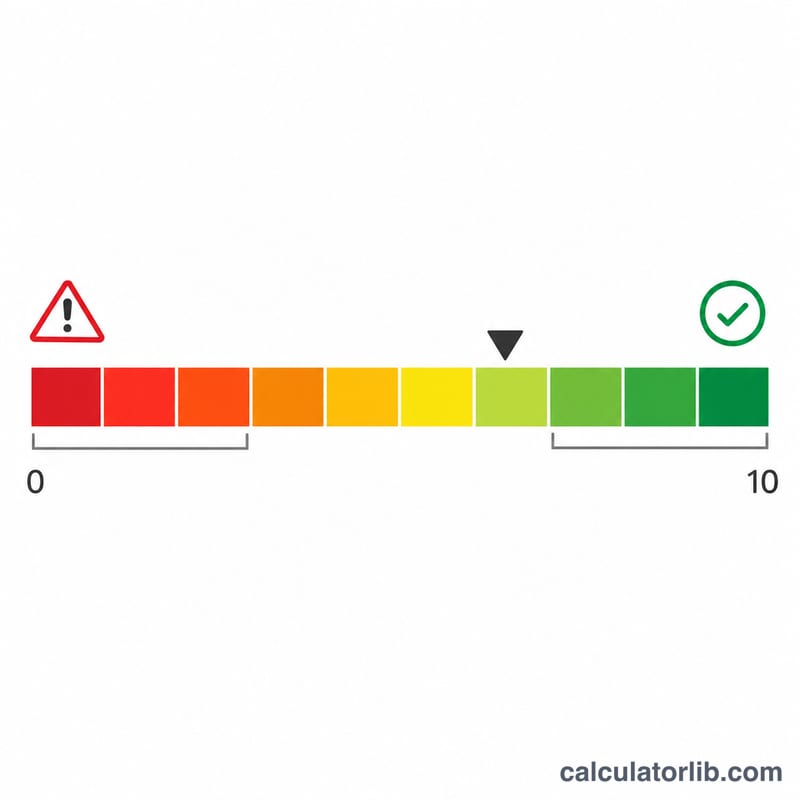
This tool groups scores into tiers: 9-10 low risk, 7-8 moderate, 5-6 high and 0-4 very high. These labels are this tool's wording; the cut-offs are the published ones. In the 2009 validation study (Regenbogen et al.), major complications within 30 days occurred in 5.0% of patients scoring 9-10 versus 56.3% of those scoring 4 or less; Gawande's 2007 derivation cohort reported major complications or death in 3.6% and 58.6%.
Worked example
A patient has 300 mL blood loss, a lowest MAP of 65 mmHg and a lowest heart rate of 70 bpm. Each value earns 2 points:
$$\text{SAS} = 2 + 2 + 2 = 6$$A score of 6 falls into the high-risk tier, suggesting closer postoperative monitoring.
Interpreting Your Surgical Apgar Score
The Surgical Apgar Score (SAS) is a 10-point score calculated at the end of an operation from three intraoperative values: estimated blood loss, lowest mean arterial pressure (MAP) and lowest heart rate. It was introduced by Gawande et al. in 2007 (Journal of the American College of Surgeons), using patients undergoing general and vascular surgery at a single academic center. Later studies in other hospitals and surgical specialties have generally found the same pattern: lower scores are associated with higher rates of major postoperative complications and 30-day mortality. Because this is a population-level association, it describes groups of patients, not what will happen to any one person.
- 9-10 (lowest-risk group): little blood loss, preserved blood pressure and a low heart rate. In the published cohorts, major complications and death within 30 days were least common in this group.
- 7-8 (low-to-intermediate group): mild to moderate physiological stress during surgery. Risk is higher than in the 9-10 group but still below the groups with lower scores.
- 5-6 (elevated-risk group): a noticeable combination of blood loss, hypotension or a faster heart rate. Complication rates in the studies were clearly higher, and many centers consider closer postoperative monitoring for patients in this range.
- 0-4 (highest-risk group): the largest intraoperative physiological disturbance. In the original and validation cohorts, this group had the highest rates of major complications and 30-day mortality.
Important limits:
- The score groups 9-10, 7-8, 5-6 and 0-4 are those of the published studies; the risk labels shown by this tool are its own wording.
- The SAS is a prognostic estimate, not a diagnosis. It cannot confirm or exclude any complication.
- It applies best to the patients and operations studied, mainly adult general and vascular surgery, and is less well validated elsewhere.
- If the lowest heart rate came from a pathologic bradyarrhythmia (for example heart block or asystole), tick the bradyarrhythmia box: as in the published score table, the heart rate then earns 0 points instead of the points for its value.
- The score does not account for age, comorbidities, urgency of surgery or the type of procedure.
This is general information, not medical advice. Questions about an individual patient's score or recovery should go to the surgical or anesthesia team.
FAQ
When is the score calculated? Immediately after the operation, using the worst intraoperative values.
Does a low score mean a complication will occur? No. It estimates risk and helps triage patients to higher-acuity care; it is not a diagnosis.
Can I use it for every surgery? It was derived in general and vascular surgery, and later studies extended it to other specialties, but performance varies. Always combine it with clinical judgement.