What is the MELD 3.0 score?
The Model for End-Stage Liver Disease (MELD) 3.0 is an updated version of the MELD-Na score used to rank the severity of chronic liver disease and to prioritize candidates for liver transplantation. Introduced to reduce sex-based disparities in access to transplant, MELD 3.0 adds a term for female sex and a serum albumin term, along with a sodium–bilirubin interaction term and an albumin–creatinine interaction term. The score ranges from 6 (least severe) to 40 (most severe) and correlates with 90-day mortality risk.
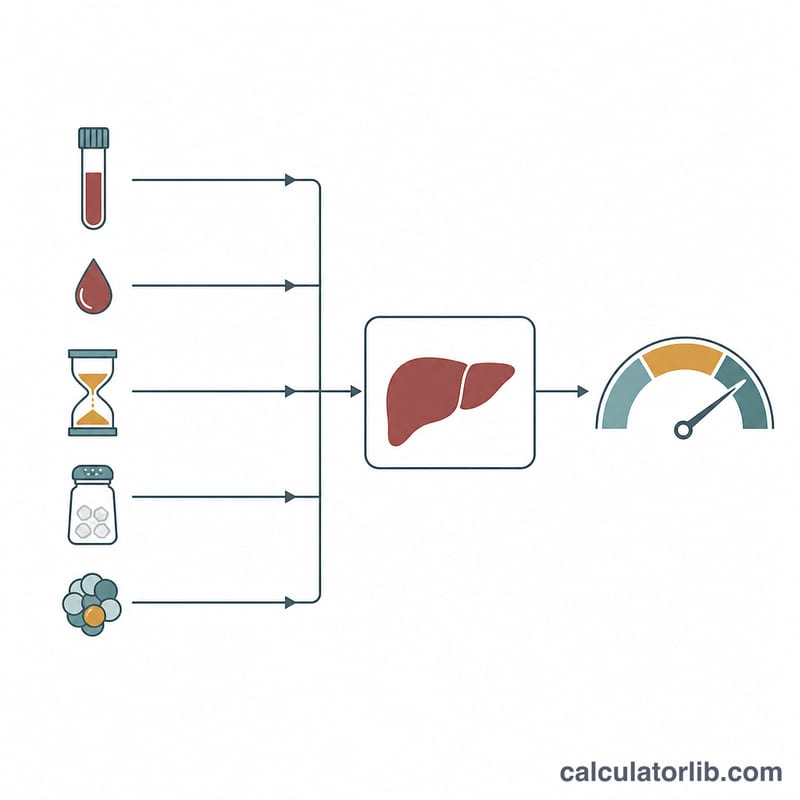
The formula
The score combines five laboratory values plus a sex indicator:
$$\text{MELD 3.0} = 1.33\,\text{Fem} + 4.56\ln(\text{Bili}) + 0.82(137-\text{Na}) - 0.24(137-\text{Na})\ln(\text{Bili}) + 9.09\ln(\text{INR}) + 11.14\ln(\text{Cr}) + 1.85(3.5-\text{Alb}) - 1.83(3.5-\text{Alb})\ln(\text{Cr}) + 6$$Here \(\text{Fem}=1\) for female and \(0\) for male, \(\text{Cr}\) is creatinine (mg/dL), \(\text{Na}\) is sodium (mmol/L), \(\text{Bili}\) is total bilirubin (mg/dL), \(\text{INR}\) is the international normalized ratio, and \(\text{Alb}\) is albumin (g/dL).
How to use the calculator
Enter the patient sex and the most recent lab values. Check the dialysis box if the patient had two or more hemodialysis sessions (or 24 hours of CVVHD) in the prior week; creatinine is then set to 3.0. Values are automatically clamped: \(\text{Cr}\in[1,3]\), \(\text{Na}\in[125,137]\), \(\text{Alb}\in[1.5,3.5]\), and \(\text{Bili}\) and \(\text{INR}\) have a floor of 1.0. The final score is rounded to the nearest whole number and capped between 6 and 40.
Worked example
Consider a female patient with creatinine 1.9, bilirubin 4.2, INR 1.8, sodium 135, and albumin 2.9. With \(\ln(1.9)=0.6419\), the sodium and albumin gaps are \(137-135=2\) and \(3.5-2.9=0.6\):
$$1.33 + 4.56\ln(4.2) + 0.82(2) - 0.24(2)\ln(4.2) + 9.09\ln(1.8) + 11.14(0.6419) + 1.85(0.6) - 1.83(0.6)(0.6419) + 6 = 27.72$$Rounded, the MELD 3.0 score is \(28\).
FAQ
How is MELD 3.0 different from MELD-Na? MELD 3.0 adds a female-sex term and an albumin term plus sodium–bilirubin and albumin–creatinine interaction terms, improving mortality prediction and reducing under-scoring in women.
What is the maximum score? The score is capped at 40; higher computed values are reported as 40.
Is this a diagnostic tool? No. It is an educational estimate and must not replace clinical judgment or official transplant-center scoring.