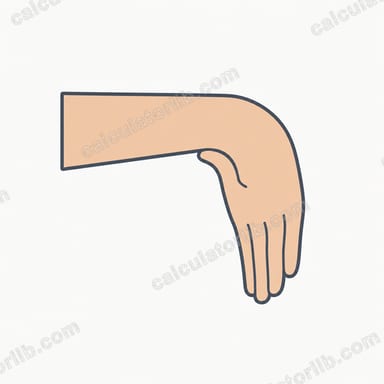

What is the Beighton Score?
The Beighton score is a widely used 9-point screening tool for generalized joint hypermobility — the tendency of joints to move beyond the normal range. It is a key part of assessing conditions such as hypermobility spectrum disorder (HSD) and hypermobile Ehlers-Danlos syndrome (hEDS). The scale is universal and not specific to any country.
How to use this calculator
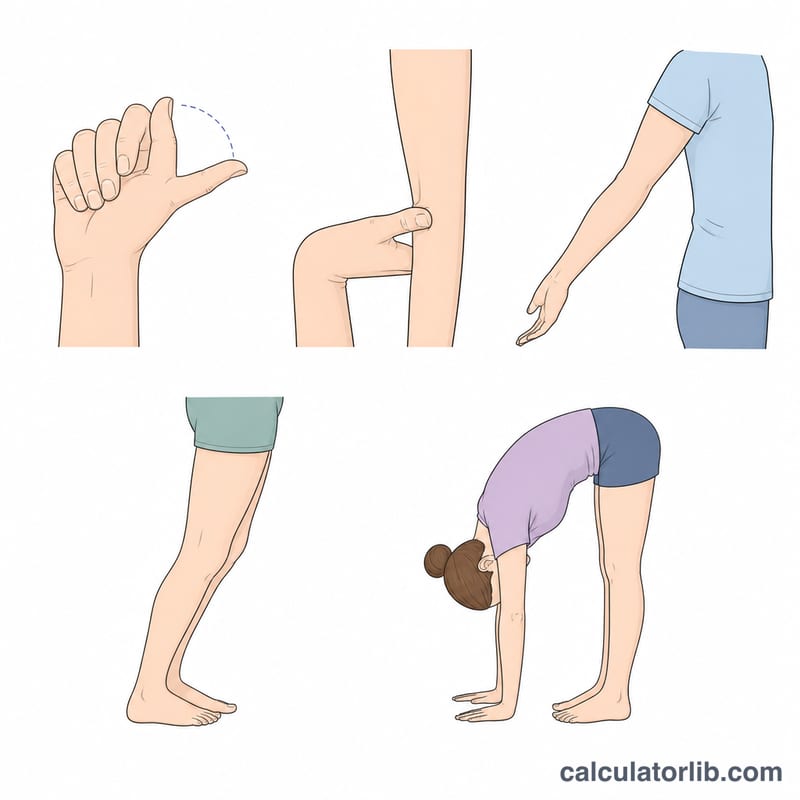
Perform each of the nine maneuvers and tick every box you can pass. Each successful maneuver earns 1 point. The five test sites are scored bilaterally (left and right) except for the trunk:
1–2. Passive bending of each little finger (pinky) beyond 90°. 3–4. Passive bending of each thumb back to touch the forearm. 5–6. Hyperextension of each elbow beyond 10°. 7–8. Hyperextension of each knee beyond 10°. 9. Bending forward with knees straight to place both palms flat on the floor.
The formula explained
The total is simply the sum of all nine binary (0 or 1) results, giving a value from 0 to 9:
$$\text{Score} = \text{L Pinky} + \text{R Pinky} + \text{L Thumb} + \text{R Thumb} + \text{L Elbow} + \text{R Elbow} + \text{L Knee} + \text{R Knee} + \text{Trunk}$$In adults, a score of 5 or more is commonly used as the threshold for generalized joint hypermobility; some clinicians use 4 for older adults. Children and adolescents often use a higher cut-off (≥6) because they are naturally more flexible. This calculator reports the raw score and a general interpretation — it is an educational screening aid, not a diagnosis.
Worked example
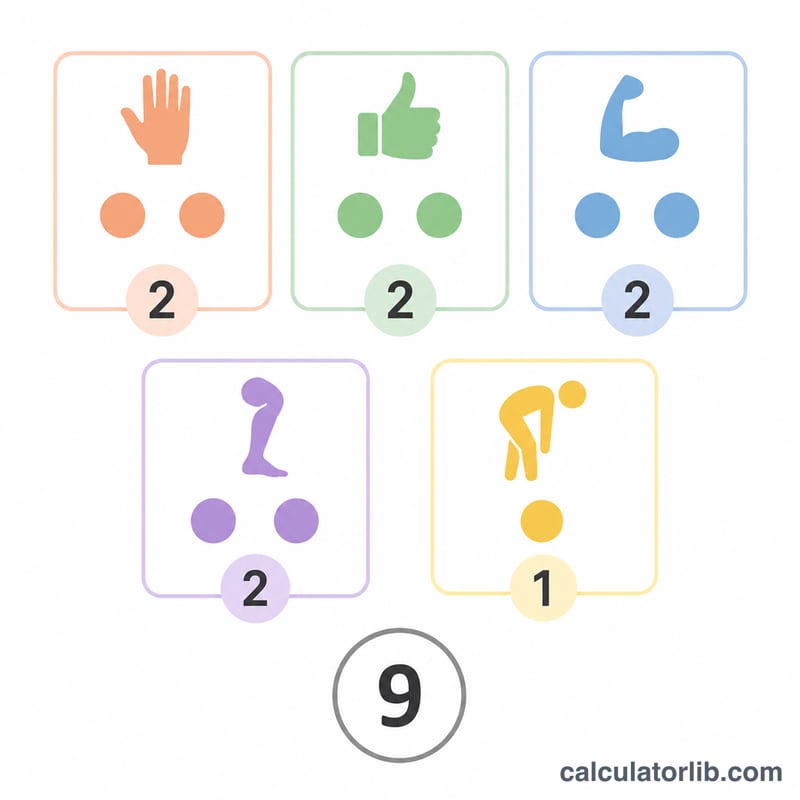
Suppose a person can bend both pinkies back, touch both thumbs to the forearm, hyperextend both elbows, but cannot hyperextend their knees and cannot place their palms flat on the floor. That is \(2 + 2 + 2 + 0 + 0 = 6\). A score of 6 is above the adult threshold, indicating generalized joint hypermobility is likely.
Interpreting Your Beighton Score
The Beighton score is a 9-point screening tool for generalized joint hypermobility (GJH). Each of the nine maneuvers that you can perform adds one point, so the total ranges from 0 (no hypermobile joints tested) to 9 (all tested joints hypermobile). The score is symmetric: the pinky, thumb, elbow, and knee maneuvers are each scored separately on the left and right sides (8 points), plus 1 point for the forward trunk flexion with palms flat on the floor.
Established cut-offs for generalized joint hypermobility
The threshold for a "positive" screen depends on age, because joint laxity decreases across the lifespan. The 2017 International Classification of the Ehlers-Danlos Syndromes uses the following cut-offs:
| Population | Cut-off for GJH |
|---|---|
| Children and adolescents (prepubertal) | ≥ 6 of 9 |
| Adults (to about age 50) | ≥ 5 of 9 |
| Adults over ~50 (older adults) | ≥ 4 of 9 |
What different score ranges suggest
- 0–3: Low likelihood of generalized joint hypermobility. Isolated hypermobility at one or two joints is common and not in itself clinically significant.
- 4: Below the adult cut-off for most adults, but meets the threshold for older adults (over ~50). In younger adults this is sometimes described as suggestive but sub-threshold.
- 5–6: Meets the adult cut-off (and the pediatric cut-off at 6). Indicates generalized joint hypermobility on screening.
- 7–9: Meets all standard cut-offs and reflects widespread joint hypermobility.
For example, a 30-year-old who can perform both pinky maneuvers, both thumb maneuvers, both elbow maneuvers, and the trunk maneuver scores 7 out of 9, which is at or above the adult cut-off of 5.
Important limitations
A Beighton score above the cut-off indicates generalized joint hypermobility — it does not by itself diagnose hypermobile Ehlers-Danlos syndrome (hEDS) or a hypermobility spectrum disorder (HSD). Under the 2017 International Classification criteria, a diagnosis of hEDS requires a positive Beighton screen plus additional clinical features (such as systemic connective-tissue findings, a positive family history, or musculoskeletal complications) and the exclusion of other conditions. The Beighton maneuvers also do not assess every joint (for instance the shoulders, hips, ankles, and jaw), so historical questionnaires are sometimes added for people whose tested joints have stiffened with age.
This is general educational information about how the score is interpreted, not medical advice. Diagnosis and management require evaluation by a qualified healthcare professional.
FAQ
Is a high Beighton score a diagnosis? No. It only screens for hypermobility. A diagnosis like hEDS requires additional clinical criteria assessed by a healthcare professional.
What is a normal Beighton score? Many people score 0–3. Scores tend to be higher in children, women, and certain ethnic groups.
Can my score change over time? Yes. Joint flexibility usually decreases with age, so a score taken in childhood may differ from one taken in adulthood.