
What is the Pet BCS Calculator?
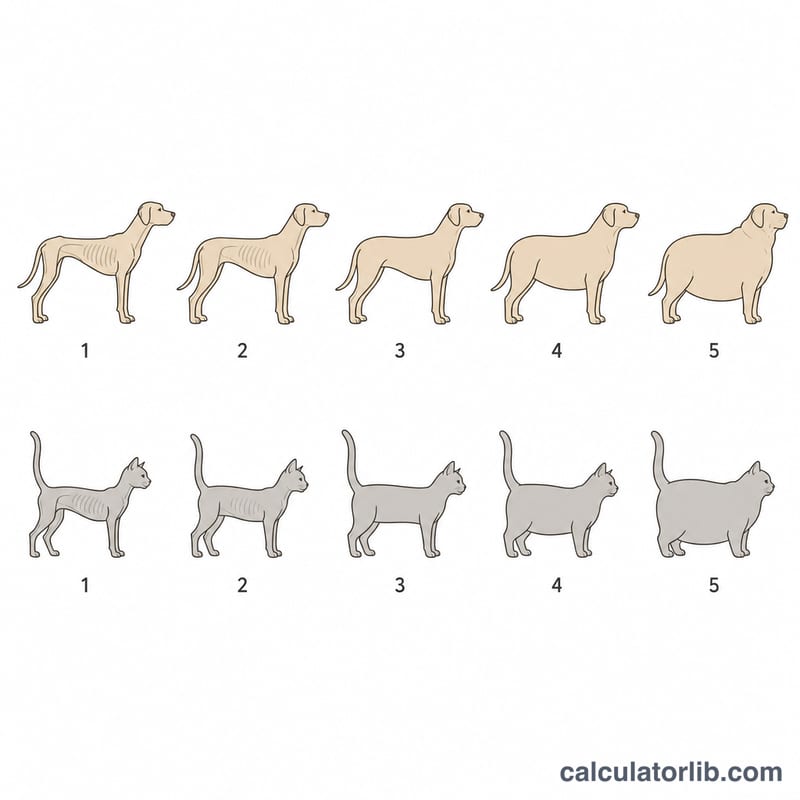
This tool is based on the 5-level body-condition guide published by Japan's Ministry of the Environment for dog and cat owners. A Body Condition Score (BCS) is a standardized way to judge whether a pet is too thin, ideal, or overweight using visual inspection and hands-on (palpation) assessment rather than weight alone. You pick the number from 1 to 5 whose illustration and description best match how your pet looks and feels, and the calculator returns the BCS, an obesity category, and an approximate body-fat range.
How to use it
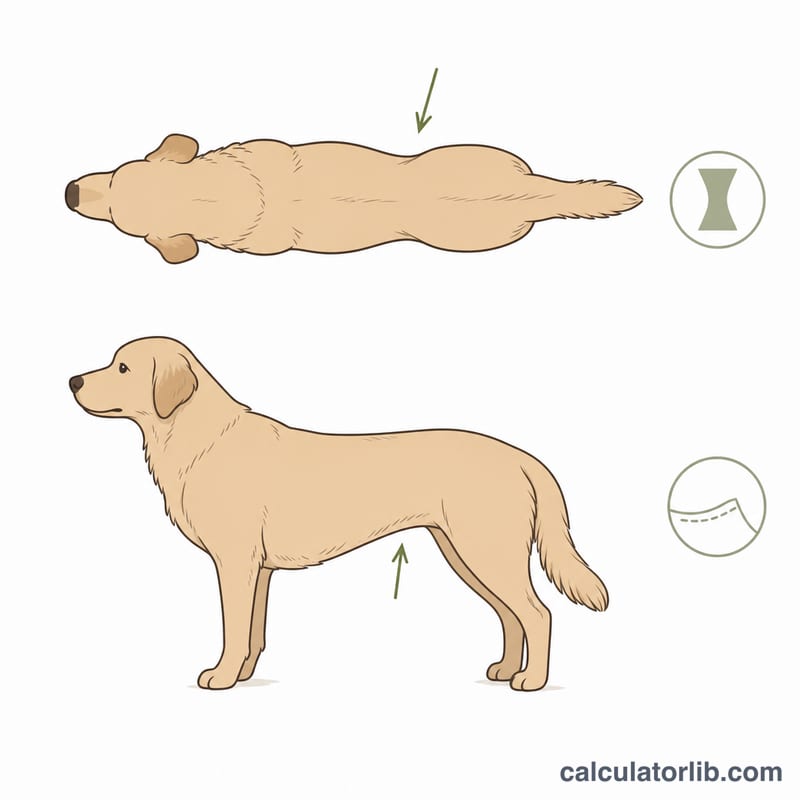
Choose whether you have a dog or a cat, then run your hands over the rib cage and look at the waist and abdominal tuck from above and the side. Select the matching number: 1 (ribs and bones visible, no fat), 3 (ribs easily felt, clear waist and tuck - ideal), or 5 (ribs not palpable, no waist, fat deposits). The result shows your pet's score out of 5.
The formula explained
This is a deterministic lookup, not a measured calculation. Let \(n\) be the matching number you selected. The BCS equals \(n\) and is shown as \(n/5\). The obesity category and body-fat range come from reference tables associated with each level. The body-fat percentages are approximate associations, not a measurement of your individual pet.
$$\text{BCS} = \text{Matching number}\,/\,5 \qquad \text{9-scale} = 2 \times \text{Matching number} - 1$$
Worked example
A dog assessed at level 3: \(\text{BCS} = 3/5\), obesity level = Ideal, body fat = 15-25% (ideal). A cat assessed at level 5: \(\text{BCS} = 5/5\), obesity level = Obese, body fat = over 35%.
FAQ
Is this a 5-point or 9-point scale? This uses the Japanese 5-point scale. Many veterinary clinics abroad use a 9-point scale where ideal is 4-5/9. The result includes a rough 9-point equivalent.
Is the body-fat percentage exact? No. It is an approximate reference range linked to each BCS level, not a body-fat measurement.
Does dog versus cat change the score? No. The numeric mapping is the same; only the reference descriptions differ slightly between species. Always confirm with your veterinarian.