
What is the Stefan-Boltzmann Law?
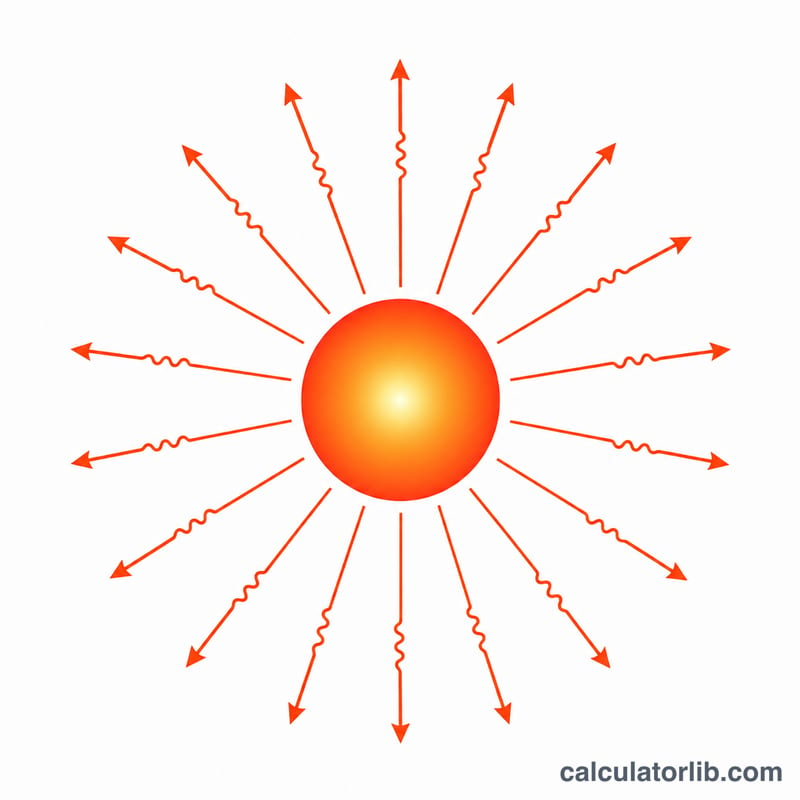
The Stefan-Boltzmann law describes how much thermal radiation an object emits based on its temperature. It states that the total power radiated by a surface is proportional to the fourth power of its absolute temperature. This calculator computes the radiated power P (in watts) from an object's emissivity, surface area, and temperature.
The Formula
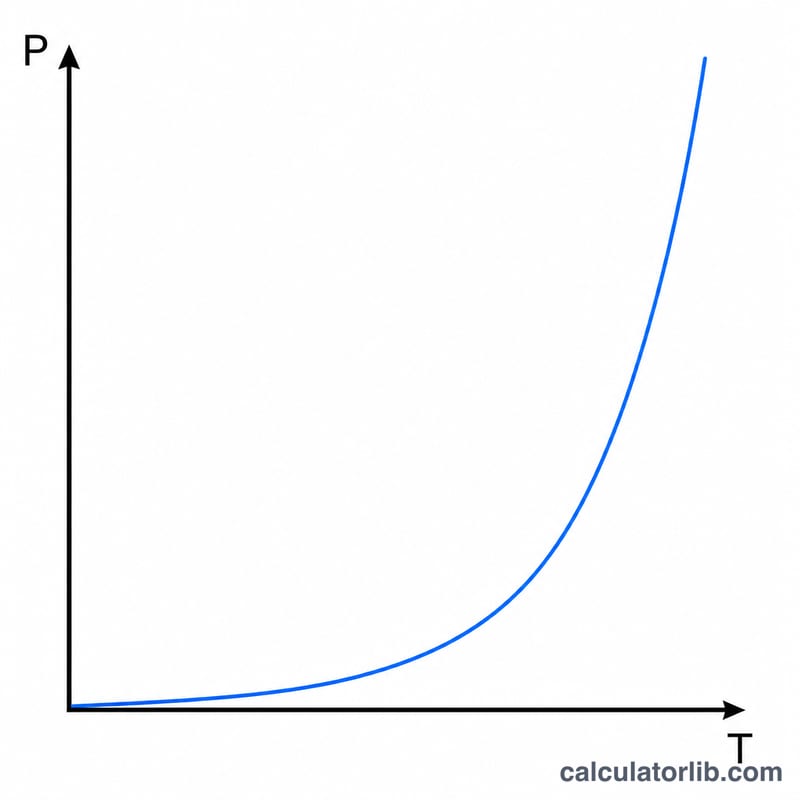
The law is written as $$P = \varepsilon \cdot \sigma \cdot A \cdot T^{4}$$ where:
• \(\varepsilon\) is the emissivity (0 for a perfect reflector, 1 for an ideal black body).
• \(\sigma\) is the Stefan-Boltzmann constant, \(5.670374419 \times 10^{-8}\ \text{W}\cdot\text{m}^{-2}\cdot\text{K}^{-4}\).
• \(A\) is the radiating surface area in square meters.
• \(T\) is the absolute temperature in kelvin (K).
Because temperature is raised to the fourth power, even small temperature increases dramatically raise the emitted power.
How to Use the Calculator
Enter the emissivity (between 0 and 1), the surface area in square meters, and the temperature in kelvin. To convert Celsius to kelvin, add 273.15. The calculator returns total radiated power in watts and the radiant flux density (power per unit area) in W/m².
Worked Example
Consider a black body (\(\varepsilon = 1\)) with a surface area of 1 m² at 300 K. Then $$P = 1 \times 5.670374419 \times 10^{-8} \times 1 \times 300^{4}.$$ Since \(300^{4} = 8.1 \times 10^{9}\), \(P \approx 459.3\ \text{W}\). The flux density is the same value, \(\approx 459.3\ \text{W/m}^{2}\), because the area is 1 m².
FAQ
Why must temperature be in kelvin? The law uses absolute temperature; using Celsius or Fahrenheit gives wrong results. Always convert first.
What is emissivity? A dimensionless measure (0–1) of how effectively a surface emits radiation compared with an ideal black body. Polished metals are near 0.05; matte black surfaces approach 1.
Does this account for absorbed radiation? No. This gives gross emitted power. For net radiative exchange, subtract the power absorbed from surroundings: \(P_{net} = \varepsilon \sigma A (T^{4} - T_{surr}^{4})\).