

What the Ohm's Law Calculator Does
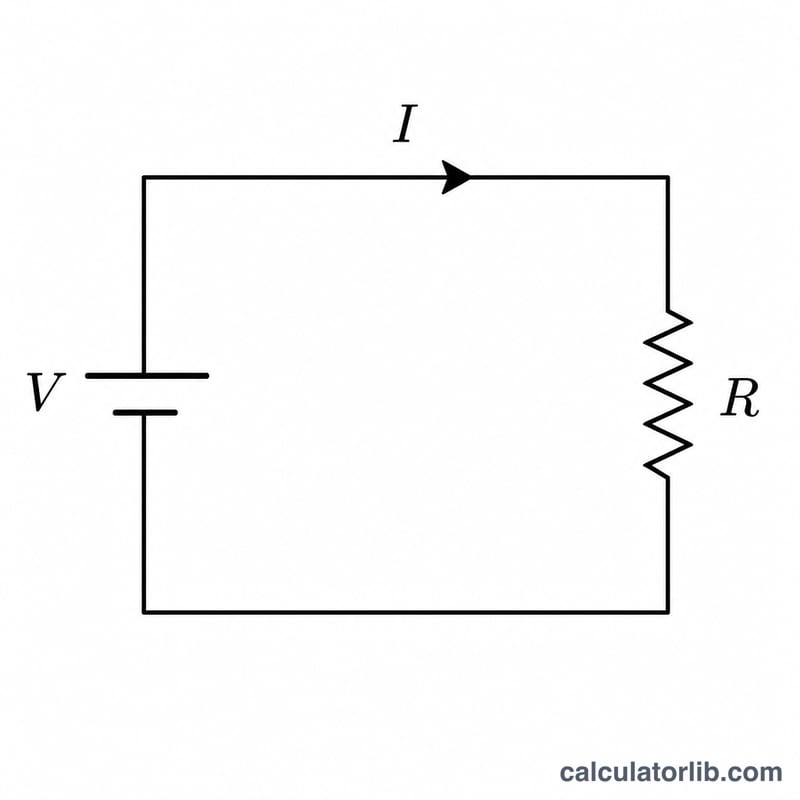
This calculator solves the four core quantities of a simple DC electrical circuit: voltage (V, in volts), current (I, in amperes), resistance (R, in ohms) and power (P, in watts). You only need to know any two of these values—enter them and the tool instantly works out the remaining two. It's a quick way to size resistors, check current draw, or estimate power dissipation without juggling formulas by hand.
How to Use It
- Fill in exactly two of the four fields: Voltage (V), Current (A), Resistance (Ω) or Power (W).
- Leave the other two fields blank.
- The calculator detects which pair you entered and computes the missing values.
- Note: all inputs must be positive numbers greater than zero. If fewer than two valid values are supplied, you'll see a prompt to enter at least two.
The Formulas Behind It
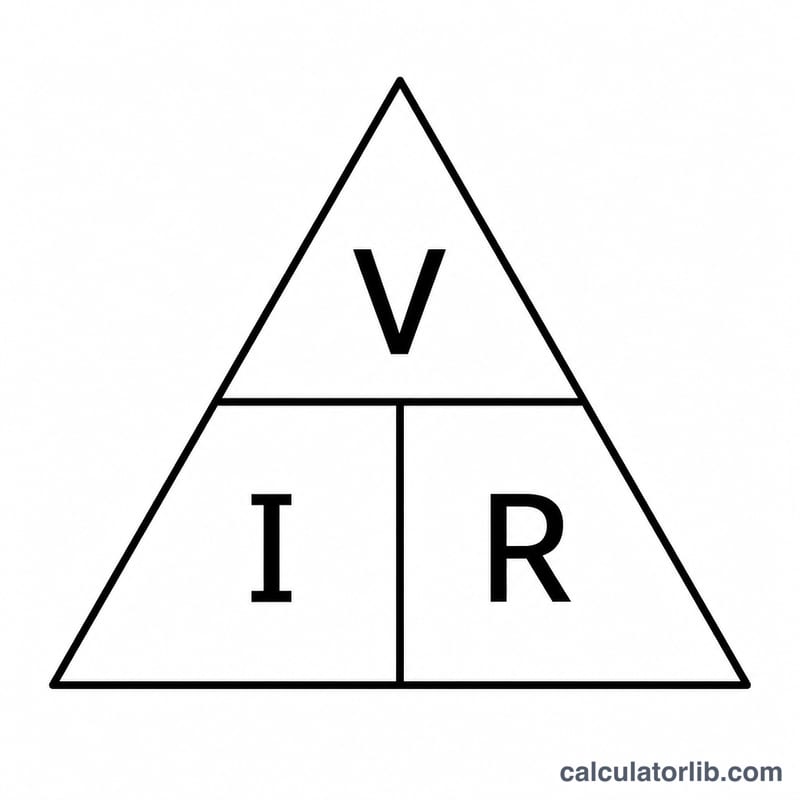
Ohm's Law states that \(V = I \times R\), and electrical power adds \(P = V \times I\). The calculator rearranges these depending on which two values you give:
- V & I: \(R = V \div I\), \(P = V \times I\)
- V & R: \(I = V \div R\), \(P = V^2 \div R\)
- V & P: \(I = P \div V\), \(R = V^2 \div P\)
- I & R: \(V = I \times R\), \(P = I^2 \times R\)
- I & P: \(V = P \div I\), \(R = P \div I^2\)
- R & P: \(V = \sqrt{P \times R}\), \(I = \sqrt{P \div R}\)
Worked Example
Suppose you enter a Voltage of 12 V and a Resistance of 4 Ω. The calculator uses the V & R case:
- Current: $$I = 12 \div 4 = 3\ \text{A}$$
- Power: $$P = 12^2 \div 4 = 144 \div 4 = 36\ \text{W}$$
So a 12-volt supply across a 4-ohm load pushes 3 amps and dissipates 36 watts.
FAQ
Can I enter all four values? You only need two. If you enter more, the calculator uses the first matching pair in its priority order (starting with voltage and current).
Why must values be positive? The tool treats zero or blank entries as "not provided." A resistance or current of zero would also make the equations undefined, so it requires values greater than zero.
Does this work for AC circuits? It applies to DC and purely resistive loads. For AC circuits with reactance, you'd need impedance and power factor, which this basic Ohm's Law tool does not account for.