
What Is an Osculating Circle?
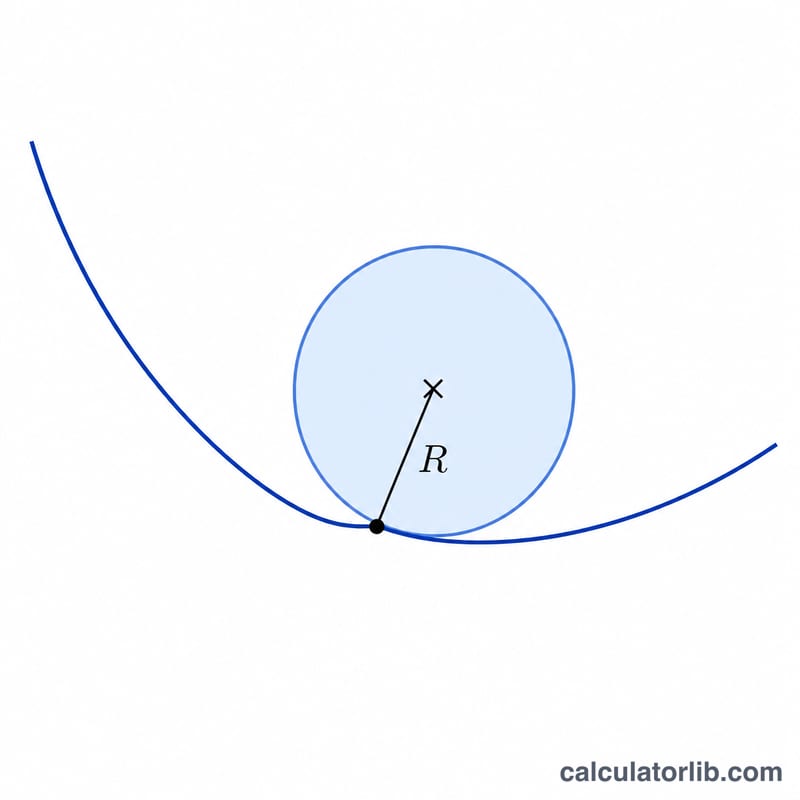
The osculating circle is the circle that best approximates a curve at a specific point. It "kisses" the curve there (the Latin osculare means "to kiss"), matching not just the point itself but also the curve's slope and how sharply it bends. For any smooth parametric curve defined by x(t) and y(t), the osculating circle at a chosen parameter t shares the curve's tangent direction and its curvature at that point.
This calculator takes your parametric equations and a value of t, then returns three things: the curvature \(\kappa\), the radius of curvature \(R\), and the coordinates of the circle's center. These quantities are widely used in physics, road and railway design, computer graphics, and differential geometry.
How to Use the Calculator
- Enter the x-component of the curve as a function of t, e.g.
cos(t). - Enter the y-component, e.g.
sin(t). - Enter the parameter value t at which you want the circle (in radians where trig functions are used).
- Read off the curvature, radius, and center point.
The Formulas Explained
For a parametric curve, the curvature is:
$$\kappa = \frac{\left| x^{\prime} y^{\prime\prime} - y^{\prime} x^{\prime\prime} \right|}{\left( x^{\prime 2} + y^{\prime 2} \right)^{3/2}}$$
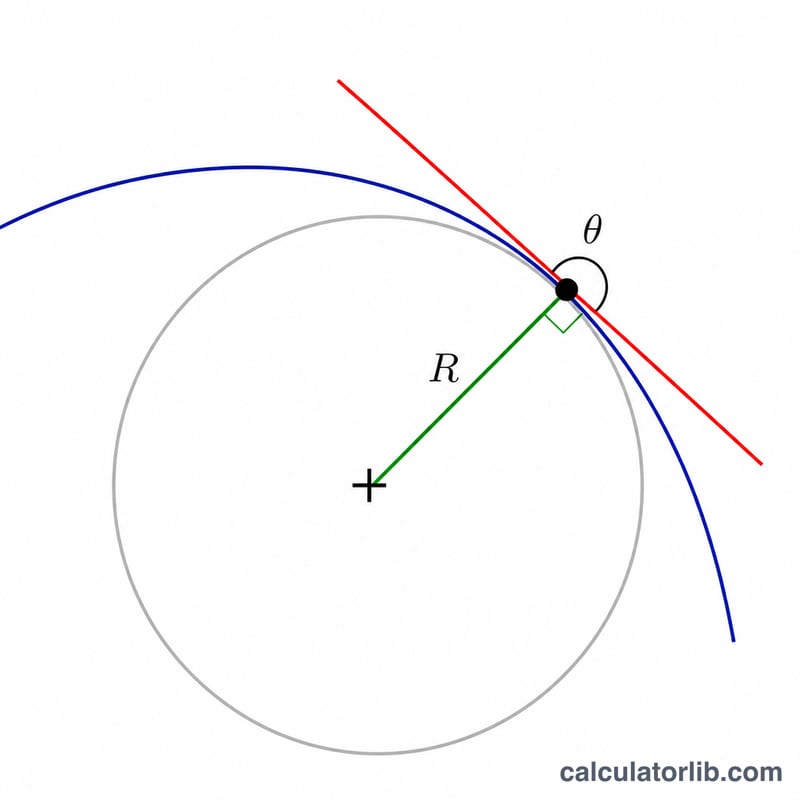
The radius of curvature is simply the reciprocal: $$R = \frac{1}{\kappa}$$ A large radius means a gentle bend; a small radius means a tight turn.
The center of the osculating circle lies a distance \(R\) from the curve, along the inward-pointing normal direction. Its coordinates are computed from the point \((x, y)\) plus the appropriate normal offset.
Worked Example
Take the curve \(x(t) = \cos(t)\), \(y(t) = \sin(t)\) — the unit circle — at \(t = 0\). Here \(x^{\prime} = -\sin(t)\), \(y^{\prime} = \cos(t)\), \(x^{\prime\prime} = -\cos(t)\), \(y^{\prime\prime} = -\sin(t)\). At \(t = 0\) this gives curvature \(\kappa = 1\), so the radius \(R = 1\). The center sits at the origin \((0, 0)\). That makes perfect sense: the osculating circle of a unit circle is the circle itself.
Frequently Asked Questions
What units does t use? If your functions contain trigonometric terms, t is treated as radians. For polynomial curves, t is just a dimensionless parameter.
What if the curvature is zero? At an inflection point or a straight segment, \(\kappa = 0\) and the radius becomes infinite — there is no finite osculating circle, only a tangent line.
Why is curvature useful? It quantifies how sharply something turns. Engineers use it to limit lateral acceleration on roads, and animators use it to create smooth motion paths.