
What the Percent to Fraction Calculator Does
This calculator converts any percentage into its decimal equivalent and an equivalent fraction — both in unsimplified and fully simplified form. You enter a single number (the percentage), and the tool instantly returns the decimal value, the raw fraction, and the reduced fraction. It works with whole numbers and decimals alike, so a value like 12.5% is handled just as easily as 50%.
How to Use It
- Enter Percentage: Type a value between 0 and 100. Decimals are allowed (for example, 37.5 or 12.5).
- Submit to see four results: the decimal equivalent, the unsimplified numerator, the fixed denominator, and the simplified fraction.
The Formula Explained
The calculator follows a fixed, predictable method based on the code behind it:
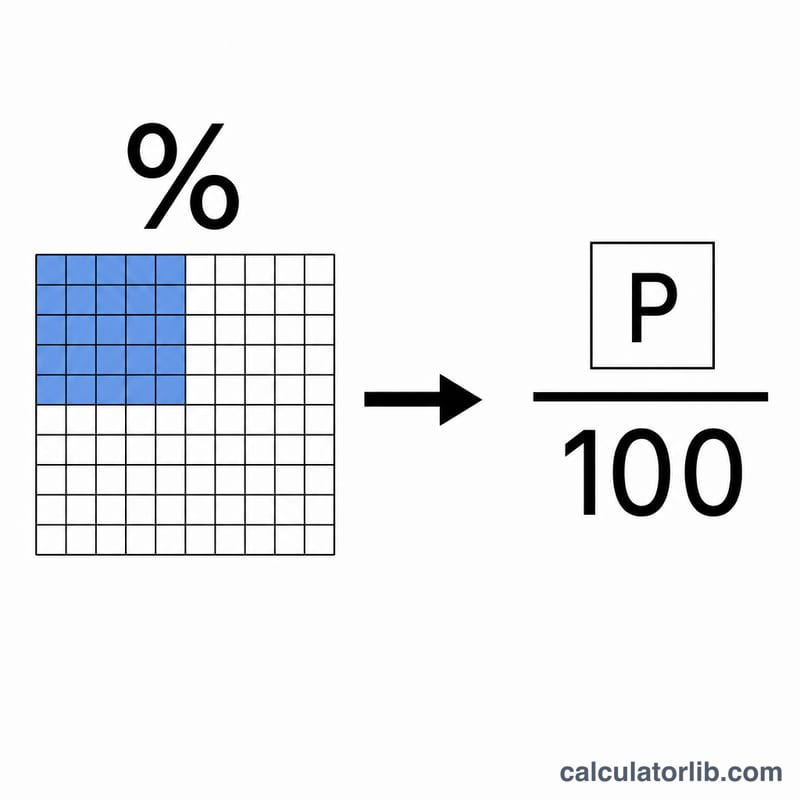
$$\text{Fraction} = \frac{\text{Percent} \times 100}{10000} \quad \text{(simplified)}$$- Decimal: percentage \(\div\) 100. So 25% becomes 0.25.
- Numerator: percentage \(\times\) 100, rounded to a whole number. This shifts the value so that decimal percentages still produce a clean integer.
- Denominator: always 10,000. Because the numerator is the percentage multiplied by 100, dividing by 10,000 returns the original percentage as a fraction.
- Simplified fraction: the numerator and 10,000 are divided by their greatest common divisor (GCD), reducing the fraction to its lowest terms.
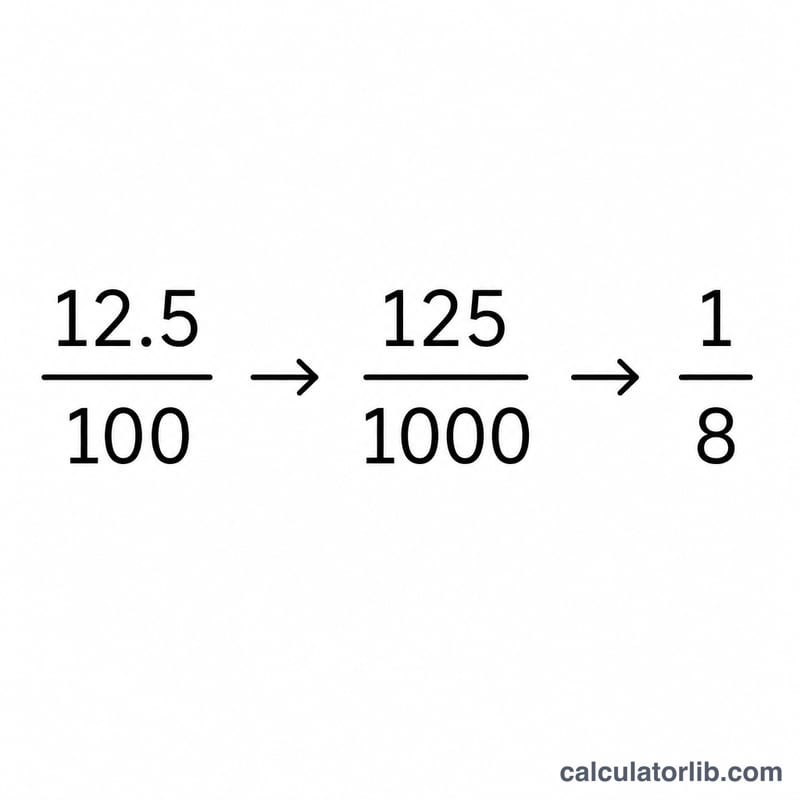
Worked Example: 12.5%
Suppose you enter 12.5:
- Decimal = \(12.5 \div 100 = \mathbf{0.125}\)
- Numerator = \(12.5 \times 100 = \mathbf{1250}\)
- Denominator = 10000, so the unsimplified fraction is \(\frac{1250}{10000}\)
- GCD of 1250 and 10000 is 1250, giving the simplified fraction \(\mathbf{\frac{1}{8}}\)
So 12.5% equals \(\frac{1}{8}\), which matches the decimal 0.125.
Frequently Asked Questions
Why is the denominator always 10,000? Multiplying the percentage by 100 to build the numerator means dividing by 10,000 keeps the value correct. This consistent base allows decimal percentages (like 12.5%) to convert cleanly before simplification.
Can I enter decimal percentages? Yes. Values such as 12.5, 37.5, or 6.25 are fully supported and produce accurate simplified fractions.
What happens with whole-number percentages? They work the same way. For example, 50% gives numerator 5000 over 10000, simplifying to \(\frac{1}{2}\).