
What is the ICH Score?
The ICH Score is a simple, validated clinical grading scale developed by Hemphill and colleagues (2001) to assess the severity of spontaneous intracerebral hemorrhage (ICH) and to estimate 30-day mortality. It combines five readily available factors into a single number from 0 to 6, providing a common language for clinicians communicating about stroke patients and supporting prognostic discussions. This tool is intended for educational and decision-support purposes and does not replace clinical judgment.
How to use it
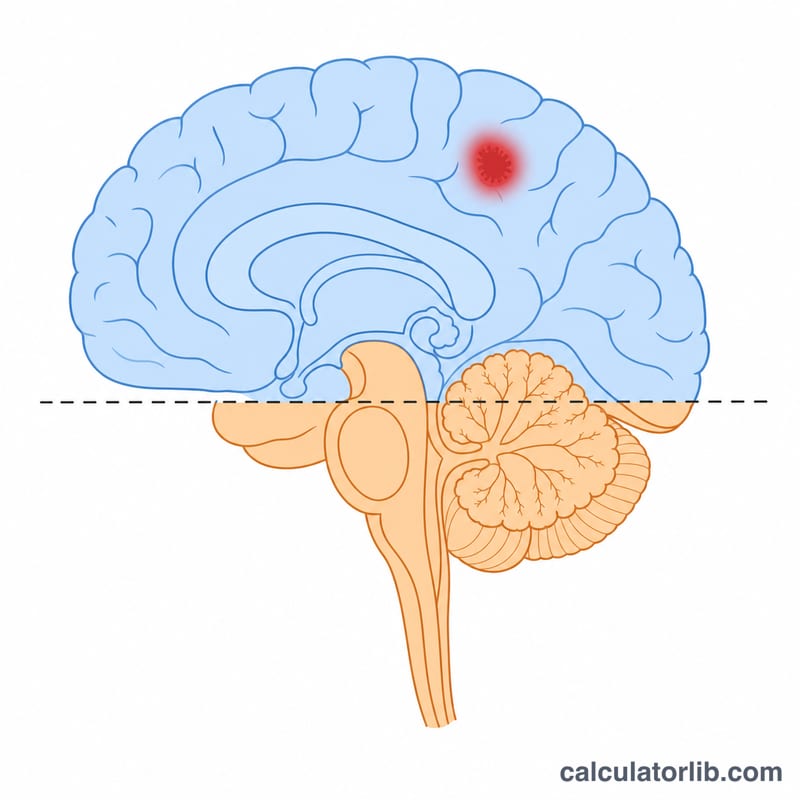
Enter the patient's Glasgow Coma Scale (GCS) score on admission, the ICH volume in milliliters (typically measured by the ABC/2 method on CT), whether intraventricular hemorrhage (IVH) is present, whether the hemorrhage originates in the infratentorial compartment (brainstem or cerebellum), and the patient's age. The calculator sums the weighted points and returns the total ICH Score along with an approximate 30-day mortality estimate from the original validation cohort.
The formula explained
Points are assigned as follows: GCS 3-4 scores 2 points, GCS 5-12 scores 1 point, GCS 13-15 scores 0; ICH volume \(\geq 30\,\text{mL}\) adds 1 point; presence of IVH adds 1 point; infratentorial origin adds 1 point; and age \(\geq 80\) years adds 1 point. The maximum score is 6.
$$\begin{gathered} \text{ICH Score} = G + V + I + F + A \\[1.5em] \text{where}\quad \left\{ \begin{aligned} G &= \begin{cases} 2 & \text{GCS} \in [3,4] \\ 1 & \text{GCS} \in [5,12] \\ 0 & \text{GCS} \geq 13 \end{cases} \\ V &= \begin{cases} 1 & \text{Volume} \geq 30\,\text{mL} \\ 0 & \text{otherwise} \end{cases} \\ I &= \text{IVH present} \;?\; 1 : 0 \\ F &= \text{Infratentorial} \;?\; 1 : 0 \\ A &= \begin{cases} 1 & \text{Age} \geq 80 \\ 0 & \text{otherwise} \end{cases} \end{aligned} \right. \end{gathered}$$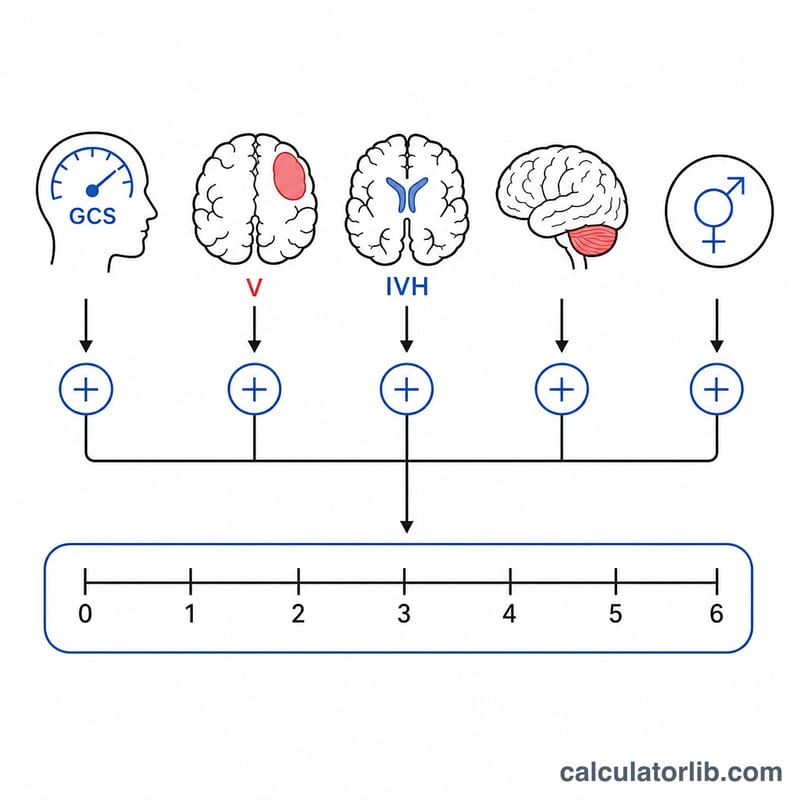
Worked example
Consider a 75-year-old patient with a GCS of 10, an ICH volume of 35 mL, IVH present, and a supratentorial hemorrhage. GCS 10 falls in the 5-12 range = 1 point; volume \(\geq 30\,\text{mL}\) = 1 point; IVH = 1 point; supratentorial = 0; age < 80 = 0.
$$\text{ICH Score} = 1 + 1 + 1 + 0 + 0 = 3$$Total ICH Score = 3, corresponding to roughly a 72% estimated 30-day mortality in the original cohort.
FAQ
How is ICH volume measured? Most clinicians use the ABC/2 ellipsoid approximation on the CT slice with the largest hematoma.
What mortality figures are shown? The estimates (0, 13%, 26%, 72%, 97%, 100% for scores 0-5) come from the original Hemphill 2001 single-center study and should be interpreted with caution.
Does a high score mean treatment is futile? No. The ICH Score is a prognostic aid, not a treatment directive; outcomes depend on many factors and care decisions should be individualized.