
What Is the GAD-7?
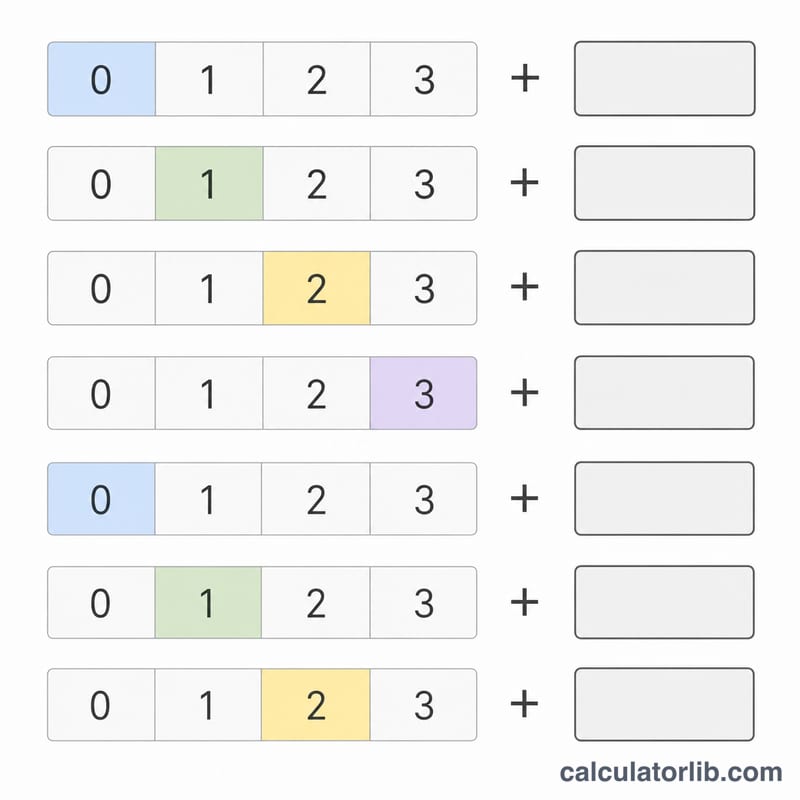
The Generalized Anxiety Disorder 7-item (GAD-7) scale is a widely used screening tool for anxiety. It asks how often, over the last two weeks, you have been bothered by seven common symptoms of anxiety. Each item is rated from 0 (not at all) to 3 (nearly every day), and the responses are added together for a total score between 0 and 21. This calculator is an educational tool and is not a diagnosis — only a qualified clinician can assess and treat anxiety disorders.
How to Use This Calculator
For each of the seven questions, select how often the symptom has affected you over the past two weeks. Choose a value from 0 to 3 for every item, then submit. The calculator adds all seven responses and reports your total score along with the matching severity band.
The Formula Explained
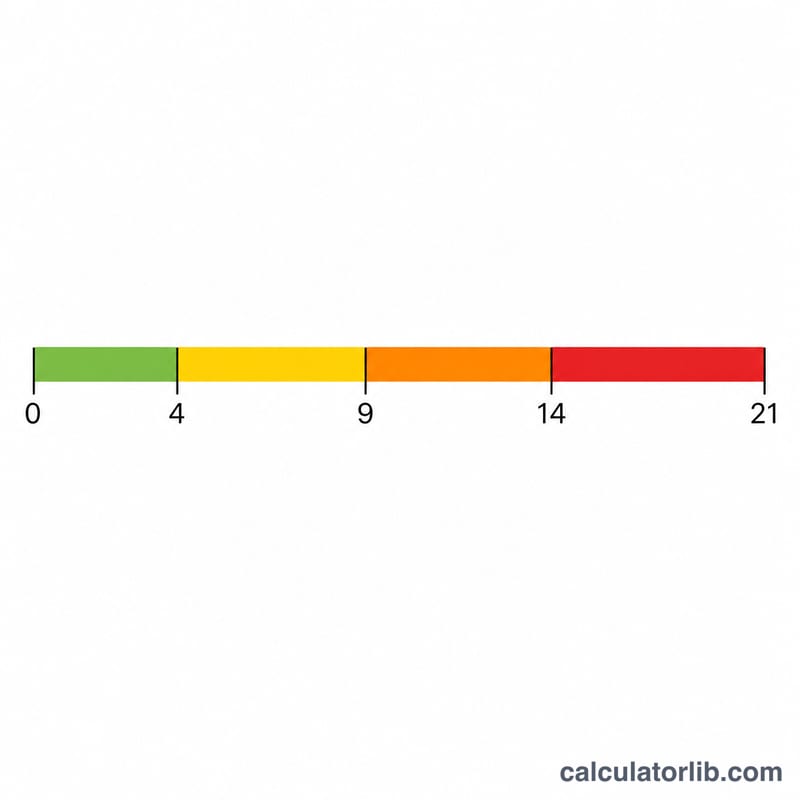
The score is simply the sum of all seven answers: $$\text{GAD-7} = \text{Q1} + \text{Q2} + \text{Q3} + \text{Q4} + \text{Q5} + \text{Q6} + \text{Q7}$$ Because each answer is 0–3, the minimum is 0 and the maximum is 21. The total is interpreted using standard cut points: 0–4 indicates minimal anxiety, 5–9 mild, 10–14 moderate, and 15–21 severe. A score of 10 or more is often used as a threshold suggesting further evaluation.
Worked Example
Suppose someone answers: 2, 3, 2, 1, 0, 2, 2. Adding these gives $$2 + 3 + 2 + 1 + 0 + 2 + 2 = 12$$ A total of 12 falls in the 10–14 band, so the result is moderate anxiety.
FAQ
Is a high GAD-7 score a diagnosis? No. The GAD-7 is a screening instrument that flags the likely presence and severity of anxiety symptoms. A formal diagnosis requires clinical assessment.
What score should prompt me to seek help? A score of 10 or above is commonly treated as a clinically significant threshold, but talk to a healthcare professional about any score that concerns you.
How often can I take it? Clinicians often re-administer the GAD-7 over time to track changes, since each administration reflects the prior two weeks.