
What Is the Bishop Score?
The Bishop Score is a clinical scoring system developed by Dr. Edward Bishop in 1964 to assess cervical "ripeness" — how ready the cervix is for labor. It is used to predict whether an induction of labor is likely to succeed or whether spontaneous labor is imminent. The total ranges from 0 to 13, with higher scores indicating a more favorable cervix. This tool is intended for use by clinicians and is for educational reference only.
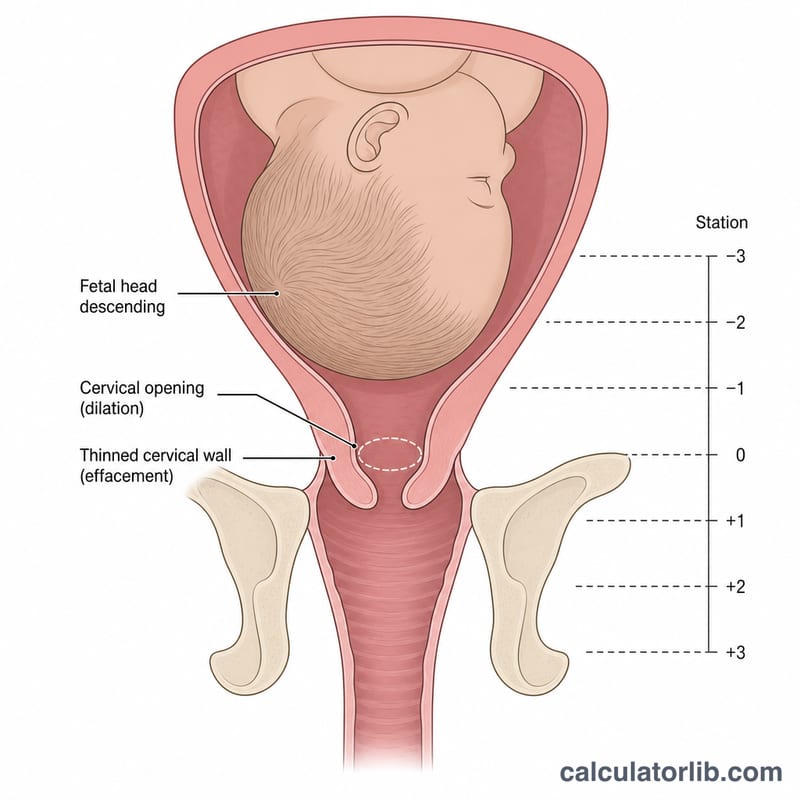
How to Use It
Select the appropriate option for each of the five components based on a vaginal examination: cervical dilation (cm), effacement (%), fetal station, cervical consistency, and cervical position. The calculator adds the points assigned to each parameter and reports the total score with an interpretation.
The Formula Explained
Each parameter contributes points: dilation, effacement, and station each score 0–3, while consistency and position each score 0–2. The total Bishop Score is simply their sum:
$$\text{Score} = \text{Dilation} + \text{Effacement} + \text{Station} + \text{Consistency} + \text{Position}$$
Generally, a score of 8 or higher suggests the cervix is favorable and induction is likely to succeed (similar odds to spontaneous labor). A score of 5 or less suggests an unfavorable cervix that may benefit from cervical ripening agents before induction.
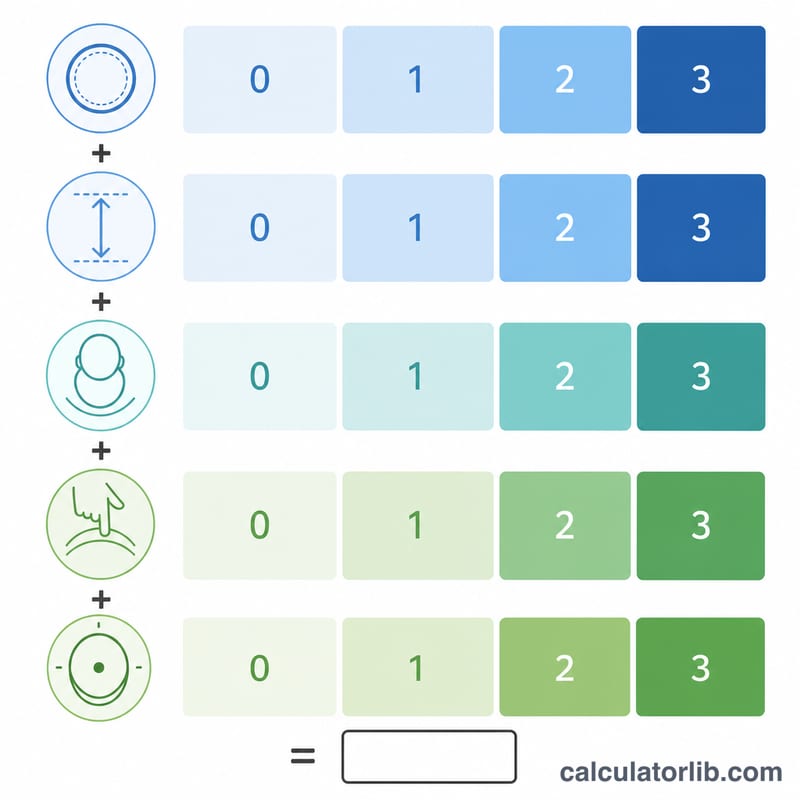
Worked Example
Consider a patient with: dilation 3–4 cm (2 points), effacement 80%+ (3 points), station -1/0 (2 points), soft consistency (2 points), and anterior position (2 points). The total is $$2 + 3 + 2 + 2 + 2 = 11$$ — a favorable cervix, strongly predicting a successful induction.
Interpreting Your Bishop Score
The Bishop Score is the sum of five cervical and fetal assessments, each scored individually, giving a total from 0 to 13. A higher score indicates a more "favorable" (ripe) cervix and a greater likelihood that induction of labor will succeed and proceed like spontaneous labor.
| Total Score | Interpretation | Clinical relevance |
|---|---|---|
| 0–5 | Unfavorable cervix | Lower likelihood of successful induction; cervical ripening agents (e.g., prostaglandins or mechanical methods) are often considered before or with induction. |
| 6–7 | Intermediate | An indeterminate range; the decision to ripen versus proceed depends on the individual clinical picture. |
| 8 or higher | Favorable cervix | Induction success rates approach those of spontaneous labor; ripening agents are generally not needed. |
A worked example: a cervix that is 1–2 cm dilated (1 point), 40–50% effaced (1 point), at station −3 (1 point), of medium consistency (1 point), and in a mid position (1 point) yields a total of 5, which falls in the unfavorable range.
Several modified versions of the score exist, including the simplified Bishop score (using dilation, effacement, and station) and variants that adjust points for factors such as prior vaginal deliveries, prematurity, postdates, pre-eclampsia, or premature rupture of membranes. Because thresholds and scoring details vary between systems, always confirm which version is being used.
This information is educational reference only and is not medical advice. Decisions about labor induction and cervical ripening should be made by a qualified clinician based on a full assessment of the pregnancy.
Definitions & Glossary
- Cervical dilation — How open the cervical opening (os) is, measured in centimeters from closed (0 cm) to fully dilated (10 cm), at which point the cervix is wide enough for the baby's head to pass.
- Cervical effacement — The thinning and shortening of the cervix, expressed as a percentage. At 0% the cervix is thick and uneffaced; at 100% it is paper-thin and fully effaced.
- Fetal station — The position of the presenting part (usually the head) relative to the mother's ischial spines, measured in centimeters. Above the spines is negative (e.g., −3), level with the spines is 0 (engaged), and below is positive (e.g., +1 to +3).
- Cervical consistency — How firm the cervix feels on examination, described as firm, medium, or soft. A soft cervix is more favorable and resembles the lips, while a firm one resembles the tip of the nose.
- Cervical position — The orientation of the cervix within the pelvis, classified as posterior, mid, or anterior. An anterior position is more favorable for labor.
- Cervical ripening — The process, natural or assisted, by which the cervix softens, thins, and begins to dilate in preparation for labor; assisted methods include pharmacologic (prostaglandins) and mechanical (balloon catheter) approaches.
- Induction of labor — The use of medical or mechanical interventions to start uterine contractions and labor before they begin on their own, often guided by the favorability of the cervix as reflected in the Bishop Score.
FAQ
What is a "favorable" Bishop Score? A score of 8 or higher is generally considered favorable, meaning the chance of vaginal delivery after induction is similar to spontaneous labor.
What does a low score mean? A score of 5 or below suggests an unfavorable cervix; cervical ripening (e.g., prostaglandins or a balloon catheter) is often used first.
Is the maximum score 13? Yes — dilation, effacement, and station each top out at 3, while consistency and position top out at 2, giving a maximum of 13.