
What Is the Waist-to-Hip Ratio?
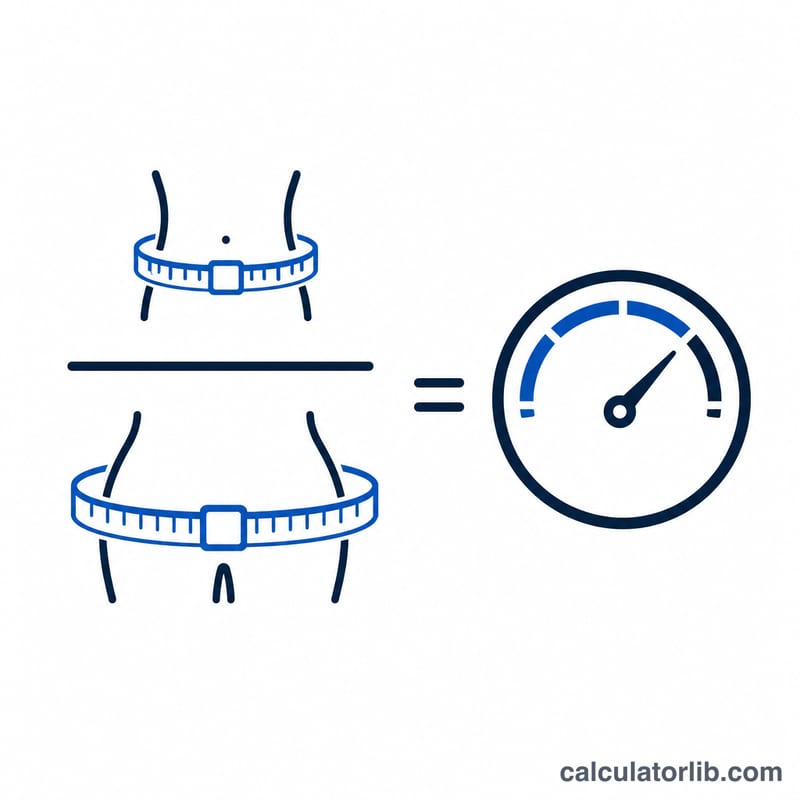
The waist-to-hip ratio (WHR) is a simple measure of how fat is distributed around your body. It compares the circumference of your waist to that of your hips. A higher ratio means more fat is stored around the abdomen (an "apple" shape), which research links to greater risk of heart disease, type 2 diabetes, and other conditions, compared with fat carried around the hips and thighs (a "pear" shape).
How to Use This Calculator
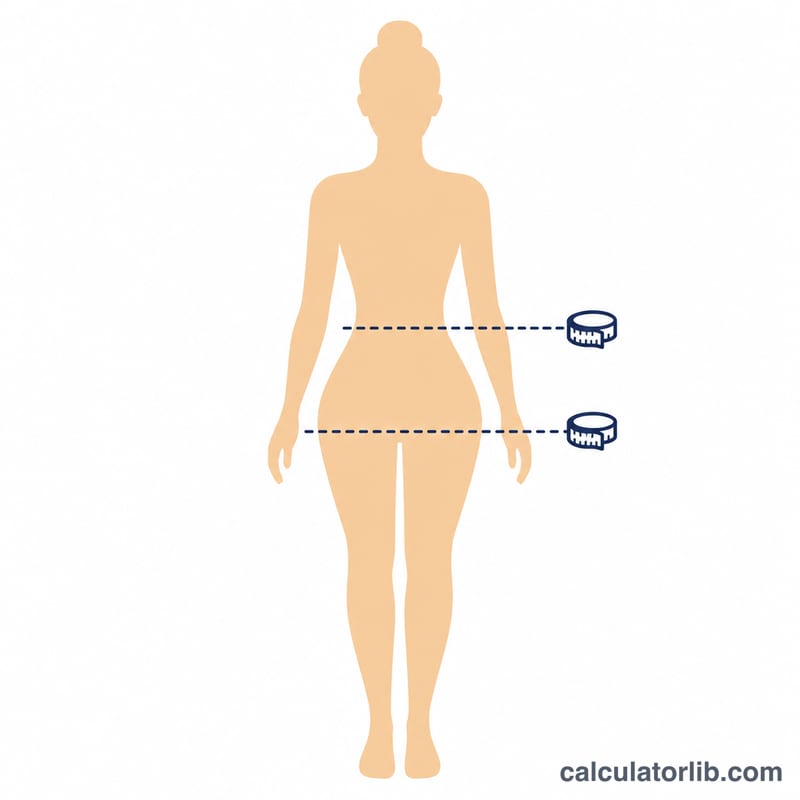
Measure your waist at the narrowest point (usually just above the belly button) and your hips at the widest point of your buttocks, keeping the tape snug but not compressing the skin. Enter both numbers using the same unit — centimeters or inches — and select your gender. The calculator divides waist by hip and instantly shows your ratio plus a health-risk category.
The Formula Explained
The math is straightforward: $$\text{WHR} = \dfrac{\text{Waist}}{\text{Hip}}$$. Because both measurements use the same unit, the units cancel and the result is a pure ratio. The World Health Organization classifies risk by gender: for men, 0.95 or below is low risk, 0.96–1.0 is moderate, and above 1.0 is high; for women, 0.80 or below is low, 0.81–0.85 is moderate, and above 0.85 is high.
Worked Example
Suppose a man has a waist of 90 cm and hips of 100 cm. His $$\text{WHR} = 90 \div 100 = 0.90.$$ Since \(0.90\) is at or below the male threshold of \(0.95\), he falls into the low-risk category.
FAQ
Does it matter whether I use inches or centimeters? No — as long as both measurements use the same unit, the ratio is identical.
Is WHR better than BMI? WHR captures fat distribution that BMI misses, so the two are often used together for a fuller picture of health.
How often should I measure? Measuring every few weeks under similar conditions (same time of day, relaxed posture) gives the most reliable trend.