What this calculator does
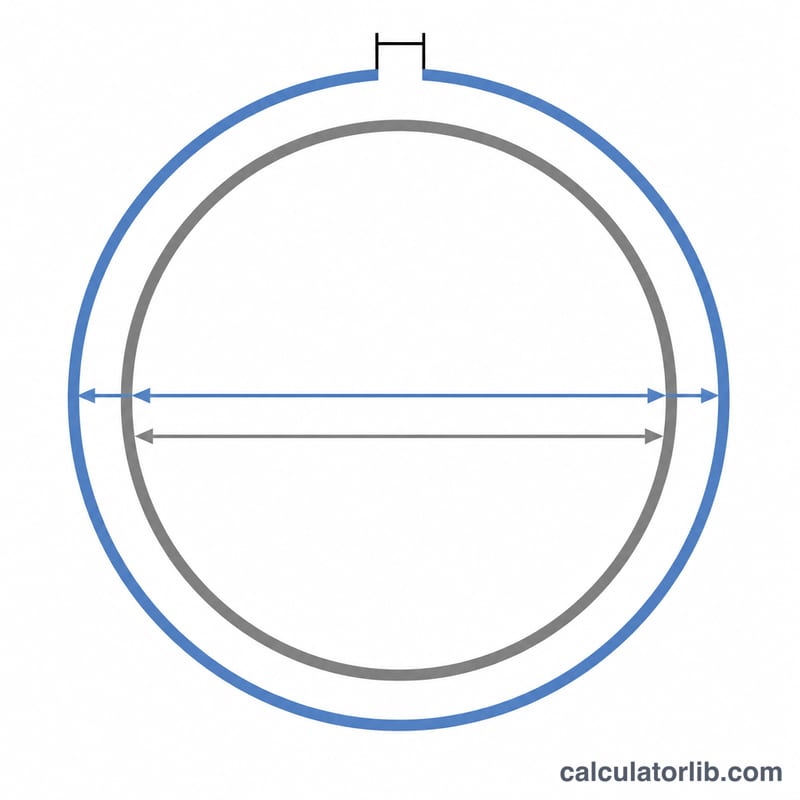
The Tyre Size Difference Calculator compares two tyre sizes written in the standard metric format (for example 205/55 R16) and reports how much the overall diameter, rolling circumference, and speedometer reading change when you switch from one size to the other. This matters because a tyre that is taller or shorter than the original alters your effective gearing, ground clearance, and the accuracy of your speedometer.
How to use it
Enter the three numbers for each tyre: the section width in millimetres, the aspect ratio as a percentage of that width, and the rim diameter in inches. The calculator returns the overall diameter and circumference for both tyres, the difference between them, and the resulting speedometer error.
The formula explained
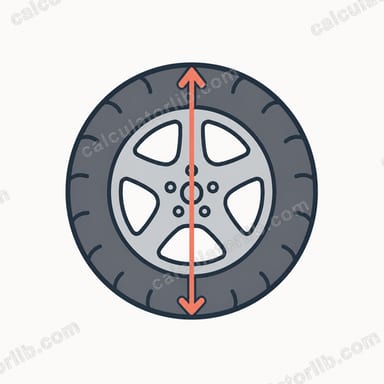
The overall diameter combines the rim and two sidewalls. With \(R\) = rim diameter (in), \(W\) = section width (mm) and \(A\) = aspect ratio (%):
$$D = R \times 25.4 + 2 \times W \times \frac{A}{100}$$The rolling circumference is \(C = \pi D\), and the speedometer error between an original tyre \(D_1\) and a new tyre \(D_2\) is:
$$E = \left(\frac{D_2}{D_1} - 1\right) \times 100$$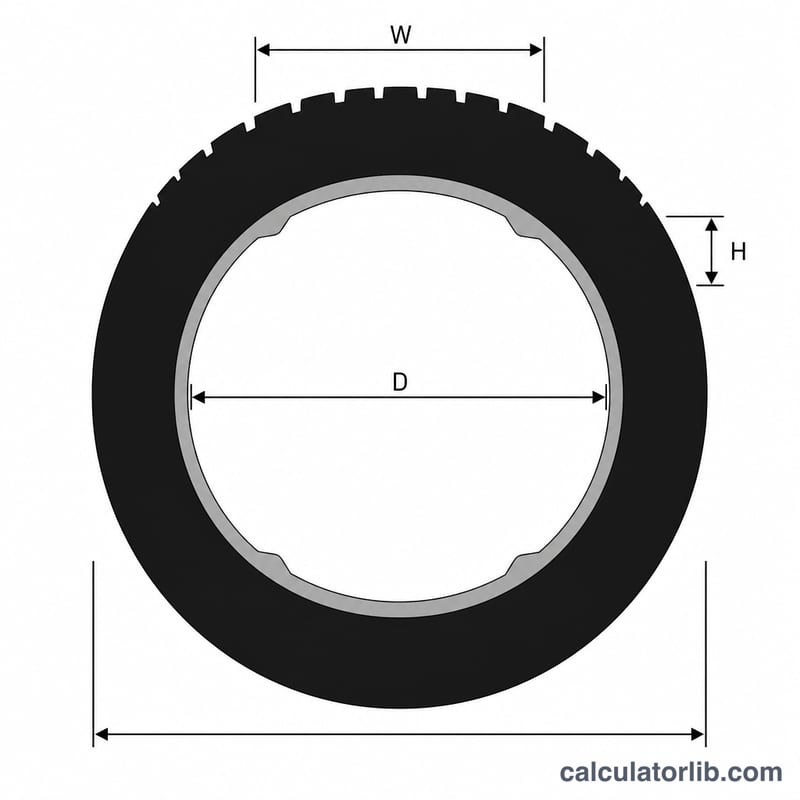
Worked example
Comparing 205/55 R16 with 225/45 R17:
$$D_1 = 16 \times 25.4 + 2 \times 205 \times \tfrac{55}{100} = 631.9\,\text{mm}$$$$D_2 = 17 \times 25.4 + 2 \times 225 \times \tfrac{45}{100} = 634.3\,\text{mm}$$The diameter grows by \(2.4\,\text{mm}\), so the speedometer error is:
$$E = \left(\frac{634.3}{631.9} - 1\right) \times 100 \approx 0.38\%$$A positive error means your true speed is slightly higher than the number shown on the dial.
Interpreting the Speedometer Error
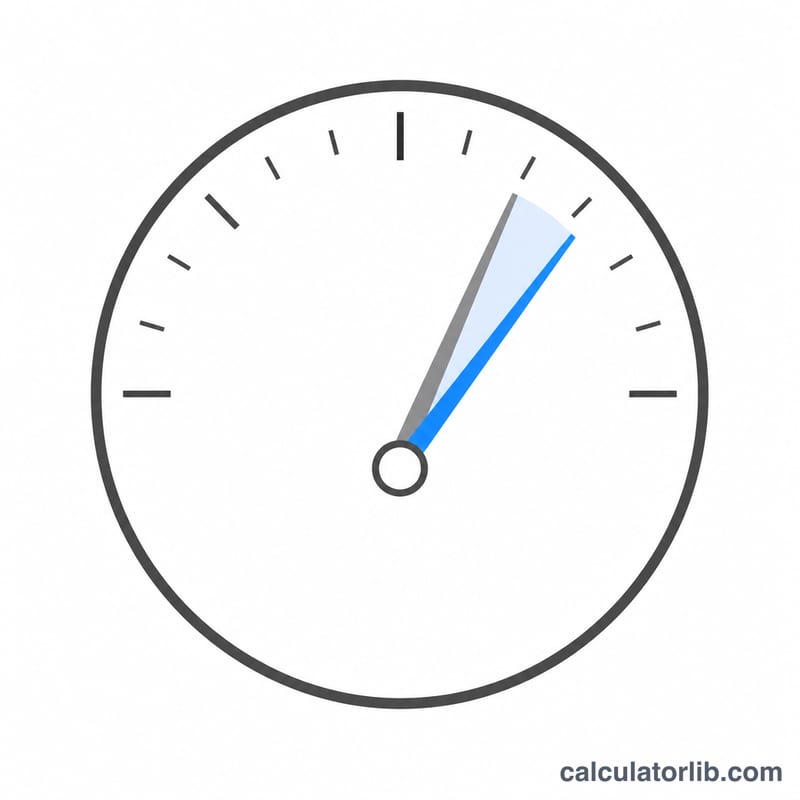
Sign convention. A positive error means the new tyre is larger. It covers more ground per revolution, so the car is going faster than the speedometer shows: the speedo reads lower than true speed. A negative error means a smaller new tyre, and the speedo reads higher than true speed. This assumes the speedometer was accurate before the change.
Converting error to true speed. Use \(v_{\text{true}} = v_{\text{shown}}\times\left(1 + \frac{E}{100}\right)\). For the +2.98% swap (225/45 R17 → 245/40 R18):
| Speedo shows | True speed |
|---|---|
| 50 km/h | 51.49 km/h |
| 100 km/h | 102.98 km/h |
| 120 km/h | 123.58 km/h |
| 30 mph | 30.89 mph |
| 60 mph | 61.79 mph |
| 70 mph | 72.09 mph |
Odometer. The odometer uses the same wheel-speed signal, so it under-counts distance after a positive error. With +2.98%, a displayed 100 km is really about 102.98 km. Service intervals and fuel-economy figures based on the odometer shift by the same proportion.
Effective gearing. A larger tyre acts like a taller final drive. At the same road speed the engine turns about \(1 - 1/1.0298 \approx 2.9\%\) slower in the 2.98% example. That can slightly reduce acceleration and, for large increases, strain towing or hill-climbing performance. A smaller tyre does the opposite.
Ground clearance. The wheel radius changes by half the diameter change. In the 2.98% example the body rises about \(18.9 / 2 = 9.45\) mm. Check also that the larger tyre clears the wheel arches, suspension and brake components at full steering lock and suspension compression.
Tolerance guidelines. A difference within about 3% in overall diameter is a commonly cited rule of thumb for a like-for-like replacement. Roadworthiness and inspection rules differ by country and region, and some set their own limits on speedometer accuracy or on permitted tyre sizes. Check the rules that apply where you drive and the vehicle manufacturer's approved sizes. This is general information, not legal advice.
Tyre Size Markings Explained
- Section width (mm): the width of the tyre from sidewall to sidewall, measured in millimetres.
- Aspect ratio (%): sidewall height as a percentage of the section width. A 55 means the sidewall is 55% as tall as the tyre is wide.
- Construction letter: R means radial construction. Other letters, such as D for diagonal (bias-ply), are much less common on modern passenger cars.
- Rim diameter (in): the diameter of the wheel the tyre fits, in inches (1 in = 25.4 mm).
- Sidewall height: \(\frac{W\times A}{100}\) in mm, the distance from the rim edge to the tread.
- Overall diameter: rim diameter in mm plus two sidewall heights, \(D = 25.4\,R + \frac{2WA}{100}\).
- Rolling circumference: the distance travelled in one wheel revolution. Nominally \(\pi D\); in practice it is slightly smaller because the tyre flattens under load and varies with wear, pressure and speed.
Example: 205/55 R16
- 205: section width of 205 mm.
- 55: aspect ratio, so sidewall height = 205 × 0.55 = 112.75 mm.
- R: radial construction.
- 16: rim diameter of 16 in = 406.4 mm.
- Overall diameter = 406.4 + 2 × 112.75 = 631.9 mm, and nominal circumference \(\pi \times 631.9 \approx 1985.2\) mm.
A marking such as 91V after the size gives the load index (91) and speed rating (V). These matter for safety and fitment, but they are not used in the diameter, circumference or speedometer-error calculation.
FAQ
What error is acceptable? Most guidance keeps the overall diameter within about 3% of the original to preserve speedometer accuracy and clearance.
Does the wheel width matter? This calculator uses only the tyre dimensions; extreme rim widths can slightly change the mounted profile.
Which tyre is which? Tyre 1 is the size your speedometer was calibrated for; Tyre 2 is the new size you are fitting.