What this calculator does
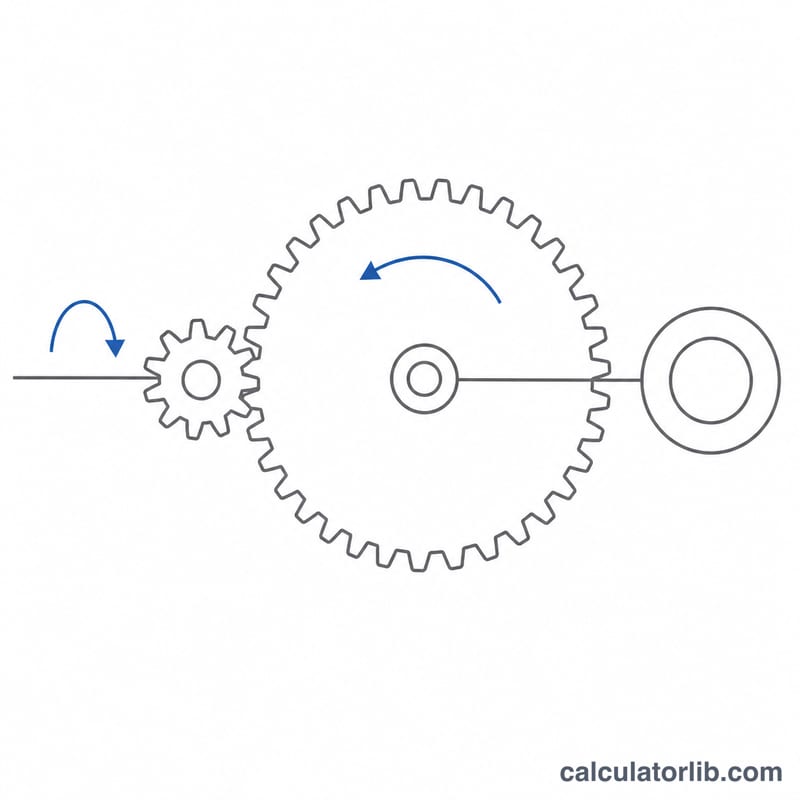
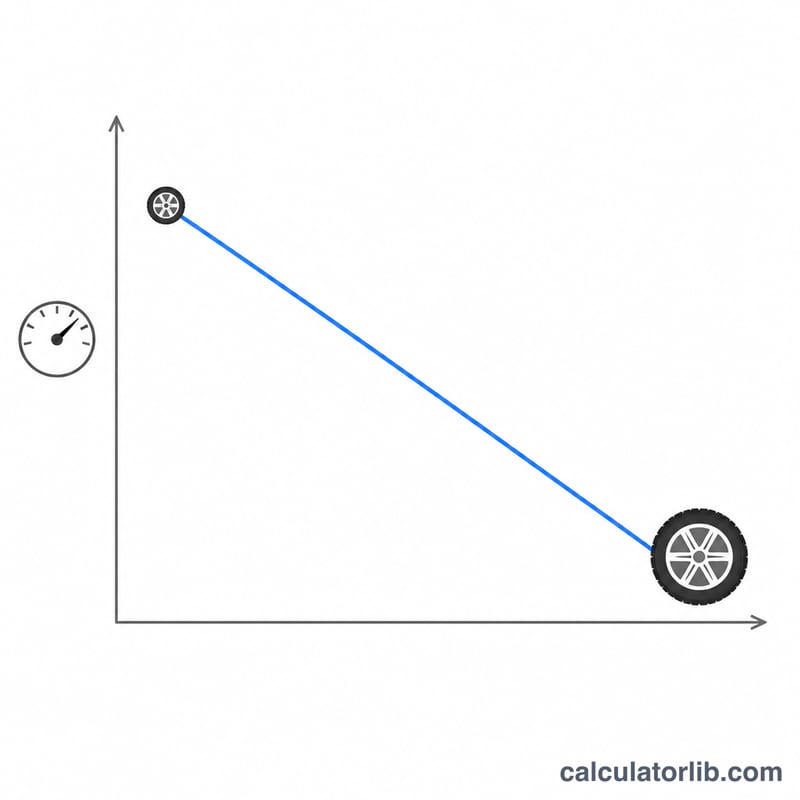
The Tire Size and Axle Ratio Calculator shows how swapping tires or changing your differential gears affects your drivetrain. When you fit taller tires, each wheel revolution covers more distance, which lowers your engine RPM at any speed and effectively raises (numerically lowers) your gear ratio. This tool reports the effective gear ratio, the engine RPM before and after, the percentage RPM change, and the axle ratio you would need to fully restore the original performance.
The formula explained
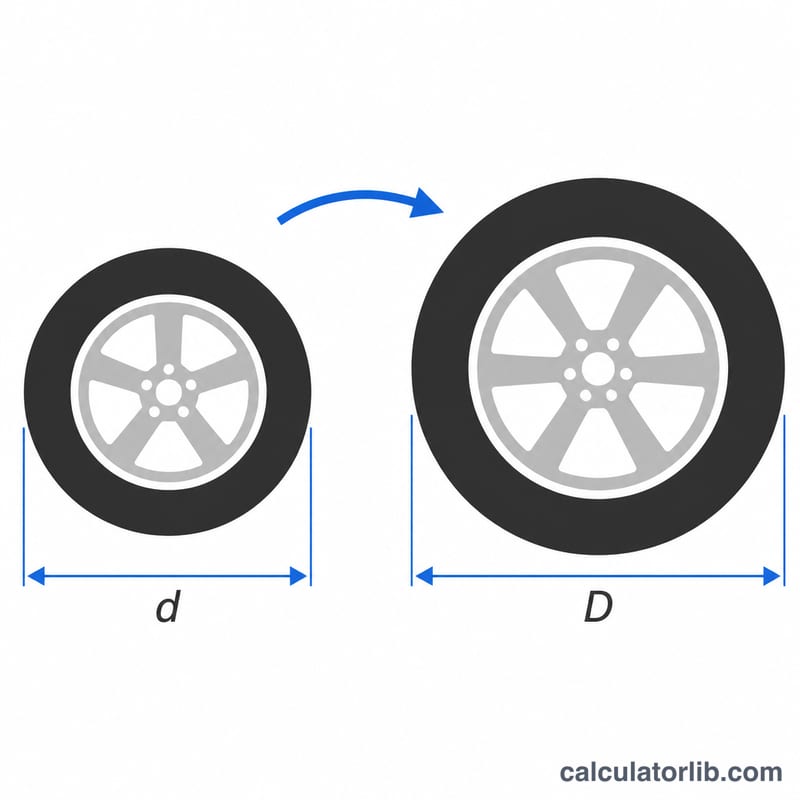
The effective ratio scales your original axle ratio \(R\) by the ratio of the old to new tire diameters:
$$\text{Ratio}_{eff} = R \times \frac{D_{orig}}{D_{new}}$$where \(D_{orig}\) is the original tire diameter and \(D_{new}\) is the new tire diameter, both in inches. Engine RPM at a road speed follows:
$$\text{RPM} = \frac{ \text{MPH} \times R \times 336}{D}$$The constant \(336\) converts miles per hour and inches into revolutions per minute. To keep the same feel with new tires, pick a new axle ratio of \(R \times \tfrac{D_{new}}{D_{orig}}\).
How to use it
Enter your original and new tire diameters, your current axle ratio, and a cruising speed. The calculator instantly returns the effective ratio, both RPM figures, and the recommended replacement gear.
Worked example
With \(D_{orig}=28\), \(D_{new}=35\), \(R=4.10\) at \(60\) mph:
$$\text{Ratio}_{eff} = 4.10 \times \frac{28}{35} = 3.28$$$$\text{RPM}_{new} = \frac{60 \times 4.10 \times 336}{35} = 2361.6$$RPM drops by \(20\%\), and a \(5.125\) axle ratio would restore the original 2952 RPM.
FAQ
Do bigger tires hurt performance? They reduce mechanical advantage, lowering acceleration and RPM unless you re-gear.
What tire diameter do I use? Use the loaded overall diameter in inches, not just the section width.
Why 336? It bundles the 5280 ft/mile, 12 in/ft and 60 min/hr conversions divided by pi.