What this calculator does
The Drip Irrigation Water Calculator estimates the total volume of water a drip system delivers over a chosen run time. Drip systems apply water slowly through emitters, so knowing total usage helps you plan schedules, size tanks or pumps, and control water bills without guesswork.
The formula
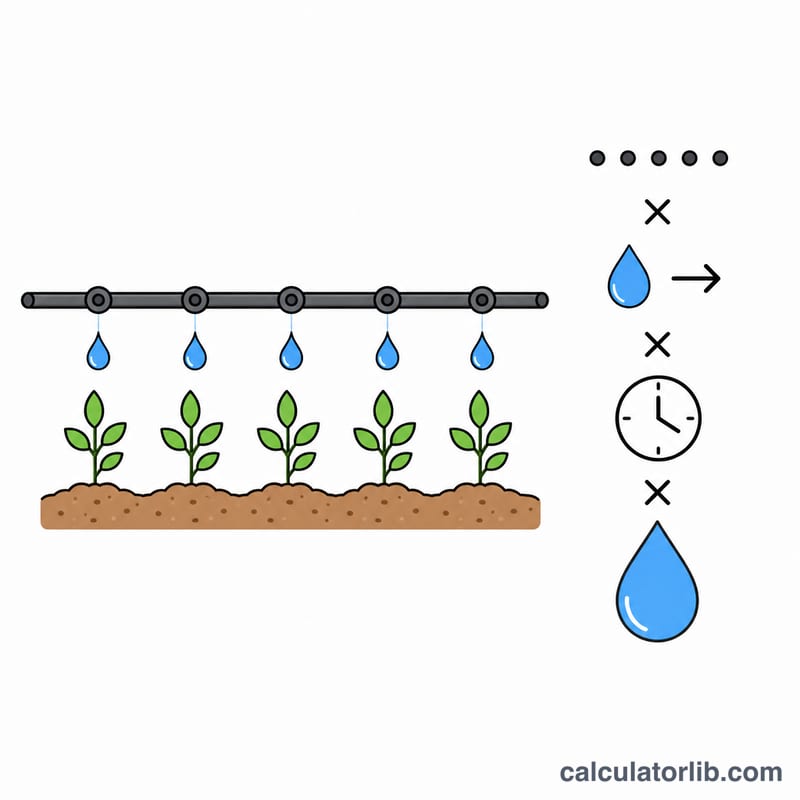
Total water depends on how many emitters run, how fast each one drips, and for how long. With \(N\) = number of emitters, \(Q\) = flow per emitter in liters per hour, and \(t\) = run time in hours, the total water \(W\) in liters is:
$$W = N \times Q \times t$$To express the result in US gallons, divide by the liters-per-gallon constant: \(G = \frac{W}{3.785411784}\). To get cubic meters, divide liters by 1000.
How to use it
Count the emitters on the zone you are running, read the rated flow printed on the emitter or dripline (commonly 2 or 4 L/h), and enter your planned run time in hours. The calculator returns total water in liters, gallons, and cubic meters instantly.
Worked example
Suppose a bed has 20 emitters rated at 4 L/h and you run the zone for 2 hours:
$$W = 20 \times 4 \times 2 = 160\,\text{L}$$That is \(\frac{160}{3.785411784} \approx 42.27\) gallons, or \(0.16\) cubic meters for a single watering cycle.
Scenario Comparison
Total water use follows \( \text{Water} = N \times Q \times t \), where \(N\) is the number of emitters, \(Q\) is the flow per emitter in litres per hour (L/h), and \(t\) is the run time in hours. The volume is computed in litres, then converted. Note: gallons below are US gallons (1 US gal = 3.785 L); an imperial (UK) gallon is larger (4.546 L), so use the litre or cubic-metre column if you work in imperial units.
| Scenario (\(N \times Q \times t\)) | Total (L) | US gal | m³ |
|---|---|---|---|
| 20 × 2 L/h × 1 h | 40 | 10.57 | 0.04 |
| 20 × 4 L/h × 2 h | 160 | 42.27 | 0.16 |
| 50 × 2 L/h × 1.5 h | 150 | 39.63 | 0.15 |
| 100 × 4 L/h × 3 h | 1200 | 317.01 | 1.2 |
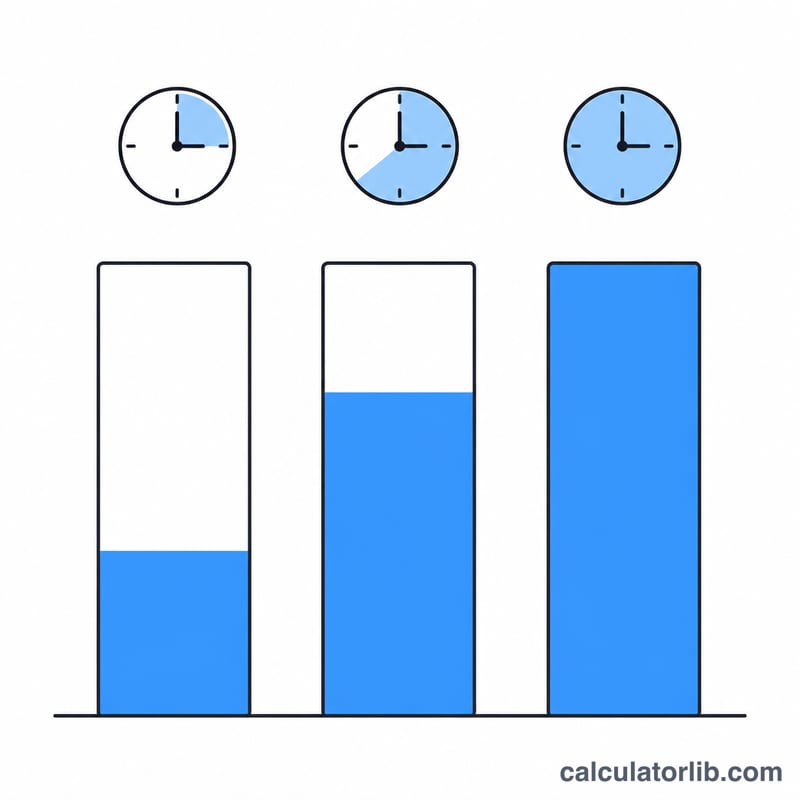
Worked check of the largest row: \( 100 \times 4\,\text{L/h} \times 3\,\text{h} = 1200\,\text{L} \). Converting, \( 1200\,\text{L} \times 0.264172 = 317.01\,\text{US gal} \) and \( 1200\,\text{L} \div 1000 = 1.2\,\text{m}^3 \). Doubling either the flow rate or the run time doubles the total, so small changes in emitter flow scale directly into your water demand.
Practical Recommendations
Use your computed per-cycle volume to size the system realistically:
- Size the tank or cistern to at least one full cycle. If a cycle delivers \( \text{Water} = N \times Q \times t \), store at least that many litres so a run never drains the source mid-cycle. For the 1200 L example above, a tank of 1200 L or larger covers one full run.
- Match pump and source flow to peak demand. All emitters draw at once, so the instantaneous demand is \( N \times Q \) litres per hour. A 100-emitter, 4 L/h layout needs a supply capable of \( 100 \times 4 = 400\,\text{L/h} \); an undersized pump or narrow supply line will starve the far emitters and cause uneven watering.
- Add a modest buffer. Plan for roughly 5–10% above the calculated volume to cover evaporation, minor leaks, flushing, and line losses. This buffer is a general planning margin, not a fixed standard — adjust it to your climate and pipe run.
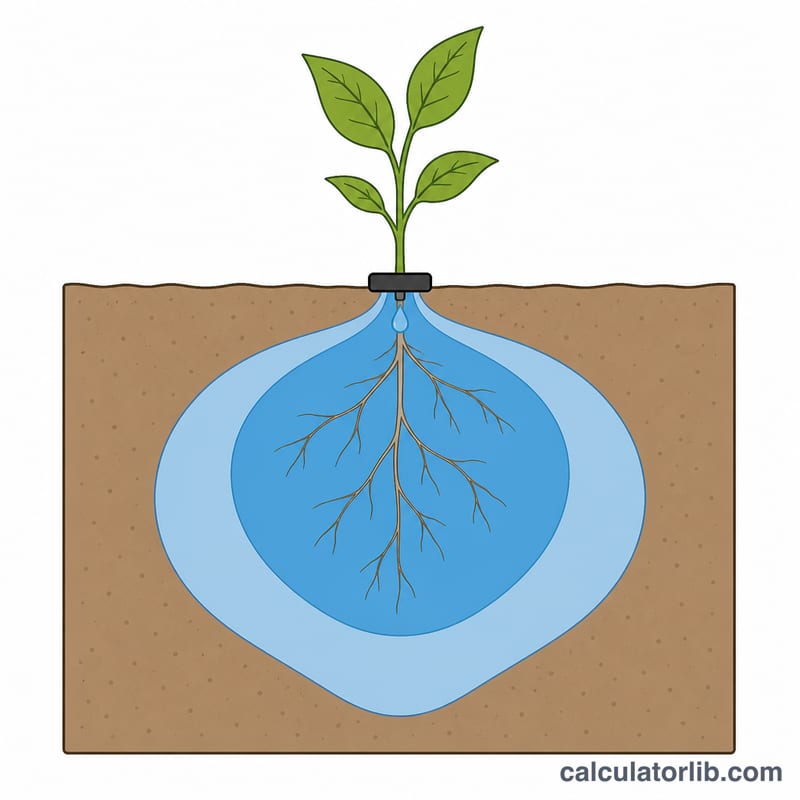
- Split long runs into cycles on slow-draining soils. Clay and compacted soils absorb water slowly, so a single long run can pond or run off. Delivering the same total in two or three shorter cycles (with soak intervals) lets water infiltrate and reduces waste, while keeping the daily total \( N \times Q \times t \) unchanged.
- Verify emitter specs. Rated flow assumes the design pressure; check actual output at the emitter and re-run the calculation if your measured flow differs from the label.
FAQ
What flow rate should I use? Use the emitter's rated flow at your operating pressure; most drippers are 2 or 4 L/h.
Does pressure change the result? Pressure-compensating emitters hold a steady flow across a range, while non-compensating ones vary, so use the rated value at your working pressure.
Can I enter minutes? Convert minutes to hours first (for example, 30 minutes = 0.5), since the run time field expects hours.