What this calculator does
This calculator converts a target chemical concentration in treated water into a practical feed rate for a dosing pump. Enter the water flow rate, the dose you want (in mg/L), the strength of the chemical as supplied, and its specific gravity. You get the active chemical needed, the product mass and volume per hour, a pump setting in mL/min, and daily consumption for ordering and tank sizing.
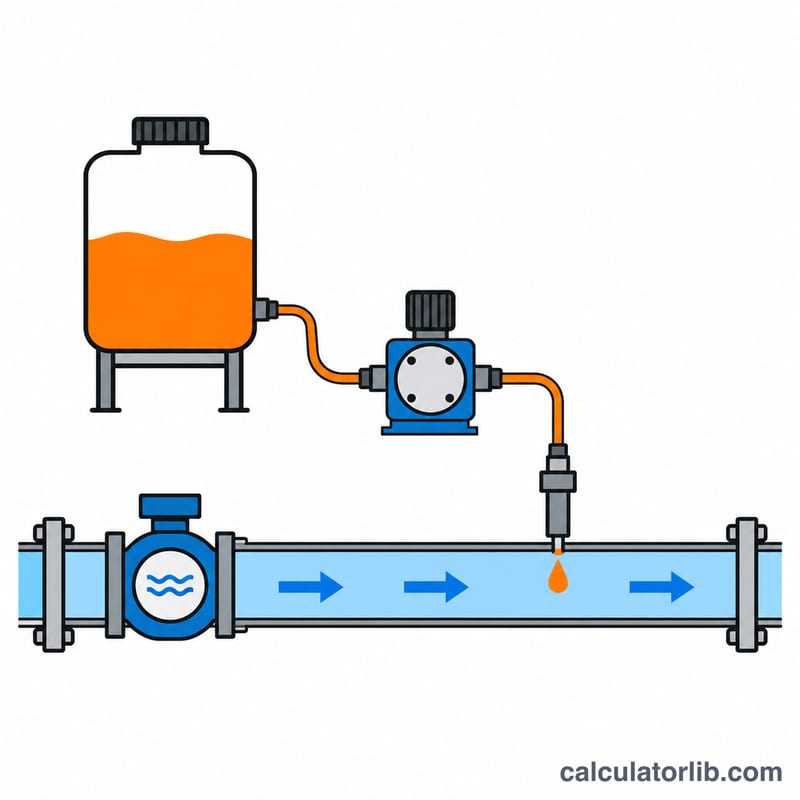
How to use it
Enter the flow in cubic metres per hour, the dose in mg/L (equal to g/m³), the percent active content by weight (for example 12.5 for sodium hypochlorite, 100 for a dry product dissolved on site), the solution specific gravity in kg/L, and the hours per day the plant runs. Use jar-test or process results to choose the dose, and always check the supplier data sheet for strength and density.
The formula explained
Because 1 mg/L equals 1 g/m³, the active mass per hour is the flow times the dose:
$$\dot{m}_{active} = \frac{Q \times D}{1000}\ \text{kg/h}$$Here \(Q\) = flow in m³/h and \(D\) = dose in mg/L. The product contains only a fraction \(P/100\) of active ingredient, and liquid volume depends on density \(SG\):
$$\dot{V} = \frac{Q \times D}{1000 \times (P/100) \times SG}\ \text{L/h}$$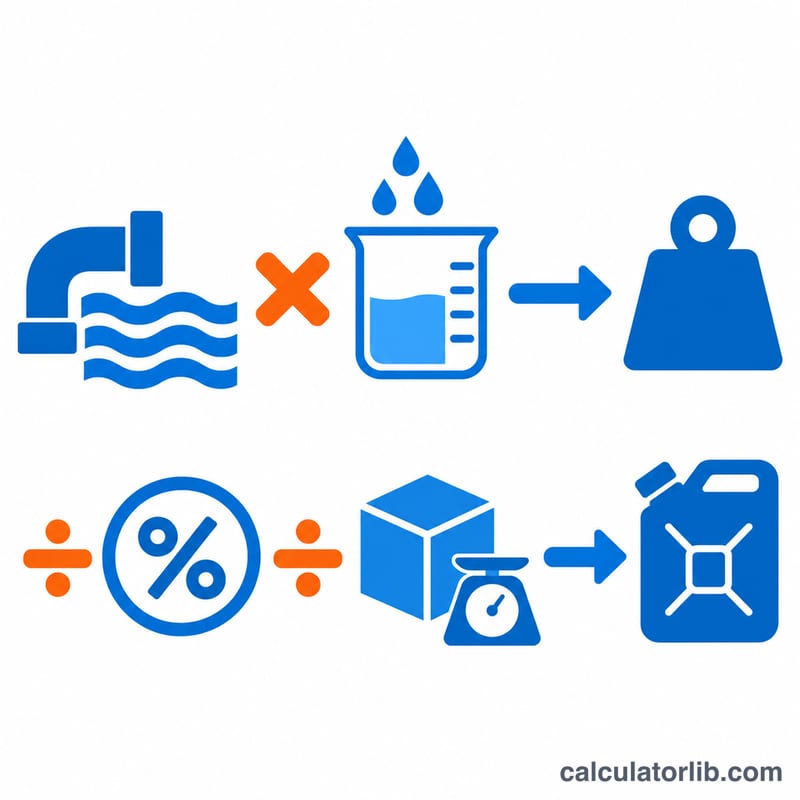
Worked example
Dose 5 mg/L of chlorine into 100 m³/h using 12.5% hypochlorite with SG 1.2:
$$\dot{m}_{active} = \frac{100 \times 5}{1000} = 0.5\,\text{kg/h}$$$$\dot{m}_{product} = \frac{0.5}{0.125} = 4\,\text{kg/h}$$$$\dot{V} = \frac{4}{1.2} = 3.33\,\text{L/h} \approx 55.6\,\text{mL/min}$$Over 24 hours that is 96 kg or 80 L of product.
Typical Treatment Chemical Strengths and Specific Gravities
The calculator needs the product strength (% w/w active) and the specific gravity (kg/L) of the solution you actually buy. The table lists indicative commercial values for common water treatment chemicals. Values are indicative only; the supplier's data sheet and certificate of analysis always govern.
| Chemical | Typical commercial strength (% w/w) | Approx. SG (kg/L) |
|---|---|---|
| Sodium hypochlorite | 10–15 (as available chlorine) | 1.10–1.20 |
| Ferric chloride | ~40 (as FeCl3) | ~1.40 |
| Aluminium sulfate (liquid alum) | ~8 (as Al2O3) | ~1.32 |
| Sodium hydroxide (caustic soda) | 50 | ~1.52 |
| Sodium hydroxide (caustic soda) | 25–30 | ~1.28–1.33 |
| Sulfuric acid | 98 | ~1.84 |
| Polyaluminium chloride (PACl) | ~10 (as Al2O3) | ~1.2–1.35 |
| Hydrochloric acid | 31–33 | ~1.16 |
Check what basis the strength is quoted on (for example available chlorine, Al2O3 or FeCl3) and make sure your target dose uses the same basis. Strength and SG both change with temperature, and hypochlorite loses strength as it ages.
Typical Dose Ranges
The table shows commonly quoted dose ranges for typical applications. They are indicative only. The right dose depends on raw-water quality, jar tests, plant performance and local regulations.
| Application | Typical dose (mg/L) | Notes |
|---|---|---|
| Chlorine disinfection of drinking water | ~1–5 | Dose must cover chlorine demand and leave a residual. Free chlorine residual of about 0.2–0.5 mg/L at the tap is common guidance. The WHO health-based guideline value for chlorine is up to 5 mg/L. |
| Coagulation with alum | ~10–50 | Depends on turbidity, organics, alkalinity and pH. |
| Coagulation with ferric chloride | ~5–40 | Determine by jar testing; check the alkalinity and pH impact. |
| pH adjustment (acid or caustic) | Varies widely | Depends on alkalinity and the target pH; use titration or a pH-control loop. |
| Polymer (coagulant or flocculant aid) | ~0.1–2 | Very sensitive to the specific product; overdosing can harm filtration. |
Always confirm doses against applicable drinking-water or discharge regulations in your country and against supplier and operator guidance. This is general information, not professional advice.
Dosing Scenario Comparison
Each row uses the calculator's method: active chemical \(A = \text{flow} \times \text{dose} / 1000\) in kg/h, then \(Q = A / (S/100 \cdot \rho)\) in L/h, with mL/min = L/h × 1000 / 60 and daily volume = L/h × run hours.
| Scenario | Flow (m³/h) | Dose (mg/L) | Strength (%) | SG (kg/L) | Feed (L/h) | Feed (mL/min) | Run hours | Daily volume (L) |
|---|---|---|---|---|---|---|---|---|
| A: Hypochlorite, 12.5% | 100 | 5 | 12.5 | 1.2 | 3.33 | 55.6 | 24 | 80.0 |
| B: Same dose, hypothetical 50% product (SG 1.2 assumed) | 100 | 5 | 50 | 1.2 | 0.83 | 13.9 | 24 | 20.0 |
| C: Larger flow, low chlorine dose, 12.5% hypochlorite | 250 | 2 | 12.5 | 1.2 | 3.33 | 55.6 | 24 | 80.0 |
| D: Ferric chloride coagulation | 50 | 30 | 40 | 1.4 | 2.68 | 44.6 | 8 | 21.4 |
Worked check for scenario A: \(A = 100 \times 5 / 1000 = 0.5\) kg/h; the product carries \(0.125 \times 1.2 = 0.15\) kg of active chlorine per litre; so \(Q = 0.5 / 0.15 = 3.33\) L/h, which is 3333 / 60 ≈ 55.6 mL/min, or 80 L over 24 h.
Worked check for scenario D: \(A = 50 \times 30 / 1000 = 1.5\) kg/h; \(0.40 \times 1.4 = 0.56\) kg/L; \(Q = 1.5 / 0.56 = 2.68\) L/h, or about 21.4 L over 8 h.
Notes: scenarios A and C show that only the product of flow and dose matters (both give 0.5 kg/h). Scenario B is a hypothetical comparison that shows feed rate falling in proportion to strength; real hypochlorite is not sold at 50%. Scenario D assumes the 30 mg/L dose is expressed as FeCl3 on the product basis.
FAQ
Does this include demand or residual?
No. The dose is the amount you add. Chlorine demand, alkalinity consumption, or other water chemistry must be considered when choosing the dose.
Why does strength matter?
A 50% product needs only a quarter of the volume of a 12.5% product for the same active dose.
Can I use US units?
Convert first: 1 MGD is about 157.7 m³/h, and 1 mg/L is the same in both systems.