What this Pot-Limit Omaha odds calculator does
Pot-Limit Omaha (PLO) gives each player four hole cards and requires exactly two of them to be used with three from the board. Because hands run close together, decisions often come down to draws. This calculator turns your number of outs, the pot and the price of a call into your draw equity, the equity you need, the expected value of calling and the largest pot-limit raise available.
How to use it
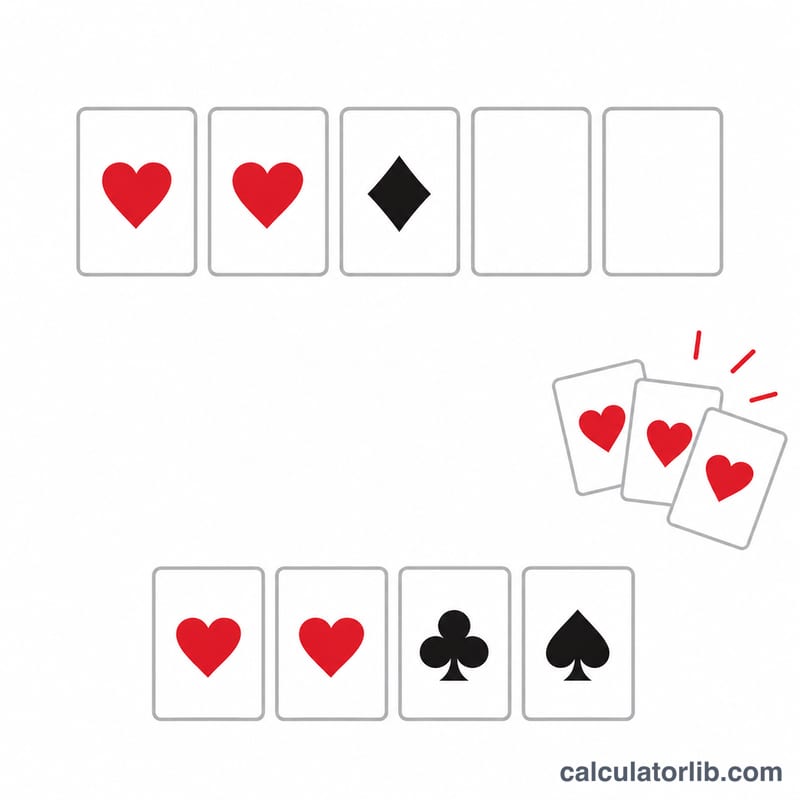
Choose the street (flop or turn), enter how many outs you have, the pot size including your opponent bet, and the amount you must call. Your four hole cards and the board are the seen cards: 4 + 3 = 7 on the flop, so 45 cards are unseen, and 4 + 4 = 8 on the turn, leaving 46. Opponent cards are treated as unseen as well.
The formulas
With \(o\) outs, the chance of hitting at least one on the flop (two cards to come) is:
$$P_{flop} = 1 - \frac{\binom{45-o}{2}}{\binom{45}{2}}$$On the turn only one card remains:
$$P_{turn} = \frac{o}{46}$$The break-even equity for a call \(C\) into a pot \(P\) is:
$$E_{req} = \frac{C}{P + C}$$The maximum pot-limit raise to is \(P + 2C\): you call \(C\), making the pot \(P + C\), then raise that amount.
Worked example
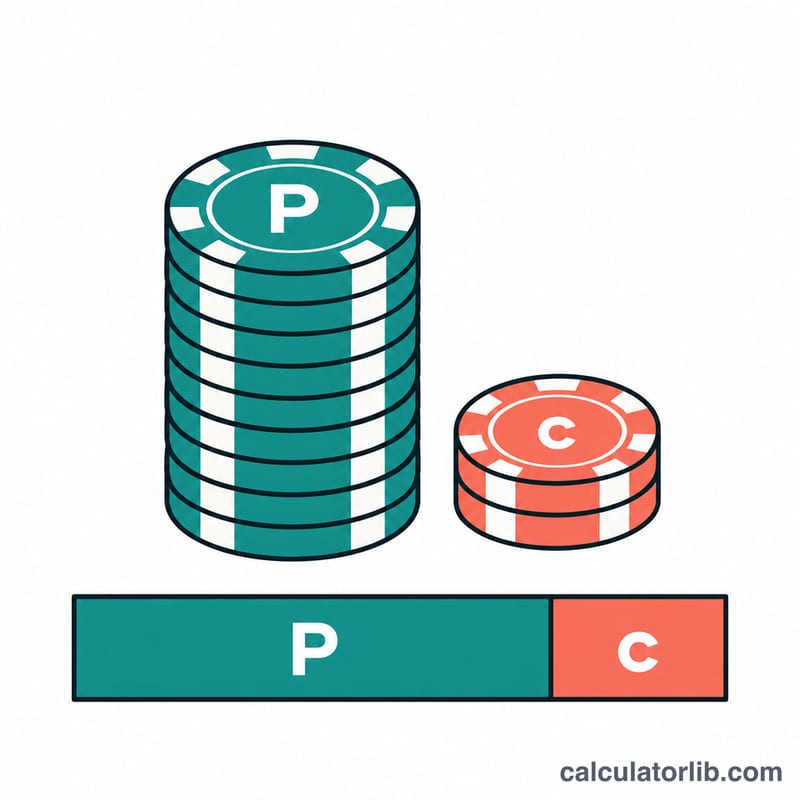
You hold a nut flush draw plus a straight draw on the flop with 12 clean outs. The pot is 100 and you face a 50 bet.
$$P_{flop} = 1 - \frac{528}{990} = 0.4667$$$$E_{req} = \frac{50}{100 + 50} = 0.3333$$$$EV = 0.4667 \times 100 - 0.5333 \times 50 = 20$$Your equity of 46.7% beats the 33.3% required, so calling is profitable by 20 on average. The max pot raise is \(100 + 2 \times 50 = 200\).
PLO Outs and Draw Equity Lookup Table
In Pot-Limit Omaha you hold 4 cards. On the flop you see 7 cards (4 + 3), so 45 cards are unseen. On the turn you see 8 cards, so 44 are unseen. The table assumes every out is clean (it wins when it arrives) and ignores the cards in opponents' hands.
Flop equity (two cards to come): \(\text{Equity}_{flop} = 1 - \frac{(45-o)(44-o)}{45 \cdot 44}\), which is the same as \(1 - \binom{45-o}{2}/\binom{45}{2}\). Turn equity (one card to come): \(\text{Equity}_{turn} = \frac{o}{44}\).
| Outs | Typical draw | Exact flop equity | Rule of 4 | Exact turn equity | Rule of 2 |
|---|---|---|---|---|---|
| 4 | Gutshot straight (one rank) | 17.17% | 16% | 9.09% | 8% |
| 8 | Open-ended straight draw | 32.73% | 32% | 18.18% | 16% |
| 9 | Nut flush draw | 36.36% | 36% | 20.45% | 18% |
| 12 | Flush draw + gutshot, or wrap-type draw | 46.67% | 48% | 27.27% | 24% |
| 13 | Wrap straight draw | 49.90% | 52% | 29.55% | 26% |
| 15 | Nut flush draw + open-ended straight draw | 56.06% | 60% | 34.09% | 30% |
| 17 | Big wrap plus extra outs | 61.82% | 68% | 38.64% | 34% |
| 20 | Large wrap (the maximum straight-draw wrap is 20 outs) | 69.70% | 80% | 45.45% | 40% |
Worked check for 9 outs on the flop: \(1 - \frac{36 \cdot 35}{45 \cdot 44} = 1 - \frac{1260}{1980} = 1 - 0.6364 = 0.3636\), or 36.36%. For 9 outs on the turn: \(9/44 = 20.45\%\).
The rule of 4 (flop) and rule of 2 (turn) are quick estimates. The rule of 4 overstates equity as the out count grows; at 20 outs it gives 80% against a true 69.70%. Real equity also drops when some outs are dirty (they improve an opponent too) or when the draw is not to the nuts.
FAQ
Does this include opponent hand ranges?
No. It is an outs-based draw calculator; it assumes your outs are genuinely live and not shared with a better hand. In PLO, count only clean outs, since many draws are dominated.
What is the rule of 4 and 2?
A quick estimate: multiply outs by 4 on the flop or by 2 on the turn. It overestimates with many outs, which is why the exact value is shown too.
Does EV include implied odds?
No. The EV only counts the current pot and the call, so a slightly negative result can still be a profitable call when you expect to win more on later streets.