What this calculator does
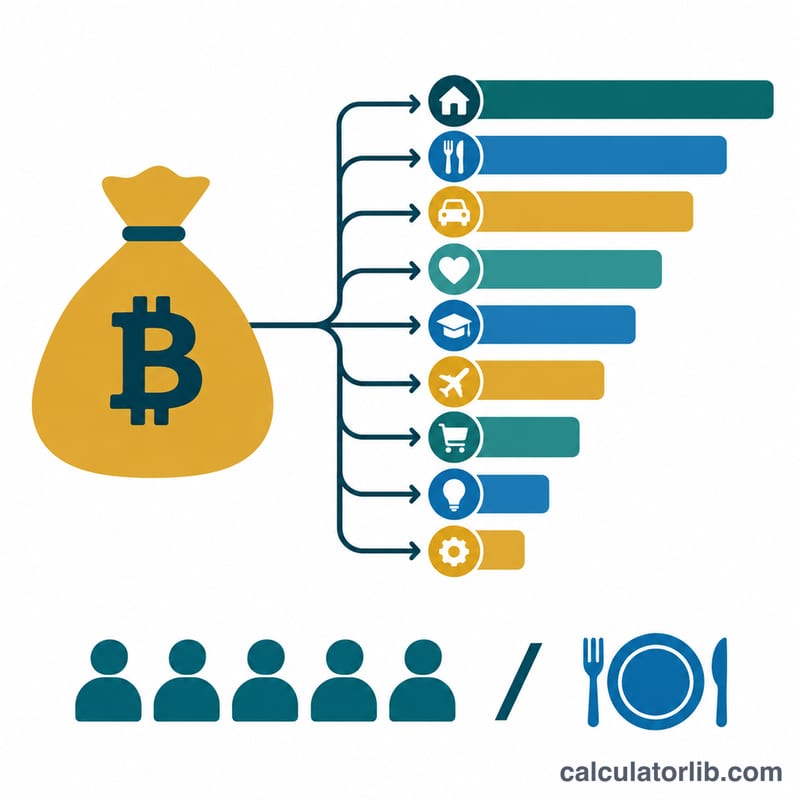
This calculator is designed for weddings in India. It takes your total wedding budget in Indian rupees and your expected guest count, then splits the money across the categories that dominate a typical Indian wedding: catering, venue and decor, attire and jewellery, photography, entertainment, rituals, invitations and gifts, travel and stay, and a contingency reserve. The percentages are planning assumptions based on common Indian wedding spending patterns, not rules, so adjust them mentally to fit your family priorities and region.
How to use it
Enter the total amount you are willing to spend, including all functions such as engagement, mehendi, sangeet, wedding and reception. Then enter the guest count. The tool shows an amount for every category, the cost per guest and the catering budget per plate, which is the number most caterers quote against.
The formula explained
Each category amount is the total budget multiplied by its share:
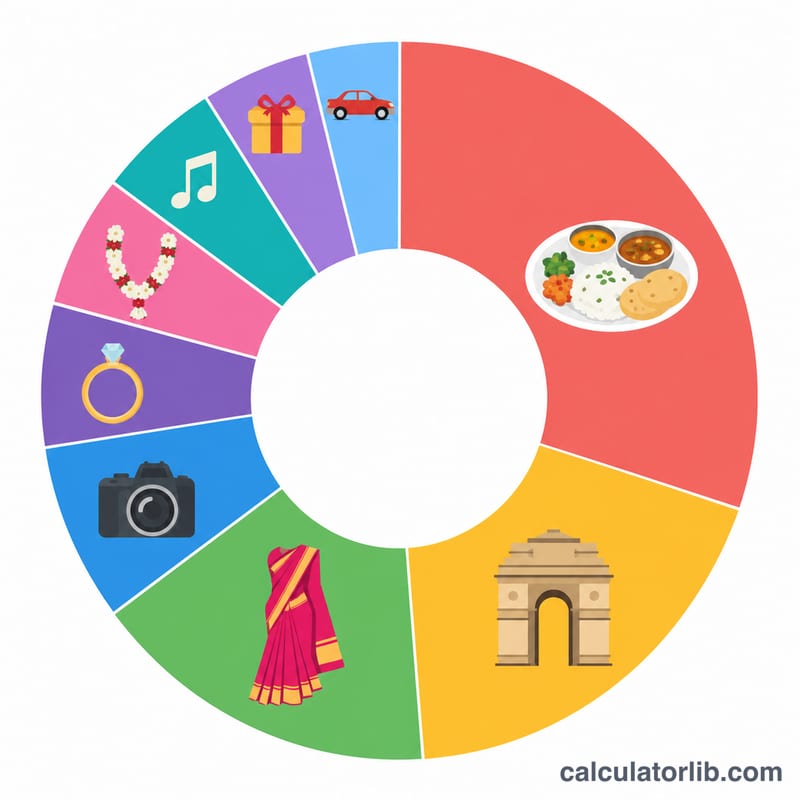
$$A_i = B \times \frac{p_i}{100}$$Here \(B\) is the total budget and \(p_i\) is the percentage for category \(i\). The shares used are catering 30, venue and decor 22, attire and jewellery 18, photography 7, entertainment 5, rituals 3, invitations and gifts 4, travel and stay 5 and contingency 6, summing to 100. Cost per guest is:
$$C_{guest} = \frac{B}{G}$$where \(G\) is the number of guests.
Worked example
Suppose the budget is 2,000,000 rupees for 400 guests. Catering is:
$$A_{catering} = 2{,}000{,}000 \times \frac{30}{100} = 600{,}000$$Catering per plate is:
$$\frac{600{,}000}{400} = 1{,}500$$Overall spend per guest is 2,000,000 / 400 = 5,000 rupees.
Default Category Shares at a Glance
This calculator splits your total wedding budget across nine categories using fixed default percentages. These are planning assumptions for a typical Indian wedding, not official standards, and real spending varies widely by region, community and city. The amounts below use an example budget of ₹2,000,000 (20 lakh; 1 lakh = 100,000 rupees). Each amount is \(\text{Share} \times B\).
| Category | Share | Amount on ₹2,000,000 | Typically covers |
|---|---|---|---|
| Catering | 30% | ₹600,000 | Food and beverages for all functions, live counters, service staff |
| Venue and decor | 22% | ₹440,000 | Banquet hall or lawn hire, mandap, flowers, lighting, stage |
| Attire and jewellery | 18% | ₹360,000 | Bridal and groom outfits, family clothing, jewellery, makeup |
| Photography | 7% | ₹140,000 | Photographers, videographers, albums, pre-wedding shoot |
| Entertainment | 5% | ₹100,000 | DJ, band, sangeet performances, baraat music |
| Rituals | 3% | ₹60,000 | Priest, puja materials, ceremonial items |
| Invitations and gifts | 4% | ₹80,000 | Cards or digital invites, return gifts, sweets boxes |
| Travel and stay | 5% | ₹100,000 | Guest accommodation, transport, baraat vehicles |
| Contingency | 6% | ₹120,000 | Buffer for overruns, last-minute changes, tips |
The shares add up to 100%: \(30+22+18+7+5+3+4+5+6 = 100\). The amounts add up to ₹2,000,000.
FAQ
Are these percentages fixed?
They are typical planning shares. Use the output as a starting point and shift money between categories as quotes arrive.
Why keep a contingency?
Indian weddings often see last-minute guest additions, extra rituals and price changes, so reserving about 6 percent protects you from overruns.
Does the guest count change the categories?
No, the guest count only drives the per-guest and per-plate figures. Categories depend on the total budget.