What is an ASIC mining profitability calculator?
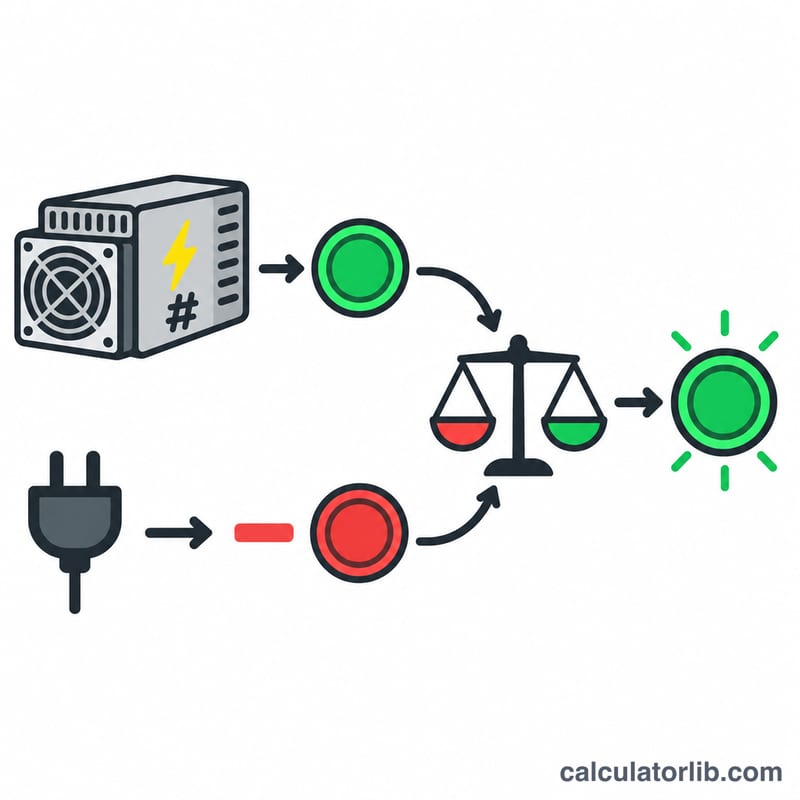
An ASIC miner is a machine built to compute SHA-256 style proof-of-work hashes, as used by Bitcoin. This calculator estimates how many coins your machine should earn per day and whether that revenue beats your electricity bill. It is a statistical estimate: real results vary with luck, pool payout schemes and changing difficulty.
How to use it
Enter your miner hash rate in TH/s and its power draw in watts. Add your electricity price per kWh, the current coin price, the network difficulty, the block reward and your pool fee. Optionally enter the hardware cost to see how many days it takes to pay back at current profit. Currency amounts are your own, so use whatever currency you pay power bills in.
The formula explained
A network at difficulty \(D\) needs on average \(D \times 2^{32}\) hashes to find one block. With hash rate \(H\) (hashes per second) and block reward \(R\), expected coins per day are:
$$\text{Coins/day} = \frac{H \times 86400 \times R}{D \times 2^{32}} \times (1 - \text{fee})$$Daily electricity cost is \(P \times 24 / 1000\) kWh multiplied by the price per kWh, and profit is revenue minus that cost. The break-even coin price is the daily power cost divided by coins per day.
Worked example
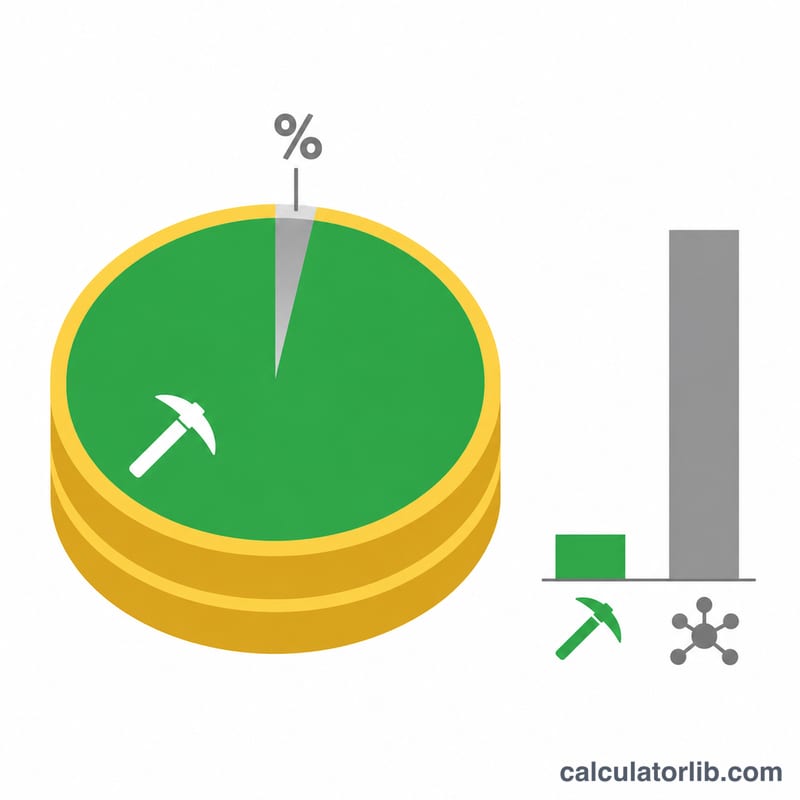
Take \(H = 100\) TH/s, \(D = 10^{14}\), \(R = 3.125\), no fee, a coin price of 60,000, 3,000 W and 0.05 per kWh.
$$\text{Coins/day} = \frac{100\times 10^{12} \times 86400 \times 3.125}{10^{14} \times 2^{32}} \approx 0.0000628643$$$$\text{Revenue} \approx 0.0000628643 \times 60000 = 3.77$$$$\text{Cost} = 72 \times 0.05 = 3.60$$Daily profit is about 0.17, or roughly 5.16 over 30 days. The break-even price is around 57,266.
Profit Scenarios: How Price, Difficulty and Power Cost Change the Result
These scenarios use one example miner: 100 TH/s hash rate, 3,000 W power draw, block reward 3.125 BTC and no pool fee. Coins per day follow \(\text{Coins/day} = \frac{H \cdot 86400 \cdot R}{D \cdot 2^{32}}\), with \(H = 10^{14}\) H/s. Power use is 3 kW × 24 h = 72 kWh/day. The base difficulty is \(10^{14}\), and the second case is 20% higher (\(1.2 \times 10^{14}\)). The difficulty and prices are illustrative, not current network data.
- Base difficulty: \(\frac{10^{14} \cdot 86400 \cdot 3.125}{10^{14} \cdot 4{,}294{,}967{,}296} \approx 0.000062864\) coins/day.
- Difficulty +20%: \(0.000062864 / 1.2 \approx 0.000052387\) coins/day.
| Difficulty | Coin price | Electricity ($/kWh) | Coins/day | Revenue/day | Power cost/day | Daily profit | Profitable? |
|---|---|---|---|---|---|---|---|
| 10^14 | 40,000 | 0.03 | 0.000062864 | $2.51 | $2.16 | $0.35 | Yes |
| 10^14 | 40,000 | 0.05 | 0.000062864 | $2.51 | $3.60 | -$1.09 | No |
| 10^14 | 40,000 | 0.10 | 0.000062864 | $2.51 | $7.20 | -$4.69 | No |
| 10^14 | 60,000 | 0.03 | 0.000062864 | $3.77 | $2.16 | $1.61 | Yes |
| 10^14 | 60,000 | 0.05 | 0.000062864 | $3.77 | $3.60 | $0.17 | Yes (marginal) |
| 10^14 | 60,000 | 0.10 | 0.000062864 | $3.77 | $7.20 | -$3.43 | No |
| 10^14 | 80,000 | 0.03 | 0.000062864 | $5.03 | $2.16 | $2.87 | Yes |
| 10^14 | 80,000 | 0.05 | 0.000062864 | $5.03 | $3.60 | $1.43 | Yes |
| 10^14 | 80,000 | 0.10 | 0.000062864 | $5.03 | $7.20 | -$2.17 | No |
| 1.2×10^14 | 40,000 | 0.03 | 0.000052387 | $2.10 | $2.16 | -$0.06 | No |
| 1.2×10^14 | 40,000 | 0.05 | 0.000052387 | $2.10 | $3.60 | -$1.50 | No |
| 1.2×10^14 | 40,000 | 0.10 | 0.000052387 | $2.10 | $7.20 | -$5.10 | No |
| 1.2×10^14 | 60,000 | 0.03 | 0.000052387 | $3.14 | $2.16 | $0.98 | Yes |
| 1.2×10^14 | 60,000 | 0.05 | 0.000052387 | $3.14 | $3.60 | -$0.46 | No |
| 1.2×10^14 | 60,000 | 0.10 | 0.000052387 | $3.14 | $7.20 | -$4.06 | No |
| 1.2×10^14 | 80,000 | 0.03 | 0.000052387 | $4.19 | $2.16 | $2.03 | Yes |
| 1.2×10^14 | 80,000 | 0.05 | 0.000052387 | $4.19 | $3.60 | $0.59 | Yes |
| 1.2×10^14 | 80,000 | 0.10 | 0.000052387 | $4.19 | $7.20 | -$3.01 | No |
Takeaways: a 20% rise in difficulty cuts revenue by about 16.7% (revenue is divided by 1.2). Electricity cost is the biggest swing factor for this miner, and at $0.10/kWh none of the scenarios is profitable. Figures are rounded to the cent, and hardware cost is not included.
Constants and Unit Conversions Used
| Quantity | Value | Notes |
|---|---|---|
| Hashes per difficulty unit | \(2^{32} = 4{,}294{,}967{,}296\) | At difficulty 1, about 2^32 hashes are needed on average to find a block. |
| Seconds per day | 86,400 | 24 × 60 × 60 |
| Hash rate prefix | 1 TH/s = \(10^{12}\) H/s | Terahash per second |
| Power | 1 kW = 1,000 W | Divide watts by 1,000 to get kilowatts. |
| Energy | kWh = kW × hours | A 3,000 W miner running 24 h uses 3 × 24 = 72 kWh. |
| Bitcoin block reward | 3.125 BTC | In effect since the April 2024 halving; it halves again roughly every 210,000 blocks. Transaction fees are extra and not included here. |
| Average block time | 10 minutes | About 144 blocks per day (1,440 min ÷ 10). |
| Difficulty retarget | Every 2,016 blocks | Roughly every two weeks if blocks arrive every 10 minutes. |
These constants are specific to Bitcoin (SHA-256). Other coins use different block rewards, block times and difficulty definitions, so enter their own values if you mine something else.
Interpreting Your Profitability Result
Positive vs negative daily profit. Daily profit is the coin revenue (after any pool fee) minus electricity cost. A positive number means the coins mined are worth more than the power consumed at your price assumption. A negative number means the miner costs more to run than it earns under those inputs. Neither figure includes hardware cost, cooling, hosting, taxes or downtime unless you account for them separately.
Break-even coin price. This is the price at which daily profit is zero:
$$P_{\text{break-even}} = \frac{ \text{kW} \cdot 24 \cdot \text{cost per kWh}}{B \cdot (1 - f/100)}$$
For the example miner (3 kW, difficulty \(10^{14}\), \(B \approx 0.000062864\) coins/day, no fee) at $0.05/kWh: \(\frac{3.60}{0.000062864} \approx\) $57,266 per coin. At $0.03/kWh the break-even is about $34,360, and at $0.10/kWh about $114,532. A higher difficulty or pool fee raises the break-even price.
Efficiency. Miner efficiency is measured in joules per terahash: \(\text{J/TH} = \frac{\text{watts}}{\text{TH/s}}\). The example miner gives \(\frac{3000}{100} = 30\) J/TH. Lower is better, because less energy is spent per unit of hash rate, which lowers the break-even price at any given electricity rate.
Why payback days are an estimate. A payback period is roughly hardware cost ÷ daily profit. It assumes difficulty, coin price, electricity rate and block reward all stay constant. In reality difficulty adjusts about every 2,016 blocks and usually trends upward over time, the price can move sharply, and the block reward halves about every four years. Payback is therefore a snapshot, not a forecast. If daily profit is zero or negative, no payback exists under those inputs.
Variance and payouts. Block finding is random, so actual short-term earnings can differ from the expected value, especially for a small miner. Pool payout schemes also change when and how rewards arrive. PPS pays a fixed amount per share, which smooths income but usually carries a higher fee. FPPS also includes transaction fees. PPLNS and similar schemes depend on the pool's luck, so they vary more day to day. Over longer periods results tend toward the calculated expectation.
This is general educational information about how the calculation works, not financial or investment advice.
Bitcoin Block Reward Halving History
Bitcoin's block subsidy is cut in half every 210,000 blocks (roughly every four years). This is the "Block Reward" input in the calculator when you mine Bitcoin. Dates below are approximate.
| Event | Approximate date | Block height | Resulting subsidy |
|---|---|---|---|
| Genesis | 2009 | 0 | 50 BTC |
| 1st halving | Nov 2012 | 210,000 | 25 BTC |
| 2nd halving | Jul 2016 | 420,000 | 12.5 BTC |
| 3rd halving | May 2020 | 630,000 | 6.25 BTC |
| 4th halving | Apr 2024 | 840,000 | 3.125 BTC |
Notes: The next halving is scheduled at block 1,050,000. The figures above are the block subsidy only and exclude transaction fees, which miners also collect. If you want to include fees, add the average fee per block to the Block Reward input. Because the subsidy halves, revenue per unit of hash rate falls at each halving unless the coin price rises or difficulty drops.
Mining Terms and Variables Glossary
- Hash rate (H/s, TH/s)
- The number of hash calculations a miner performs per second. 1 TH/s = 1012 H/s. The calculator's Hash Rate field is in TH/s and is multiplied by 1012 in the formula.
- Network difficulty
- A unitless number that sets how hard it is to find a valid block. Higher difficulty means fewer expected coins per unit of hash rate. In the formula, expected blocks per hash are 1 ÷ (Difficulty · 232). Bitcoin adjusts difficulty every 2,016 blocks.
- Block reward / subsidy
- The newly issued coins awarded per block, in coins (e.g. BTC). Transaction fees are separate and can be added to this field if you want them included.
- Pool fee (%)
- The percentage of mining rewards a pool keeps. The formula multiplies revenue by (1 − fee ÷ 100).
- Power draw (W)
- The electrical power the miner consumes, in watts. Daily energy in kWh = W × 24 ÷ 1000.
- Efficiency (J/TH)
- Energy used per terahash. Since 1 W = 1 J/s, efficiency = W ÷ (TH/s). Lower is better.
- Electricity price per kWh
- What you pay for each kilowatt-hour, in your local currency. It is multiplied by daily kWh to get the daily power cost.
- Coin price
- The market price of one coin in your chosen currency, used to convert mined coins to revenue.
- Break-even coin price
- The coin price at which daily revenue after pool fees equals daily electricity cost, so profit is zero. Below it, the miner loses money on power alone.
- ROI / payback period
- ROI compares profit with the hardware cost. Payback period is the hardware cost divided by daily profit. It is only meaningful if daily profit is positive, and it assumes price and difficulty stay constant, which rarely holds in practice.
- Stale / orphan share
- A share or block that is valid but arrives too late or loses to another block, so it earns no reward. Stale rates reduce real-world income below the theoretical figure, so actual results are often slightly lower.
FAQ
Does difficulty stay constant?
No. Difficulty adjusts about every two weeks and usually rises, so profit tends to shrink over time unless the coin price rises.
Are halvings included?
Not automatically. Enter the current block reward, and update it after a halving.
What is missing from the estimate?
Transaction fees, cooling, hosting, taxes, downtime and hardware resale value are not modelled, so treat the result as an optimistic baseline.