
What Is the Bitcoin Mining Profitability Calculator?
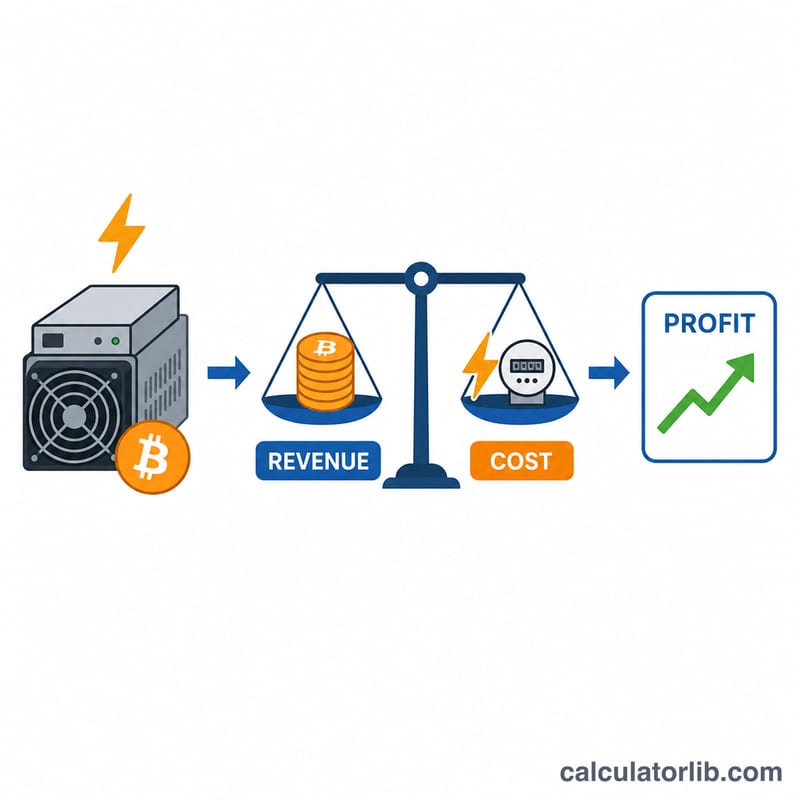
This tool estimates how much money a Bitcoin miner can earn after electricity costs. You enter your hardware hash rate, its power draw, your electricity price, the Bitcoin price, the current network hash rate and the block reward. The calculator returns the daily, monthly and yearly Bitcoin mined plus the profit in your currency. It is universal and works for any region — just use your local electricity tariff and Bitcoin price.
How to Use It
Enter your miner hash rate in terahashes per second (TH/s), its power consumption in watts, your electricity cost per kilowatt-hour, the current Bitcoin price, the network hash rate in exahashes per second (EH/s) and the block reward in BTC (currently 3.125 BTC after the 2024 halving). Press calculate to see daily revenue, electricity cost and net profit.
The Formula
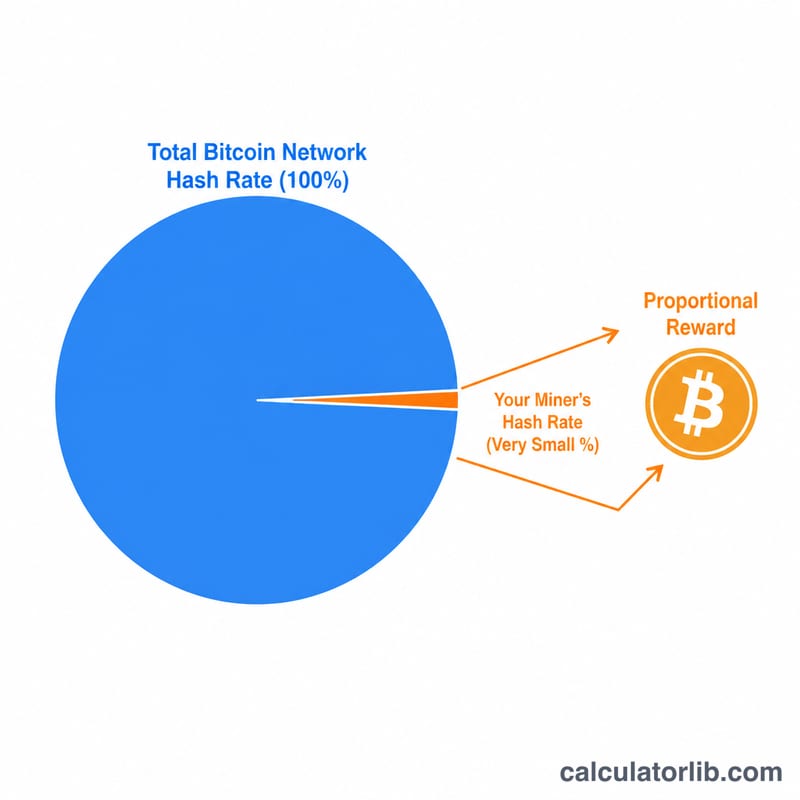
Your share of the network determines how much BTC you mine. With \(h\) = miner hash rate (TH/s), \(N\) = network hash rate (TH/s), \(R\) = block reward and 144 blocks per day:
$$\text{BTC}_{day} = \frac{h}{N}\times 144 \times R$$Daily revenue is \(\text{BTC}_{day}\times P\) where \(P\) is the BTC price. Daily electricity cost is:
$$\text{Cost}_{day} = \frac{W}{1000}\times 24 \times c$$where \(W\) = watts and \(c\) = price per kWh. Net daily profit is revenue minus cost.
Worked Example
A miner running 100 TH/s at 3000 W, electricity at $0.10/kWh, BTC at $60,000, network at 600 EH/s (= 600,000,000 TH/s) and reward 3.125 BTC:
$$\text{BTC}_{day} = \frac{100}{600{,}000{,}000}\times 144 \times 3.125 = 7.5\times10^{-5}$$Revenue = \(0.000075 \times 60000 = 4.5\). Cost = \(\frac{3000}{1000}\times 24 \times 0.10 = 7.2\). Net profit = \(4.5 - 7.2 = -2.7\) per day — a loss.
Bitcoin Halving History and Block Rewards
Bitcoin's protocol cuts the block reward in half roughly every 210,000 blocks, or about every four years. This event, called the halving, steadily reduces the rate at which new bitcoin enter circulation. The table below summarizes each halving to date along with the next expected one.
| Event | Approx. Block Height | Approx. Date | Block Reward (BTC) |
|---|---|---|---|
| Genesis (launch) | 0 | January 2009 | 50 |
| 1st Halving | 210,000 | November 2012 | 25 |
| 2nd Halving | 420,000 | July 2016 | 12.5 |
| 3rd Halving | 630,000 | May 2020 | 6.25 |
| 4th Halving | 840,000 | April 2024 | 3.125 |
| 5th Halving (expected) | 1,050,000 | ~2028 | 1.5625 |
When you run a profitability estimate, the block reward field should reflect the current reward (3.125 BTC after the April 2024 halving). Because each halving cuts the BTC earned per block in half, mining revenue tied to the block subsidy drops sharply at each event unless the BTC price or transaction-fee income rises to offset it.
Key Mining Terms Explained
- Hash rate (TH/s)
- The speed at which your mining hardware performs hashing computations. One terahash per second (TH/s) equals one trillion (\(10^{12}\)) hashes per second. A higher hash rate means more attempts per second to find a valid block.
- Network hash rate (EH/s)
- The combined hashing power of every miner on the Bitcoin network, measured in exahashes per second (EH/s). One EH/s equals one quintillion (\(10^{18}\)) hashes per second, or one million TH/s. Your share of total rewards is roughly your hash rate divided by the network hash rate.
- Block reward
- The amount of newly minted BTC paid to the miner who successfully adds a block to the blockchain. After the 2024 halving this subsidy is 3.125 BTC (transaction fees are paid on top of this).
- Halving
- A scheduled event, occurring every 210,000 blocks (~4 years), that cuts the block reward in half. It limits Bitcoin's total supply to 21 million coins.
- Network difficulty
- A self-adjusting value that controls how hard it is to find a valid block, re-targeted roughly every 2,016 blocks (~2 weeks) so that blocks are found about every 10 minutes on average. As more hash power joins, difficulty rises.
- Pool fee
- A percentage (commonly 1%–3%) that a mining pool deducts from your earnings in exchange for combining many miners' hash power and paying out steady, smaller rewards.
- kWh (kilowatt-hour)
- A unit of energy equal to running a 1,000-watt load for one hour. Electricity is billed per kWh, so it is the basis for your mining power cost.
- 144 blocks/day
- Because Bitcoin targets one block every 10 minutes, the network produces about \(24 \times 60 / 10 = 144\) blocks per day on average. This factor converts a per-block reward into a daily figure.
Understanding Your Profitability Result
The calculator estimates your daily profit as mining revenue minus electricity cost:
$$\text{Daily Profit} = \big(\text{BTC/day} \times \text{BTC Price}\big) - \left(\frac{\text{Power (W)}}{1000} \times 24 \times \text{Elec. Cost}\right)$$Positive net profit means your mining revenue exceeds your electricity cost — the operation is earning more than it spends to run, before other expenses. Negative net profit means electricity costs more than the BTC you can mine, so you would lose money every day the rig runs. In that case, lower power cost, more efficient hardware, or a higher BTC price would be needed to break even.
Why difficulty erodes earnings over time: as more miners join the network, the network hash rate and difficulty rise. Since your reward is proportional to your share of total hash power, the same hardware mines fewer BTC per day as the network grows. A result that looks profitable today can turn negative within weeks or months if difficulty climbs and the BTC price stays flat.
What this estimate excludes: the figures here cover only mining revenue and electricity. They do not include hardware purchase or depreciation, pool fees (typically 1%–3%), cooling and infrastructure costs, hardware downtime, transaction-fee income, or taxes on mined coins. Your real-world profit will be lower once these are accounted for.
It is a snapshot, not a forecast. The result reflects current inputs — today's BTC price, network hash rate, block reward and electricity rate — all of which change constantly. Treat the daily, monthly and yearly numbers as a point-in-time projection, not a guaranteed return. Re-run the calculation with updated values regularly to keep your estimate realistic.
This is general educational information, not financial advice. Cryptocurrency mining involves significant risk; consult a qualified professional before making investment decisions.
FAQ
Does this include mining difficulty changes? No — it is a snapshot based on the current network hash rate. Difficulty rises over time, reducing future earnings.
What block reward should I use? 3.125 BTC after the April 2024 halving. It halves roughly every four years.
Are pool fees included? No. Subtract your pool fee (typically 1–2%) from the revenue for a more precise figure.