

What Is the Airbnb Occupancy Rate?
The occupancy rate measures how often your short-term rental is booked relative to how often it is available. It is one of the most important metrics for Airbnb and vacation-rental hosts because it directly drives revenue and signals demand for your listing. A higher occupancy rate generally means stronger pricing, better visibility, and a more profitable property.
How to Use This Calculator
Enter the number of booked (occupied) nights and the number of available nights in your chosen period — typically a month (30 days) or a year (365 days). Optionally enter your average daily rate (ADR) to estimate revenue. The calculator returns your occupancy percentage and projected income for the period.
The Formula Explained
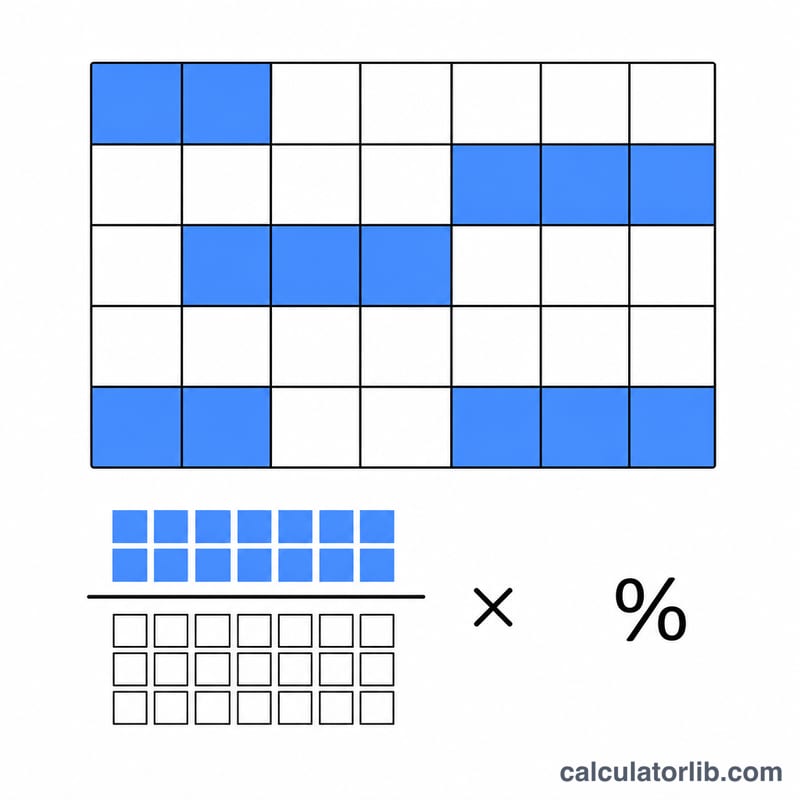
The core calculation is simply booked nights divided by available nights:
$$\text{Occupancy} = \frac{\text{Booked Nights}}{\text{Available Nights}} \times 100\%$$Where the variables are \(\text{Booked Nights}\) = nights actually reserved, and \(\text{Available Nights}\) = nights the listing was open for booking (after blocking out personal-use or maintenance days). Revenue is estimated as \(\text{Revenue} = \text{Booked Nights} \times \text{ADR}\).
Worked Example
Suppose your listing was booked 20 nights during a 30-night month, with an average daily rate of 120:
$$\text{Occupancy} = \frac{20}{30} \times 100\% = 66.67\%$$$$\text{Revenue} = 20 \times 120 = 2{,}400$$So the unit ran at about a 67% occupancy rate and earned roughly 2,400 for the month.
Key Terms Defined
- Booked Nights
- The total number of nights actually reserved and paid for by guests over a given period. A single three-night stay counts as three booked nights. This is the numerator in the occupancy formula.
- Available Nights
- The number of nights the listing was open for booking during the period — that is, nights not blocked, reserved by the host, or removed from the calendar. This is the denominator in the occupancy formula. Lowering available nights (by blocking dates) increases the occupancy percentage for the same number of bookings.
- Occupancy Rate
- The share of available nights that were booked, expressed as a percentage: \(\text{Occupancy} = \frac{\text{Booked Nights}}{\text{Available Nights}} \times 100\%\). A higher rate means the calendar is being filled more efficiently, but it does not by itself reflect pricing or profit.
- ADR (Average Daily Rate)
- The average price charged per booked night, calculated as total room revenue divided by the number of booked nights. ADR isolates pricing performance from occupancy, so two hosts with the same occupancy can earn very different amounts depending on their ADR.
- RevPAN (Revenue Per Available Night)
- A combined performance metric equal to ADR multiplied by occupancy rate, or equivalently total revenue divided by available nights. RevPAN rewards both filling the calendar and pricing well, making it harder to game by simply blocking dates. It is the short-term-rental equivalent of the hotel industry's RevPAR.
- Blocked Dates
- Nights the host manually marks as unavailable — for owner stays, maintenance, minimum-stay gaps, or personal use. Blocked dates are excluded from available nights, so they affect occupancy and RevPAN calculations and should be tracked deliberately.
FAQ
What is a good Airbnb occupancy rate? It varies by market, but many successful listings target 65–75% annual occupancy. Resort and urban markets differ widely, so compare against local listings.
Should I count blocked dates? No. Only count nights the property was actually available to guests. Blocking personal-use days lowers available nights and gives a truer occupancy figure.
Does occupancy alone show profitability? No — pair it with ADR and RevPAN (revenue per available night). A high occupancy at a low nightly rate can earn less than moderate occupancy at a premium rate.